The 20th edition of Jodhpur RIFF was held from October 22 to 26, 2026 at Jodhpur, Rajasthan.
Folk music artists from Rajasthan and from several countries across the globe took the stage, their voices soaring to the azure sky.
As the air thrummed with song and the hills came alive with the sound of folk music, the conversation veered towards the future of folk.
Jodhpur RIFF 2026: Folk Music Casts A Spell, Mulls Over The Future
Folk songs of celebration and despair, of rebellion and hope, of love and heartbreak enthralled audiences at Jodhpur RIFF this year

Summary
The sun shone bright on Mehrangarh Fort from October 22 to 26 where the 20th edition of Jodhpur RIFF regaled audiences this year. Folk music artists from Rajasthan and from several countries across the globe took the stage, their voices soaring to the azure sky, their songs of love and heartbreak, of celebration and despair, of rebellion and hope, echoing across the spectacular venue.
Singers from the Meghwal community ushered in the dawn with their meditative strains as the sun rose over the historic Jaswant Thada, perched close to the Fort. Rajasthani mother-daughter duo Ganga and Sundar, proud guardians of the Rajwadi maand; and Mohini Devi, a seasoned vocalist from the jogi-Kalabeliya tradition, sang full-throatedly when they took the stage. ‘Desert Lounge’ at the Rao Jodha Rock Park, an impressive all-acoustic night of Rajasthani sounds, showcased the masters Idu Khan Langa and Mir Bassu Khan, their timeless voices rooted in the Thar, their focus fixed on keeping their musical traditions alive.

Mangka Mayanglambam and her band at Jodhpur RIFF 2026 Jodhpur RIFF/OIJO
Mangka Mayanglambam, ‘the princess of Manipuri folk music’, and her band featuring Marjing Mayanglambam, M. Mangangsana (her guru and father) and Elangbam Jayanta, literally made the audiences’ day on the 24th. Their dawn concert blended vocals, dance and movement gracefully, sharing with the audience the music, myths and folklore of Meitei culture. Mangka is one of the last remaining players of the pena, a Meitei folk instrument traditionally played only by men. She also got the audience to dance as the sun came up, everyone gladly shaking off the remnants of sleep, stepping in tune to Mangka’s song, energised by her powerful voice and her hopes for a peaceful world.
The ‘Living Legends’ sessions showcased Padma Shri awardee Taga Ram on the alghoza, the double flute of the Bhil community; and Tungi Nath on the been, the instrument central to the Kalbelia community’s musical tradition. Both musicians are custodians of their distinctive folk traditions and have devoted their lives to their preservation. The ‘Sindhi Sarangi Special’ gave music lovers a rare chance to hear some of the best Sindhi Sarangi players. The unusual 28-string instrument of the Sarangiya Langa community has few practising musicians and makers left today.
Advertisement
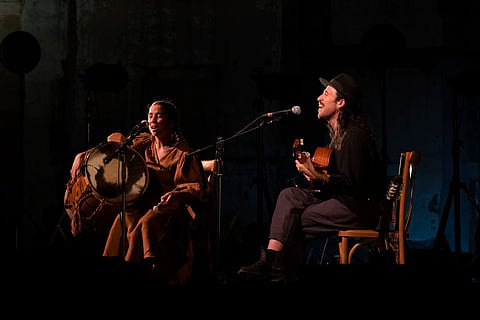
Camila y Sylvio at Jodhpur RIFF 2026 Jodhpur RIFF/OIJO
A galaxy of international stars lit up the stage at the fest. Latin American folk music duo Camila y Silvio’s performance was mesmerising. The well-travelled couple, performing in India for the first time, gave the audience a taste of their music steeped in the zamba, chacarera and cumbia traditions of South America. Celebrated Portuguese guitarist Pedro Dias, accompanied by Tiago Tomé on classical guitar and vocalist Inês Jacinto, an emerging voice in Lisbon's Fado scene, filled the night with sweet, sad notes. Palestinian musician Isam Elias, who is currently based in Paris, brought his effortless blend of the ancient and the electronic to Club Mehran. American roots music star Martha Redbone and her longtime collaborator and partner Aaron Whitby’s performance glided smoothly between genres and grappled with the themes of freedom, identity, ancestry and resilience.
Estonian nu-folk duo, Ramo Teder and Marko Veisson, returned to the Jodhpur RIFF stage this year, winning over the audience with their music as well as their scintillating wit. The acutely self-aware duo cracked plenty of jokes about their own tribe (folk musicians who must sing about ‘farming, sports and alienation) as they belted out their tunes that oscillate on the border of tradition and modern music styles, flirting with world music, underground and pop. The audience responded by breaking into a jig and giving the duo hearty rounds of applause.
Advertisement
In his India premiere, one of the United Kingdom's most accomplished flute and Uilleann pipe players, Michael McGoldrick, was joined by Donald Shaw—BAFTA-nominated composer and artistic director of Celtic Connections. They were accompanied by guitarist, singer, songwriter and composer Sorren Maclean on the guitar. The group has a project in the pipeline, where Rajasthani folk band SAZ will collaborate with them.
Many innovative collaborations made this edition of the fest sparkle. One among them featured Polish musician Karolina Cicha and Rajasthani folk singer Anita Dangi of the Damami community. Dangi, who was trained by her mother, belongs to a family that has been the custodian of the Rajwadi maand for generations.
Colombian DJ and singer-songwriter Killabeatmaker made a memorable debut at Jodhpur RIFF last year. This time, he was back with his infectious beats, accompanied by Guadalupe Giraldo (tambora, gaita, vocals) and Yulian Perc (alegre, congas, vocals). Continuing the musical dialogue that began at the last edition of the fest, he was joined by Rajasthani dhol drummers Chanan Khan, Pyaru Khan, Sawroop Khan and Sattar Khan; Dine Khan on morchang and khartal, and Zakir Khan Manganiyar on the khartal.
Advertisement
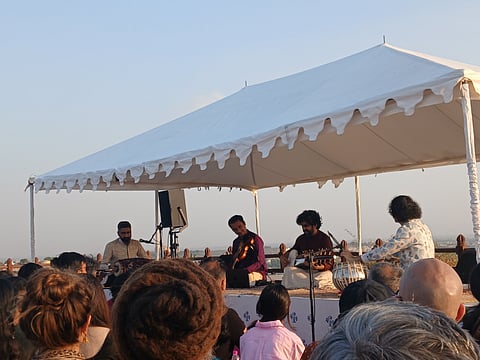
Hindustani-Carnatic heart-to-heart at Jodhpur RIFF 2026 Vineetha Mokkil
A seamless dialogue between Hindustani and Carnatic music blossomed under the full moon at the ‘Moonrise Concert’. Joining well-known Carnatic violinist Ambi Subramaniam was Pratik Shrivastava on the sarod, Ojas Adhiya on the tabla and Akshay Anathapadmanabhan on the mridangam. The two great Indian classical music traditions had a soulful heart-to-heart, holding the audience spellbound.
Bootcamps and ‘in residence’ sessions conducted by folk singers, instrumentalists, dancers and theatre persons gave festival attendees a chance to learn a few basics of some art forms as well as to interact directly with participating artists. Kathak; ghoomar and chari; Manipuri folk dances; a session on breath and the physiology of emotions: plenty of interesting sessions to choose from.
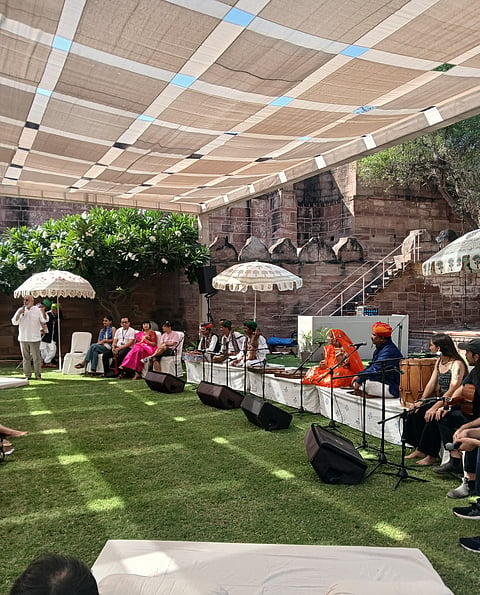
Future of Folk session at Jodhpur RIFF 2026 Vineetha Mokkil
As the air thrummed with song and the hills came alive with the sound of folk music, the conversation veered towards the future of folk. At the ‘Folk Futures’ session, ably moderated by Festival Director Divya Bhatia, artist-educators from the festival line-up spoke about what it means to practice and teach as roots musicians, while also building a future for the next generation of musicians.
Advertisement
Joining the conversation were master musicians from the Langa and Manganiyar communities who teach the youngest generation of Rajasthan’s folk musicians under the aegis of the Mehrangarh Museum Music Projects’ Folk Futures programme; Australian rapper and educator DOBBY whose music is rooted in the traditions of his Murrawarri and Ngemba lineage; Esteban Perez, Camila and Silvio; Ayesha Vasdev, founder of the independent folk music conservatory Sangeetcar; Chanan Khan Manganiyar, one of the last remaining players of the surmandal; Mangka, who teaches about 300 young students and researches traditional Manipuri instruments, and Marjing Mayanglambam.

The audience in action, Jodhpur RIFF 2026 Jodhpur RIFF/OIJO
“We [all the speakers] have many questions about the future that are rooted in our communities,” said Bhatia as the conversation took off. “But this is also about global concerns,” he added. The concerns that were voiced revolved around dwindling audiences and the uncertain prospects of folk artists’ livelihoods. Artists from across the world and from Rajasthan shared the same worry: traditional music would vanish if active efforts are not made to preserve and nurture it, and to ensure artists have sustainable livelihoods. “Roots music is a dynamic tradition passed on from generation to generation,” Silvio said, hopeful that traditional music can adapt to stay alive. Mangka, who has collaborated with many artists, encouraged folk musicians to stay open to collaboration without compromising on the originality of their own music traditions.
What’s the way forward? More platforms and festivals to provide visibility to folk musicians and music; more patrons to support artists and artist-educators; and fun, creative ways to motivate the younger generation to learn folk music and understand its deep connection to one’s identity. As the discussion wound down, Mangka suggested that all the artists on stage collaborate on an impromptu piece, and then broke into song. Without missing a beat, Anita Dangi joined in with a song of her own, and the rest of the group followed. The collaborative piece, completely unplanned, completely original and perfectly in sync, made Bhatia quip, “There may be questions hanging over the future of folk, but I see we have a beautiful present here.”
Published At:
Tags