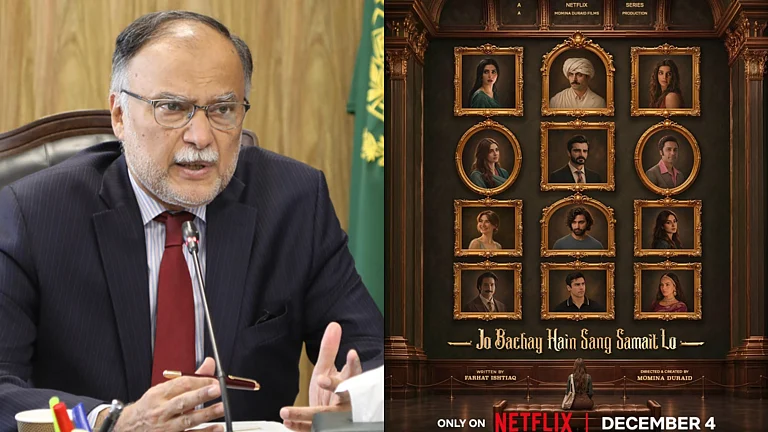
AICWA has demanded a ban on Pakistani show Jo Bachay Hai Sang Samait Lo in India
Pakistani shows' audience in India doesn't agree with this demand
Netflix is yet to respond to the plea of banning the show in India

AICWA has demanded a ban on Pakistani show Jo Bachay Hai Sang Samait Lo in India
Pakistani shows' audience in India doesn't agree with this demand
Netflix is yet to respond to the plea of banning the show in India
On November 26, the anniversary of the 2008 Mumbai terror attacks, the central government moved to block the release of an upcoming Pakistani Netflix series in the country, reigniting the controversy over cultural exchanges between the two neighbours.
Netflix’s first original Pakistani series, Jo Bachay Hain Sang Samait Lo, is the latest casualty, with the Union Ministry of Information and Broadcasting asking the streaming platform to ensure that Pakistani-origin content remains unavailable to Indian subscribers. Indian film industry organisations have also pushed to stop the release of the series, which is scheduled to premiere globally on December 4, 2026.
Film Bodies Threaten Action Amid Govt Intervention
The Federation of Western India Cine Employees (FWICE) has warned that if Netflix does not stop the release of the Pakistani show, it will pull its workers from productions backed by the streaming platform.
FWICE President BN Tiwari, tells us, “When Operation Sindoor happened, their actors Hania Aamir and Fawad Khan, made such wrong statements. If they wanted, they could have stayed quiet or said something against terrorism but they chose to support it. In 2025, Netflix agreed with the Indian Government on their decision to not stream their content in India. I don’t know why that changed. We don’t want to see the faces of these actors, who have earned from the Indian economy, gained global fame because of the support and love India gave them but later badmouthed our country. For us, India is our priority."
The latest intervention follows representations by the All Indian Cine Workers Association (AICWA) and the FWICE, to the government. In a November 24 letter to the Prime Minister, AICWA demanded a permanent ban on Pakistani entertainment content across cinema, television and OTT platforms. FWICE, in a November 25 statement, also urged the government to prevent the series' release, arguing that national interests should take precedence over commercial considerations.
The Union Ministry of Information and Broadcasting on Thursday reminded Netflix of its May 2025 advisory. The advisory asked OTT platforms, media streaming services and intermediaries operating in India to discontinue access to films, web series, songs, podcasts and other content originating in Pakistan.
Following the latest reminder, which is being seen as an act of censorship by many viewers, Netflix has not made an official statement.
Meanwhile, India has seen the growth of an audience hooked to Pakistani dramas. Several viewers told Outlook that they were dismayed by this development and that such things should not be politicised.
The series, based on a novel by Pakistani author Farhat Ishtiaq, follows interconnected love stories spanning three generations. The series features popular Pakistani actors Fawad Khan, Mahira Khan, Sanam Saeed, Hania Aamir and Ahad Raza Mir.
The increased push to block the show has made many viewers feel frustrated and dismayed. “I would have definitely watched Jo Bachay Hain Sang Samait Lo,” said Ankita Raisinghani, a 35-year-old medical professional from Bengaluru.
“I am completely against the government’s decision. I feel they have no business looking into what shows I can or cannot consume,” she said.
It’s not easy to access Pakistani shows in India anymore. One of the fans told Outlook she uses VPN to access the streams. Some find shows through alternative YouTube channels as the official ones are blocked in India.
“I used to watch a lot of [Pakistani] shows prior to the ban that followed Operation Sindoor. Now there are YouTube channels that show the dramas where we can access them,” Ankita added.
“I don’t care how governments are with each other. Indians and Pakistanis are the same people. We are cut from the same cloth and share similar cultures. Why shouldn’t we be allowed to watch what we want?” she asked.
Another viewer echoed similar views. “I feel that entertainment is sometimes viewed through a political lens, even when the content itself has nothing to do with politics,” observed Ritu Sharma, a 38-year-old film enthusiast from Mumbai.
Following the popularity of these dramas, fans started hosting watch parties, following the trend set by western audiences. In the midst of the controversy, one private screening and one watch party of popular Pakistani drama series Dar –e-Nijaat were also cancelled in Bengaluru, The Hindu reported.
On being asked why these shows draw the viewers, Ankita said, "They discuss social issues in much more depth than any of our shows do. One should watch Mitti De Baway. The author has beautifully portrayed caste issues in the story."
She adds, "The people who are against us watching these dramas are insecure because they cannot produce art of the same standard. Pakistani dramas are very well written."
Pakistani dramas gained a formal Indian following when Zee's Zindagi channel launched in June 2014, airing hits like Zindagi Gulzaar Hai, which starred Fawad Khan.
The fans also question the quality of Indian productions in the past decade, which has made them turn away from those. “I believe our country is not producing as thought provoking content as Pakistani dramas,” said Ankita.
The fans are also across age groups, from early 30s to late 60s, and perhaps even beyond that, but are concentrated among women. Rituparna Biswas, a 38-year-old Delhi-based writer, said her mother is addicted to Pakistani dramas. “My mother is hooked on this new one called Dar-e-Nijaat. She watches the episodes on repeat till a new one drops every weekend. She even wants me to find a partner like the protagonist.”
The controversy is the latest episode in a prolonged deterioration of cultural exchanges between India and Pakistan, with films, television, music and artistic collaborations frequently becoming casualties of political tensions.
Cross-border exchanges started deteriorating after the 2016 Uri attack and 2019 Pulwama attack. Pakistan, denying involvement in the attacks India accused it of, also banned Indian entertainment. Still, Pakistani dramas and music reached Indians through online platforms.
But a major rupture was the April 22 attack in Pahalgam, which resulted in the death of 26 people, mostly tourists. India blamed the attack on militants linked to Pakistan, an accusation Islamabad denied. Relations were further soured by the subsequent Indian military strikes under Operation Sindoor.
On May 8, 2025, the Ministry of Information and Broadcasting finally issued an advisory directing streaming platforms and digital intermediaries to remove Pakistani-origin content with immediate effect, citing national security concerns. The advisory covered films, web series, songs and podcasts, irrespective of whether they were available through subscription or for free.
The restrictions also affected Pakistani artists and their projects in India. The much-anticipated Bollywood comeback of Fawad Khan, who starred alongside Vaani Kapoor in Abir Gulaal, did not work out after the film failed to get permission for an Indian release.
When distribution of a film or series is stopped, it not only stops its circulation, but also raises an economic cost. Call for bans and boycotts can thus actually harm a country’s economic gains as long as the artists producing the content are situated there.
While there is no reliable data on how much India blocking Pakistani content has affected the latter, the economic consequences of restricting cultural imports have been documented in other countries.
Following China's restrictions on Korean entertainment in 2016, amid tensions over Seoul's deployment of the US-made THAAD missile defence system, South Korea faced something similar. A 2017 analysis by a Korean Government's institute reported that 35.3% of surveyed South Korean content companies had experienced direct economic losses due to the restrictions.
A ban on any industry's shows and artists can have a trickle down effect on showbiz. From loss of revenue to OTT platforms, production houses, to limited viewership for an actor's brand value across the world, the implications of the matter can vary from one show to another.