FTII Pune alumnus Pushpendra Singh has worked both as an actor and assistant director, before turning to filmmaking.
His films have been screened at eminent film festivals like Berlinale and Busan.
His work is rooted in Janpadiya aesthetics, focusing on specific micro-regions, often utilising non-official dialects that carry the collective memory of a land and its ecological history.
Pushpendra Singh Interview | “Janpadiya Aesthetics Represent Cultural Democracy”
FTII Pune alumnus Pushpendra Singh discusses his films rooted in the Janapadiya tradition—a post-colonial movement that emerged to reclaim regional languages and folk traditions against Westernised modernity.

Summary
As a FTII Pune alumnus, Pushpendra Singh first worked as an actor and assistant director. In 2014, his directorial debut Lajwanti screened at the Berlinale Forum, followed by Ashwatthama (2017) at Busan and the hybrid film Maru ro Moti (2019) at IDFA. His later work, Laila aur Satt Geet (The Shepherdess and the Seven Songs, 2020) also featured at the Berlinale.
Singh’s films are deeply rooted in Janapadiya aesthetics—a post-colonial movement that emerged to reclaim regional languages and folk traditions against Westernised modernity. Unlike ‘regional cinema’, which is defined by official state boundaries and languages (like Malayalam, Marathi, Tamil, Bengali), Janapadiya cinema is hyper-local. It focuses on specific micro-regions, tribal belts or villages, often utilising non-official dialects that carry the collective memory of a land and its ecological history. A Janpadiya film might be in a dialect that doesn't have an official state status but carries the deep memory of the people living there.
Singh’s Laila uses Gojri, the language of the nomadic Gujjar-Bakarwal community. Laila reimagines the myths surrounding a 14th-century mystic poetess from Kashmir, Lal Ded, with the character of Laila, a member of the Gujjar-Bakarwal tribe. The Gujjars and the Bakarwals are nomadic tribes found in India, Pakistan and some parts of Afghanistan, who migrate with their sheep, cows and buffaloes respectively, moving to the upper Himalayas in the summers and returning to the plains in the winters.
His Ashwatthama is rooted in the Braj region and its dialect and follows Ishvaku, a young boy who is sent to his maternal grandmother’s village in the rugged landscape of Chambal after a family tragedy. As Ishvaku navigates the rustic, labyrinthine environment of the village, the lines between reality and myth begin to blur.
In the following interview with P.K. Surendran for Outlook, Pushpendra Singh talks about his films and Janpadiya approach. Edited excerpts:
Your films follow Janpadiya aesthetics. Can you tell us what this framework entails?
Janpadiya aesthetics are rooted in the arts and aesthetics of a local region, formed around Bolis (dialects) and their distinct cultures. Ashwatthama is set in the Brij boli of Hindi. Laila aur Satt Geet is even more distinct, set in Gojri, the language of the nomadic Gujjar and Bakarwal tribes. Gojri is a unique language with roots in Rajasthani, Punjabi, Haryanvi and Dogri, formed over time as the tribes migrated from Rajasthan to Jammu and Kashmir.
Advertisement

Ashwatthama Still Facebook
Religion and political parties often use myths as a tool of revivalism to create a monolithic nation. Your comments?
The idea of Janpadiya is a Gandhian concept inspired by Gram Swaraj; it represents ‘Unity in Diversity’ and celebrates distinct cultures. If Gram Swaraj represents political democracy, Janpadiya aesthetics represent cultural democracy. It is a strong antithesis to monolithic ideas.
Lajwanti Still IMDB
Both your films are based on Vijaydan Detha’s stories. Lot of eminent people based their work on Detha’s stories like Mani Kaul, Habib Tanvir and later, Shyam Benegal. Tell us about his works and how you use his works in your films.
What draws me to Vijaydan Detha’s world is the spirit of his protagonists. In adapting Lajwanti and Kenchuli, I was captivated by these fiercely independent women who dismantle patriarchal conditioning to claim their own desire. In Kenchuli, I chose to transpose the story to contemporary Kashmir, utilising Detha’s archetypal tropes to explore modern identities. Ultimately, his literature serves as a vessel for me to explore the visual and rhythmic possibilities of cinema.
Detha is a great example of Janpadiya aesthetics. He was a Marxist writer who refused to write in Hindi, choosing Rajasthani instead. He collected and developed Rajasthani folklore into a written language to speak to people in their own tongue, while simultaneously challenging casteist, patriarchal and religious dogmas by altering the messaging of those traditional tales.
Advertisement
Laila Aur Satt Geet Still IMDB
How was your experience working with Amit Dutta on Janpadiya cinema?
Amit motivated us to embrace Janpadiya in our expression. His contribution to documenting and creating works around Pahari and Dogri culture is as significant as that of Detha.
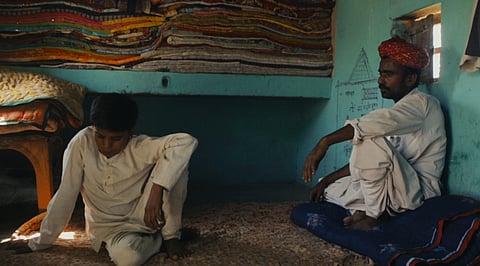
Maru Ro Moti Still Doku Fest
In the age of 'glocalism', how valid are Janpad (local) ideas?
The validity of an idea is not in the hands of the artist; it is for the people to decide.
How do you define the spirit of locality that transforms a film into a Janpadiya work?
Janpadiya is a democratic idea that provides the space to express a rooted voice inspired by the folk culture, music and theatre of a specific sub-area. For instance, while Laila aur Satt Geet is set in Jammu & Kashmir, it is specifically focused on the Bakarwal tribe, their dialect and their folk traditions.

How can a filmmaker engage with the ‘Janpad’ without exoticising it for an external market?
Advertisement
It boils down to the filmmaker's objective. If one is conscious and aware of why they are telling a story, exoticisation should not occur.

How does physical geography influence the visual grammar of your films?
Physical geography has its own sense of time, centred around the weather, landscape and specific regional challenges. Local culture develops methods to live in harmony with these elements. However, individuals still face struggles within these systems, affected by patriarchy, bureaucracy and feudal structures. These struggles are the source of my stories and the medium through which I explore the art of cinema.
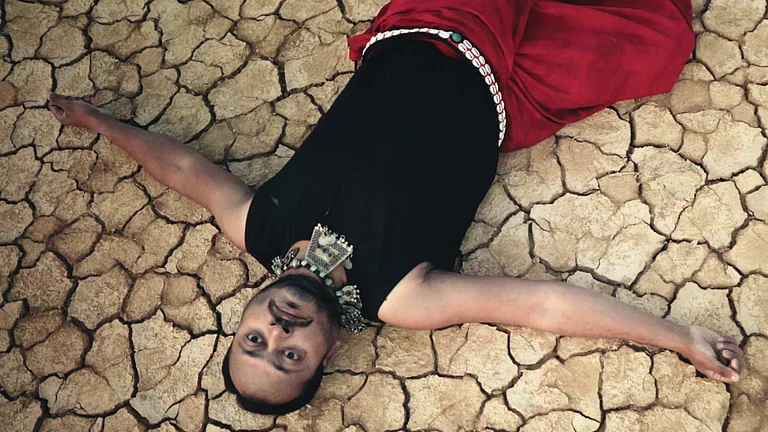
How does Janpadiya allow a filmmaker to reclaim the ‘Desi’ as an avant-garde tool?
As Detha did in literature and Dutta does in cinema, it is entirely possible to use Janpadiya as an avant-garde tool. This aesthetics provides a creative language to tap into, while the expression remains deeply personal.
Advertisement
Can Janpadiya cinema resist the standardised global aesthetics of film festivals?
With AI taking over, the ‘universal storytelling’ mantra reducing everything to a Western style and festival programmers following their own conditioned tastes, I feel Janpadiya is the only way to stand out. It offers a path to unique expressions that exist outside the purview of these standardised systems.
What are your thoughts on the tragedy of Jangarh Singh Shyam and the ‘web of the market’?
This is a constant challenge for artists. As I mentioned, we must remain conscious and aware in every decision we make.
What are your views on Amit Dutta’s model of self-sufficiency and local collaboration?
I agree completely. It mirrors the idea of Gram Swaraj. I remember Detha once telling me that the real revolution in cinema will happen when an artist can make a film in their own village and language, using resources as affordable as those needed to write a story. The idea of Janpadiya is the path toward true democracy in cinema.
You have studied acting in the FTII and acted in your films and films of other filmmakers. Tell us about your journey from acting to direction.
In the integrated common course at FTII, we were immersed in every facet of filmmaking. While I specialised in acting, the seeds of direction were sown early. My transition felt organic, catalysed by assisting Dutta on Nainsukh (2010) and The Seventh Walk (2013), and Anup Singh on Qissa: The Tale of a Lonely Ghost (2013) and The Song of Scorpions (2017). I don’t see these roles as mutually exclusive; I continue to act when a role offers a genuine challenge or excites me. For me, acting and directing are simply different vantage points from which to observe the same human truth.
You use non-professionals, the villagers, in your films. Since you have studied acting, tell us how this helps you to mould the non-professionals. What was your method? Did you give any training to these people?
My training in acting is exactly what allows me to work effectively with non-professionals. It isn’t about ‘teaching’ them to act, but rather understanding their intrinsic motivations and backgrounds. I avoid traditional training, opting instead for a brief half-day workshop to break the ice and open them to the idea that they are playing themselves in a specific setting. I’ve learned that scripts can often create resistance; now, I rarely share dialogue. I provide the context and let the scene breathe through improvisation, guiding them towards the authentic core of the scene.
Acting in your films is very realistic. At the same time, you use devices which create a sense of alienation. For example, you do not use close-up frames. Please explain.
I am fascinated by the play between fiction and non-fiction. While I employ a naturalistic acting style to ground the film, I deliberately use cinematic formalisms, such as avoiding close-ups, to create a distancing effect. This breaks the realistic illusion and prevents the audience from falling into a passive trance. While this mirrors Brechtian distancing, it also aligns deeply with the Indian concept of Sakshi Bhava (the witness consciousness), where one is aware of the experience without being entirely consumed by the spectacle.
It is interesting to note that you have been explaining your films through Indian aesthetics, especially Rasa. Our approach to cinema in general—filmmaking and film writing—is Euro-American centric. Please elaborate on your framework.
Yes, our contemporary understanding of film is heavily influenced by Western structures that prioritise catharsis—a literal ‘purging’ of emotion. I find this restrictive. Indian aesthetics, specifically the theory of Rasa, align well with cinema. It can be a site for the experience of feelings/emotions. It is about the lingering resonance (Dhwani) and the internal state of the audience rather than just the resolution of a plot. Cinema has a great potential to evoke Rasa, if we move beyond mere storytelling and towards an experiential form.
The establishment of the Film Finance Corporation in 1969 (later NFDC) marked a significant rupture in Indian cinema. However, the neoliberal policies of the 1990s dismantled this ecosystem. The State withdrew financial support for such films. Recently, Malayalam film actor G. Krishnakumar was appointed as its new Chairman, who was contested Assembly and Lok Sabha elections on a BJP ticket. He has no connection with the parallel cinema movement. What are your views on the issue?
The shift in the NFDC’s leadership and its departure from the ethos of the parallel cinema movement is a reflection of a broader systemic change. These appointments are clearly political, signalling a move away from the state's historical role as a patron of diverse, non-commercial artistic voices. When the leadership of a cultural institution has no lineage in the movement it was designed to protect, the ecosystem for independent, rigorous cinema inevitably thins out. It forces us as filmmakers to find new, more resilient ways to sustain our craft.
Published At: