On January 9, Madras High Court stayed the single judge order directing the Censor Board to grant a U/A Certificate to Vijay-starrer Jana Nayagan.
Both Jana Nayagan and Parasakthi have been embroiled in censorship battles over their content.
With elections upcoming in Tamil Nadu, the censorship has quickly turned into a political issue.
From Parasakthi To Jana Nayagan: How Tamil Cinema’s Political Voice Continues To Be Policed
Language politics, censor battles and the inconvenience of films that speak too clearly.

Summary
The Madras High Court on Friday stayed the single judge order which directed the Censor Board to grant a U/A Certificate to Vijay-starrer Jana Nayagan. The court has now posted the case for January 21, after the Pongal holidays. The film was supposed to be in the line-up of Pongal releases, but now, audiences will have to look for other things to feast on.
The delay has also had tangible economic consequences. The postponement of Jana Nayagan reportedly triggered what exhibitors describe as India’s largest mass ticket refund, underlining how censorship delays do not merely affect expression but disrupt an entire film economy—from theatres and distributors to audiences. In a star-driven industry where release timing is crucial, such interventions carry financial weight as well as political implication.
Jana Nayagan, touted to be Vijay's 500-crore swansong before he turns full-time politician, was originally scheduled to be released on January 9. The undue delay in the release of the certification by the Censor Board cites high levels of violence, communal overtones and use of defence emblems as reasons at various times. With Vijay’s looming political stature and vote-magnetism, Jana Nayagan has become more than a film awaiting a censor certificate.
What has sharpened this moment further is Chief Minister M.K. Stalin’s direct intervention. Responding to the delay in Jana Nayagan’s certification, Stalin publicly described censorship as having become a “weapon” in the hands of the BJP-led Centre, explicitly framing the issue as part of a broader pattern of cultural and linguistic centralisation. His remarks situate the film controversy within an ongoing State–Centre conflict, where Tamil Nadu’s resistance to Hindi imposition and cultural homogenisation has repeatedly clashed with New Delhi’s idea of national unity. In this reading, the censor board is no longer a neutral regulatory body, but a pressure point in a larger political struggle over language, autonomy and power.
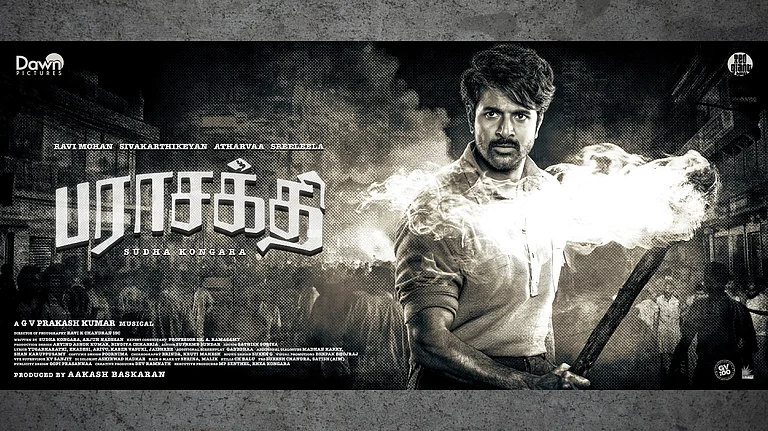
Sivakarthikeyan starrer Parasakthi, caught in a similar censor battle, for blazing references to the anti-Hindi movement in Tamil Nadu, has finally come on the other side, with its worldwide release on January 10.
Seen together, Jana Nayagan and Parasakthi don’t just share a censoring moment; they belong in a continuum in the long political life of Tamil cinema where language, ideology and power collide. At one level, the two films seem connected by procedure: both ran into CBFC roadblocks over speech—dialogues, historical references, symbols and tone—placing them squarely in a tradition where Tamil cinema is scrutinised closely when it starts sounding declarative. The anxiety, in both cases, is about how directly these films speak to collective memory and political identity.
Advertisement
More significantly, the two films mirror different ends of the Dravidian arc.
The anti-Hindi movement referenced in Parasakthi marks the beginning of the Dravidian movement, which began in the late 1930s and intensified through the 1940s and 1960s. Its opposition to Hindi imposition in the Madras Presidency was rooted in the fear that language would become a tool of cultural hierarchy. From a Dravidian ideological standpoint, Hindi was not merely another Indian language but a symbol of North Indian, upper-caste dominance being normalised as “national culture”. The original Parasakthi (1952), scripted by M. Karunanidhi, articulated this resistance through fierce, declarative dialogue that rejected Sanskritised Hindu orthodoxy and asserted Tamil as a rational, living, egalitarian language.
Award-winning filmmaker Praveen Morchhale observes that this resistance to Hindi is not about rejecting another language. “It is more about protecting Tamil as a language of culture and identity. The Dravidian movement clearly understood language as power and cinema became one of the strongest ways to express this idea in a popular and easily accessible form,” he says. Cinema has always functioned as a political weapon in Tamil Nadu, a vehicle for mass assertion and propaganda, deeply intertwined with the rise and reach of the Dravidian movement.
Advertisement
Jana Nayagan, on the other hand, uses a contemporary political star figure at its centre and recalls the Dravidian movement’s strategy of turning cinematic charisma into political capital (of which MGR, Karunanidhi, Jayalalitha are leading examples). The discomfort around its dialogues, symbols and institutional portrayals suggests that the idea of cinema shaping political imagination still provokes unease.
This political unease is inseparable from the electoral calendar. Tamil Nadu is heading towards Assembly elections, and Vijay’s entry into formal politics has already begun to rearrange the state’s political imagination. Significantly, the actor announced the formation of his party’s manifesto committee around the same time that court proceedings around Jana Nayagan were unfolding. The overlap has only reinforced perceptions that the film’s censor troubles are not occurring in isolation, but in a politically charged atmosphere where cinema, charisma and campaign-building are once again intersecting—as they have before in Tamil Nadu’s history.
Advertisement
The censorship of Jana Nayagan and Parasakthi is being read by many as a continuation of language politics in Tamil Nadu. Cinema in Tamil Nadu has never been just entertainment. From the time of the Dravidian movement, the Tamil language and cinema were consciously used as tools of self-respect and cultural expression. Films became a way to speak about dignity and identity in a language rooted in the people of the state. Tamil cinema continues to function as a site where language threatens to exceed entertainment, where history refuses to stay buried and where the act of speaking—especially in Tamil, especially politically—remains something that must be negotiated, moderated or muted.
The unease around politically assertive cinema is not confined to Tamil Nadu. In recent years, regional films across India—from L2: Empuraan, Phule and Dhadak 2 in 2025, to Jai Bhim (2021) and Kaala (2018) earlier in Tamil Nadu—have been embroiled in protests, legal challenges or censor scrutiny, often less for what they depict than for the conversations they provoke. What distinguishes Tamil cinema, however, is its historical willingness to convert such moments of friction into political capital rather than retreat from them.
Advertisement

The stalling of Jana Nayagan and Parasakthi has reopened an old fault line in Indian cinema. “When films like Jana Nayagan and Parasakthi face hurdles in reaching the public, it is difficult to see this only as censorship. It feels more like unease with cinema’s ability to reach a large audience and influence thought. The discomfort is more about what Tamil cinema has represented in the past—a strong, independent voice. This growing unease towards cinema marks a shift, not just for Tamil cinema, but for Indian cinema as a democratic space,” says Morchhale.
With language, censorship and federal power already central to political discourse in the state, the Jana Nayagan controversy is now poised to become an election issue—one that can be mobilised as evidence of cultural interference from the Centre.
Do these censorship delays indicate a weakening of cinema’s political power today, or do they paradoxically reaffirm how such narratives can still be threatening to dominant structures?
“I don’t see this as a sign of cinema becoming weak. In fact, I think it shows that cinema still has power. Cinema attracts such attention only when it can still affect people and their thoughts,” says Morchhale, and reminds us that what we are seeing is a fear of cinema. “Any attempt to block certain stories itself shows that cinema and its narratives can still provoke thought and raise questions and actually confirms cinema’s relevance. Stories rooted in language and place remain powerful,” he adds.
That these films are being stopped from reaching their audiences suggests not a break from history, but a return to an old anxiety: what happens when language mobilises people rather than merely entertains them. In a state where cinema has long doubled as political infrastructure, this anxiety is amplified by the approach of elections and the re-emergence of cinema as campaign terrain. The censorship battles around Jana Nayagan and Parasakthi are not aberrations—they are reminders that Tamil cinema’s most enduring power has always been its voice, and that voice continues to matter precisely because it still unsettles power.
Published At: