Parasakthi is visually rich and meticulously crafted.
Despite its charged backdrop, the film falters narratively, weighed down by a sluggish love track and a bloated second half.
The resulting is a period drama that looks powerful but feels oddly muted.
Parasakthi Review | Design Does The Heavy Lifting, Politics Stays Oddly Polite
Sudha Kongara’s ambitious period drama starring Sivakarthikeyan, set against the anti-Hindi agitations of the 1960s, looks impeccable and promises urgency—but doesn’t quite land.

Summary
Sudha Kongara’s Parasakthi arrives weighted with expectation. It’s a period drama set against the anti-Hindi agitations of the 1960s, a politically charged moment in Tamil Nadu’s history and headlined by Sivakarthikeyan in what appears to be a deliberate departure from his affable star persona. In the first 15 minutes, Chezhiyan (Sivakarthikeyan), the leader of student group Puranaanoorru Padai, mobilises a gang and attacks a train carrying politicians and chief officer Thirunadan (Ravi Mohan), who is a cold antagonist, determined to stop this revolution, even as his loyalties are questioned by the powers that be, referring to him as a "Madrasiharami” when he fails to capture Che in the encounter.
From its early frames, the film demonstrates its seriousness through craft and nuanced storytelling. The why of the agitation comes across poignantly when a grandmother is declared illiterate while sending a money order at a post office, but is unable to decipher the form which is now in Hindi. Or when Che is declared unfit for a job, despite proving his mettle, because his “Hindi is poor”.

Parasakthi Still IMDB
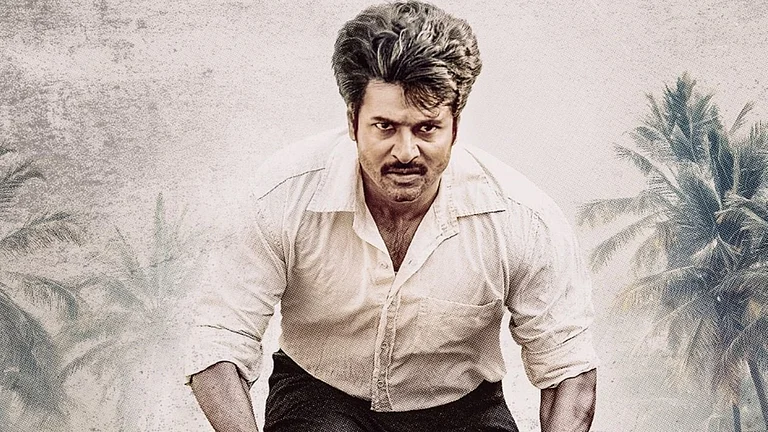
Visually, Parasakthi is a delight with its impeccable production design, which soothingly recreates 1960s Tamil Nadu with an eye for lived-in detail rather than postcard nostalgia. Streets, homes, protest grounds and political spaces are textured and convincing, grounding the film firmly in its era, and it feels as though Kongara is recording real life struggles of the everyman through her camera. Ravi K. Chandran’s cinematography enhances this immersive quality, favouring soft, earthy tones and classical compositions that lend the film an old-world gravitas. Sivakarthikeyan’s Cheizhagan is a composite of charm, suppressed rage and moral confusion—a man caught between personal desire and political awakening. He plays his part with a lot of restraint, allowing silences and small gestures to do the work. The first half, which should have firmly established the emotional and political stakes, is slightly derailed by a slow and largely inconsequential love track, which is at best a narrative padding, blunting the urgency of the anti-Hindi movement simmering in the background.
Advertisement
The political tension surfaces intermittently, but doesn’t organically seep into the narrative the way history demands. For a film set during one of Tamil Nadu’s most charged linguistic and cultural movements, Parasakthi spends an inordinate amount of time circling around safe, familiar emotional beats.
Parasakthi Still IMDB
The intermission arrives on a relative high, suggesting that the film might finally lean into its larger ambitions. Instead, the post-interval portion feels like an entirely different and slightly exhausting film with a sluggish pace. The narrative becomes crowded and unfocused, stuffed with episodes and characters that add little to the emotional or ideological arc. Sequences stretch endlessly, conversations repeat themselves, and dramatic moments are prolonged well past their natural lifespan. Rather than intensifying conflict, the second half dissipates it, testing the viewer’s patience through sheer excess and gore.
What’s most disappointing is how the film handles its central political theme. The anti-Hindi agitation, a movement fuelled by anger, pride and existential fear about cultural erasure, is rendered with surprising emotional flatness. The slogans are shouted, the protests staged, but the inner fire that should animate these moments rarely lands. The writing often opts for convenience over conviction, smoothing out ideological edges in a way that makes the movement feel more symbolic than urgent.
Advertisement
Parasakthi Still IMDB
Performances, too, are uneven. Sandhya Mridul makes a striking impression as Indira Gandhi, bringing a controlled authority to her limited screen time and leaving you wishing the film had made more room for her. Similarly, Atharvaa, who plays Che’s hot-blooded brother, feels underutilised, hinting at complexities that the screenplay never fully explores. Sreeleela’s performance is more problematic—overly ornate and self-conscious in her early scenes, only to be abruptly toned down once her romantic equation with Chezhiyan is established. The shift feels less like character development and more like narrative convenience. As for Thiru, we get a lot of insight into his methods, but little on his motivations and that is a backstory we could have dug our teeth into, given that he dominates the frame for a large part.
Parasakthi is, in many ways, a film of admirable intent undone by its own excesses. It is detailed where it should have been daring, expansive where it needed precision. The film could easily have shed at least forty minutes, emerging leaner, sharper and more emotionally resonant. As it stands, it remains an ambitious but uneven attempt at political cinema.
Advertisement
Published At: