

Dussehra is a fertile playground for Indian filmmakers.
From Swades to Ra.One, the festival has been used as fodder for all genre strides and narrative turning points.
From the mythic to the grounded, here's a list of few films where the decimation of Raavan has offered an abiding backdrop.
Indian cinema remains seduced by the staging of Dussehra. The festival lends filmmakers an instant, high-octane stage where raw human drama and ancient mythology collide. Staging a story around Ravan Dahan helps build and propel emotional stakes. A sense of moral underpinning is felt just as vividly, thanks to the overriding parable of good over evil. Over decades, Dussehra has, in Indian films, formed as a mirror, a site of social reckoning, a dramatic showdown.
1. Goliyon Ki Raasleela Ram-Leela (2013)


Sanjay Leela Bhansali brought together Ranveer Singh and Deepika Padukone for a passionate, searing desi spin on Romeo and Juliet. As the nine nights of Navratri unfold, the conflict between the two clans reaches a breaking point. The tragic resolution of the film takes place on Dussehra. The emotional and visual maximalism rises into a syncretic whole. As the giant Ravan effigy burns in the background to mark the 10th day of the festival, Ram and Leela shoot each other simultaneously to protect their love from being torn apart or tarnished by their warring families. They realise their positions as chieftains renders their union impossible. However, just as Ram and Leela pull their triggers, the latter's mother discovers a betrayal, kills the traitor and calls for an end to the war.
The lovers' double suicide becomes the ultimate Ravan Dahan. The film wraps on Vijayadashami with both families assembling in grief to cremate Ram and Leela on a single pyre, finally burning away 500 years of hatred, discord and planted distrust.
2. Babita Singh Reporting (2026)

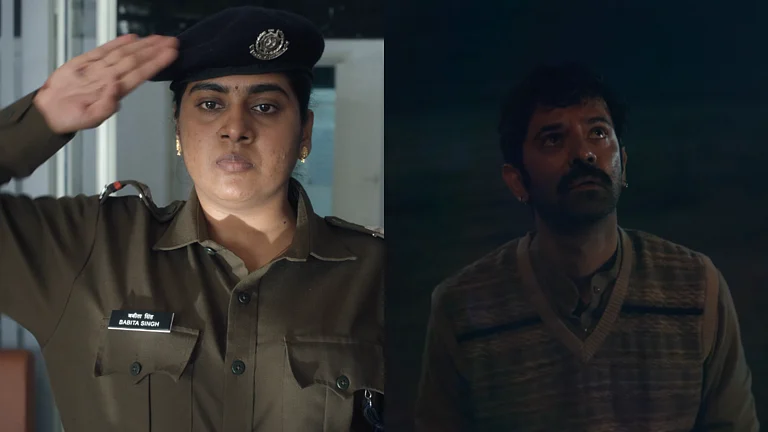
Ambiecka Pandit's quietly observant slow-burn tackles the weight of patriarchy and unacknowledged mental anguish. As Babita retraces the dead person, Bansi's final hours, she climbs inside the massive, hollow frame of the Ravan effigy that Bansi spent weeks building. Examining the height, structure, and physical clues within the effigy, she confronts the depressing truth. Crushed by systemic domestic abuse, property harassment, and isolation, Bansi had climbed to the peak of his own creation and jumped, making his death a tragic suicide rather than the homicide which she suspected. The fierce glare of the aflame effigy reflects on Nimisha Sajayan's face as she breaks down and processes the full brunt of her wrenching realisation. It's one of this year's most indelible close-ups.
3. Delhi-6 (2009)

Delhi-6 captures a poignant shift through Waheeda Rehman’s dismay at a sanitized, modernized Ramleela, a sentiment now widely felt by Delhi’s long-time residents yearning for the rich, authentic celebrations of decades past. Far from being a passive backdrop, the Ramleela in Rakeysh Omprakash Mehra's film lives and breathes through the narrow lanes of Chandni Chowk, uniting diverse, squabbling neighbors for ten nights. The film's core message, that the real Ravan is housed within human conscience rather than a festive effigy, is resonant because Ramleela is a unifying force. What if the darkness we label as an external threat also prevails because of our own prejudices, insecurities and capacity for intolerance?
4. Mardaani 2 (2019)

In Mardaani 2, Dussehra is a timer. The film opens on Dussehra in Kota with Rani Mukerji's Shivani Roy taking her oath, and a young serial rapist-killer making his first attack amid the burning Ravan effigies. Director Gopi Puthran explicitly designs the next 21 days until Diwali as a modern Ramayana. Ram needed 21 days to reach Ayodhya after killing Ravana, while Shivani has 21 days to hunt down this Ravan before Diwali. Every day the villain taunts her, the countdown takes on a bracing edge of urgency.
5. Raavan (2010)

Mani Ratnam's bold magnum opus reimagines Dussehra by transforming the Ramayana’s moral certainty into a contemporary examination of perspective, power and justice. The familiar moral binary is recast into a murky socio-political critique of state power versus marginalized resistance. In this modern retelling, the traditional Ravan figure, Beera (Abhishek Bachchan/Vikram), is humanized as a tribal rebel fighting police brutality, whose abduction of Ragini (Aishwarya Rai Bachchan, the Sita parallel) is a political retaliation for his sister's death rather than an act of lust. By mapping the Ashok Vatika onto a revelatory journey through forest oppression and transforming the climax into a devastating execution where Beera dies to protect Ragini, the film questions the traditional axis.
6. Ra. One (2011)

In the Shah Rukh Khan-starrer, Anubhav Sinha reinterprets the traditional Ravan Dahan through a sci-fi lens, framing artificial intelligence as modern humanity’s ultimate demon. The digital antagonist, named Ra.One (Random Access Version One), materializes into the physical world directly out of a roaring, ten-headed Dussehra effigy at a public celebration. By staging this breach between virtual code and physical reality against the inferno of the burning Ravan, the film puts a centuries-old ritual into a stark visual metaphor: humanity setting off a digital monster that it can no longer control. The metaphor of the ultimate victory of good over evil gains a terrifying futuristic dimension.
7. Nayyi Navelli (2026)

In Nayyi Navelli, Dussehra serves as both a literal ticking clock and the framing final mythological backdrop for the film's climax. Set in Meerut, the fantasy comedy follows a picture-perfect new bride, Mohini (Yami Gautam Dhar), whose suspicious brother-in-law accuses her of being a daayan. However, she reveals her true lineage as a guardian descended from Mandodari, bound to protect the powerful Kaalsheel gem—an ancient relic of Ravana that aggravates its dark powers as Dussehra approaches. When her husband is possessed by the spirit of Ravana and the stolen artifact turns the town chaotic, the climax rages against the backdrop of local Ramlila fervour. Mirroring the eternal triumph of good over evil, Mohini fights to vanquish Ravana and save her family just as Dussehra wraps. The climactic clash plays out as Mohini single-handedly decimates Ravana.
8. Bajrangi Bhaijaan (2015)

Kabir Khan deploys the opening Dussehra sequence to lay the mythological foundation for the protagonist's entire character arc. Introduced amidst a high-energy festival crowd celebrating Lord Hanuman's triumph over evil, Pawan (Salman Khan) is idealised as an embodiment of unyielding Hanuman-like devotion (bhakti). This festive intro prepares a direct thematic foreshadowing: just as Lord Hanuman crossed sea and land to rescue Sita and reunite her with Ram, Pawan undertakes a perilous, border-defying quest across Pakistan to reunite a lost, mute young girl with her mother.
9. Swades (2004)
In the film, the Dussehra Ramleela sequence ("Pal Pal Hai Bhaari") acts as the primary bridge, a turning point that converts Mohan’s passive observation into certain action. Watching Sita confront Ravan on stage weaves myth and reality, compelling Mohan to recognize the real "Ravan" in Charanpur’s poverty, caste divide, and systemic inertia. This sobering realization slices his detached Western perspective. It switches his goal. Instead of returning to NASA, he commits to generating local hydroelectric power. The story turns from the narrative from a story of personal homecoming to one of active social transformation.
10. Shivaay (2016)

In the opening act, Shivaay (Ajay Devgn) leads a grand Dussehra celebration in his home town, complete with a massive Ravan Dahan and mountain festivities. The burning effigy foreshadows his personal plummet into darkness and wrath when his daughter is abducted, unleashing a relentless rescue mission framed as a father’s war against evil. This becomes a critical narrative catalyst.