There have been setbacks in Mona Meshram's cricketing journey
Two decades of cricket sit lightly on her shoulders now, neither glorified nor regretted
Meshram has always been a hard worker and stayed physically and mentally strong
How Mona Meshram Bowled Out Life's Toughest Challenges
Mona Meshram rose from anonymity to attention, excelling at cricket and also balancing employment with an elite sport

Summary
The lane of memories, a little crooked like a smile, lingers on Mona Meshram’s face as she leans back into her chair. Outside, the afternoon light filters in lazily, dust motes floating in the air like unfinished thoughts. The dust that coils around her bat in stadiums across the country, however, never quite settles, not even when she rests in a hotel room between matches. It follows her on her kit bag, in the creases of her palms, and in the way she speaks about the game. There is a string telephone tattooed on her left arm. She scratches her right arm, where another tattoo shelters the word ‘Inspire’, and chuckles softly at the distance, almost the irony, of its existence. Her eyes, set deep in the burrow of her skin, drift somewhere else entirely. They do not return to a cricket field. They return to a child holding a volleyball, not a bat.
“So I started playing volleyball on the ground next to our house when I was four or five,” she says. “I can still hear the clamour of the cycles we had.” The image comes easily to her. Dusty lanes, children shouting and wheels rattling against uneven roads. Her father, however, seemed absent from her memories. “Even in my faintest memories, I cannot remember his presence. I can only remember my mother going to houses to cook food.”
Her sister, Sapna Meshram, puts it more plainly later. “We never thought of it as sacrifice,” she says. “Someone had to stay.”
Meshram coughs, gulps some water, and looks away for a moment. She cannot remember the exact day he left, or how old she was when absence eventually became routine. “That shouldn’t be of much importance,” she says finally, almost dismissively. “Because it didn’t mean that I lacked father figures.” The sentence lands with the quiet certainty of someone who learned early that survival does not always wait for explanation.
Advertisement

"If it hadn’t been for that day…” Meshram trails off, then smiles. In one of the inter-school matches at Nutan Bharat Vidyalaya and Kanishth Mahavidyalaya, she was asked to play cricket because the team was short of players. There was no grand plan, no ambition attached to it. She was already athletic, already moving fluidly between sports. In the very first round she played, she scored a fifty. The ease of it surprised everyone, including her.
From the sidelines, a man in a black jacket and glasses had been watching closely. He did not interrupt the game. He waited. When it ended, he walked up to her and introduced himself: Baba Rocque. In the 1990s, when women’s cricket in India existed mostly on the margins, Rocque had quietly kept it alive by organising matches, spotting talent and advocating for players at a time when there was no system to spot them.
Advertisement
“He called me for the Under-16 trials,” Meshram says. “I cleared those as well. But even then, I didn’t understand what cricket meant beyond the lanes of my neighbourhood.”
She pauses. Takes another sip of water. Two decades of cricket sit lightly on her shoulders now, neither glorified nor regretted. “I have tried to understand this game,” she says, “but it has not always been an uphill journey.” The phrasing matters. It suggests detours, plateaus, sudden drops and paths where effort did not always translate into reward.
Meshram kept playing for the Vidarbha Cricket Association, though persistence often felt heavier than progress. The structures were fragile. Support was inconsistent. Women’s cricket, she reminds you, was not even part of the Board of Control for Cricket in India (BCCI) until 2006. “I had almost left cricket,” she admits. The cost of simply playing the game weighed heavily. There were bats that cracked, pads that wore thin, gloves that needed replacing and travel that came out of pocket. For many girls, talent alone was never enough.
Advertisement
Sapna remembers those years differently, from the inside of the house. “Mona was playing. I was home,” she says. “That’s how it became. Not by planning, but by necessity.”
Meshram wraps her hands around her waist as she speaks of Sanjay Shrivastav, her physical education teacher, who allowed her to borrow school equipment. It was a small act, but one that kept her in the game. “Without that,” she says, “I don’t know if I would have continued.” In women’s cricket then, survival often depended on kindness.
Then came November, when women’s cricket finally came under the BCCI and training camps increased. Satish Paradkar, who began working with Meshram in 2008, remembers their first meeting clearly. “When she came to me, I didn’t see facilities or privilege; I saw seriousness,” he says. “She didn’t have resources, but she had intent. She wanted to practise more than anyone else, and that tells a coach everything.” The change was not immediate, but it was real. “Every player has a routine,” Meshram says. “And when you are young, you are like clay, easily mouldable.” She credits Paradkar for shaping her during those years.
Advertisement
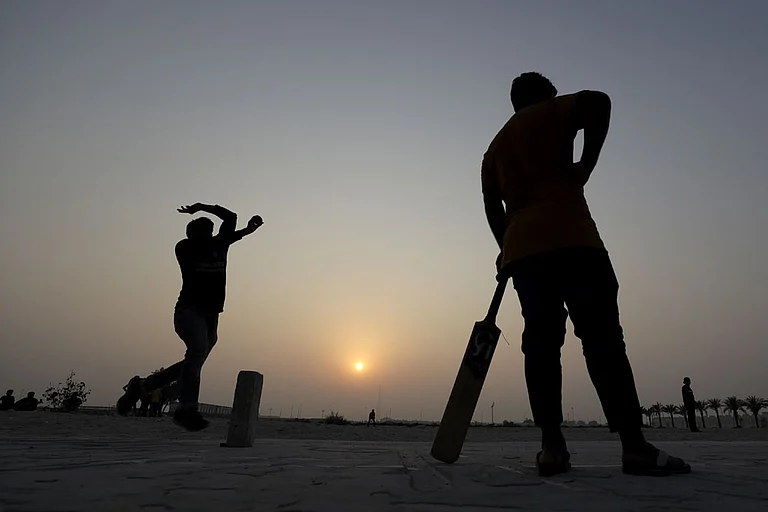
“There was no stadium or proper nets,” Paradkar says. “There was just a small space at CP Club. On Sundays, we played 50 balls, then 100, then 200, sometimes 300… Her game came from repetition and discipline.”There were no pristine nets or state-of-the-art facilities. There was just an old place where players could practise. But he gave her something more valuable: structure.
“I was not a professional cricket coach,” Paradkar says. “I am an athletics coach. I never claimed to make players. I just gave her structure. The rest—runs, records and selections—came from her hard work.”
“He made a timetable for me,” she says, “and I followed it like a religious text.”
By the time the 2013 ICC Women’s Cricket World Cup arrived, Meshram had put in years of work through age-group cricket, domestic circuits and the quiet grind that rarely makes headlines. The tournament, held in India from 31 January to 17 February, felt like a turning point for women’s cricket in the country. India were placed in Group A alongside the West Indies, England and Sri Lanka. They opened their campaign at the Brabourne Stadium in Mumbai with authority, posting 284 for 6 against the Windies and bowling them out for 179. Thirush Kamini’s innings earned her the Player of the Match award.
Meshram was there. She wore the blue jersey. But she did not step onto the field. Despite years of work and steady progress through the Under-16 and Vidarbha circuits, she remained on the bench throughout the group stage. The World Cup passed without her facing a ball.
“The value of a blue jersey for a woman has changed significantly,” she says now, without bitterness. “In my first World Cup, no one came to cheer us except Nita Ambani. The stadium was empty.” She pauses. “For people like us, the one lakh rupees we earned from a series meant everything. It was beyond measure.” Sapna is silent on this chapter.
Pardkar has watched Meshram move from anonymity to attention, but he insists something fundamental never shifted. “When young players come into the limelight, people think success makes them glamorous,” he says. “But with Mona, sincerity remained. Even when she wasn’t selected, even when she sat on the bench, mentally she stayed strong. That strength was built very early.”
“Cricket doesn’t disappear,” she says. “Life just interrupts it.” What followed was a period of quiet reckoning. Selection became irregular. The certainty she had built her life around began to fray. At one point, Meshram faced a ban from the Vidarbha Cricket Association after she stood by a senior teammate during an argument with coach Subhash Madam over additional practice sessions. It was not a dramatic rebellion, just a player asking for more time, more work. But it came at a cost. Angry and hurt, she responded in the only way she knew then, by etching her feelings onto her skin. Her first tattoo read, ‘Forgiven, but not Forgotten’. It was less defiance than documentation, a way of marking a moment she refused to erase.

The setback did not define her. She returned with resolve, entering one of the strongest phases of her domestic career. On a tour of South Africa, she amassed close to 500 runs, including a commanding double century. The innings did not just demand stamina. It demanded presence, hours of focus, repetition and belief. Around the same time, coach T. Dilip, now part of the Indian team’s support staff, began offering her weekend practice sessions. Meshram was working with the Railways team then, learning to balance employment with an elite sport. The weekends became a bridge between responsibility and ambition.
Yet, the deepest wound in Meshram’s life came not from cricket.
Around 2016, her younger brother Ashish, or Ashu as she called him, was diagnosed with a rare autoimmune disorder. What began as concern slowly became crisis. His condition worsened steadily. Organs began to fail. Seizures became frequent. Hospitals became familiar.
Treatments were tried, abandoned and replaced. The family fought on, moving between hope and exhaustion. Answers came late, and when they did, they were not enough. Sapna never told Meshram how bad it was getting. “She already carried enough,” she says. “If she knew everything, she wouldn’t have been able to play.” Ashu passed away in 2021. The exact date does not matter to Meshram. What remains is the absence. Sapna gave up her own promising cricket career to care for him. Someone had to stay. Someone always does.
“She thinks she left us,” Sapna says gently. “But she was holding (together) the family in a different way.”Meshram was often away for matches, carrying guilt she never learned how to set down.
“Money cannot save a person,” she says quietly, the sentence heavy with experience. Sapna remembers the final months with clarity. “When doctors say nothing is in your hands,” she says, “You stop asking questions.”
Meshram looks down at her left arm then. The string telephone tattoo comes into focus not as memory, but as mourning. It is for Ashish. A reminder of their final moments in a hospital room. Of one hand reaching for another. Of conversations cut short but not erased.For Mona Meshram, that line still holds. An unbroken connection. A voice she refuses to let fade.
Published At: