Opposition seeks an adjournment motion to force an urgent NEET debate.
Unlike regular discussions, the motion suspends business and requires voting.
The government indicated that it was willing to discuss students’ concerns “the way the Opposition wants it”
Why Opposition Wants To Discuss NEET Paper Leak In Parliament Through Adjournment Motion
he government indicated on Thursday that it was willing to discuss students’ concerns “the way the Opposition wants it”

Summary
The Opposition’s demand for an adjournment motion on the NEET paper leak is not merely about securing a discussion in Parliament. It is about forcing the government to suspend routine business and face a focused debate on the controversy.
The demand has gained political weight amid protests led by the Cockroach Janta Party, or CJP, over the alleged NEET-UG paper leak, police action against demonstrators and calls for Union Education Minister Dharmendra Pradhan’s resignation.
The government indicated on Thursday that it was willing to discuss students’ concerns “the way the Opposition wants it”, a formulation seen as a possible opening towards accepting an adjournment motion.
What Is An Adjournment Motion?
Parliament ordinarily functions according to a pre-decided list of business. Questions, Bills, motions and discussions are scheduled in advance, and members are generally expected to raise issues within that framework.
An adjournment motion allows a Lok Sabha member to seek the suspension of the day’s listed business in order to discuss a definite and urgent matter of public importance.
The Speaker has the authority to decide whether the motion should be admitted. Once accepted, it takes precedence over scheduled proceedings and can displace Question Hour, Zero Hour and other listed business.
The government’s Sansad website defines it as, “A motion for discussing ‘a specific and important matter that should have urgent consideration’. It can be moved by any member of the House and is in the nature of emergency motion of censure upon the Government. The object is to draw the attention of the government to a matter of urgent public importance so as to criticise the decision of government in an urgent matter in regard to which a motion or resolution with proper notice will be too late.”
Why Is The Opposition Seeking One Over The CJP Protests?
The Opposition wants the NEET controversy to be treated as an urgent national issue rather than one among several matters listed for discussion.
Advertisement
The demand comes amid a sustained agitation by the CJP, which began as a satirical political platform but developed into a wider student-led movement following allegations of a paper leak in the NEET-UG examination.
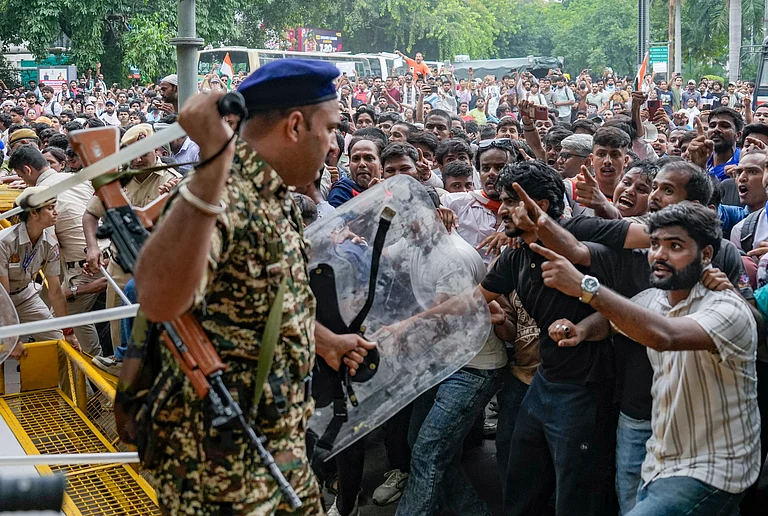
The protests gathered momentum after activist Sonam Wangchuk began an indefinite hunger strike and thousands of supporters, many of them students and young people, joined demonstrations in Delhi.
The agitation intensified after police and paramilitary personnel allegedly used lathis, tear gas and water cannons to control protesters. Opposition parties have since raised questions over the examination system, the role of the National Testing Agency, the alleged use of force and the government’s handling of the crisis.
By insisting on an adjournment motion, the Opposition is seeking to place all these issues before Parliament in a single, politically consequential debate.

How Is It Different From A Regular Parliamentary Debate?
A regular discussion usually takes place without disrupting the scheduled work of the House. It may be held under different rules, some of which allow members to express their views.
Advertisement
An adjournment motion is more confrontational. It suspends normal parliamentary business and signals that the matter is too urgent to wait.
Most importantly, the debate ends with a vote as per the rules. This gives the motion a sharper political character than an ordinary discussion.
For the Opposition, a general debate may allow the government to answer questions and defend its position without facing a formal test. An adjournment motion, in contrast, places the government’s conduct directly under scrutiny.
Why Does The Motion Put Pressure On The Government?
An adjournment motion is regarded as a form of parliamentary censure. Although losing such a vote does not automatically bring down the government, it would amount to a formal expression of disapproval by the Lok Sabha.
That is what makes the demand politically sensitive.
A government that agrees to an adjournment motion is effectively accepting a debate and vote on its own response to the controversy. Even when the ruling coalition has sufficient numbers to defeat the motion, the proceedings can give the Opposition a high-profile platform to question ministers, highlight alleged failures and demand accountability.
Advertisement
For the Opposition, even forcing the government to accept the format can be presented as a political victory.
What Has The Government Offered?
Parliamentary Affairs Minister Kiren Rijiju told the Lok Sabha that the Centre was prepared to discuss the NEET paper leak in both Houses and was willing to accept the Opposition’s preferred date and format.
He said the message had been conveyed to Opposition leaders through the Speaker.
Lok Sabha Speaker Om Birla also indicated that the rule under which the debate would be conducted could be discussed among the parties. He asked members to return after Question Hour so that consultations could be held, following which the House was adjourned.
As per Hindustan Times, the government’s position had also been communicated through back channels and was considered at an Opposition strategy meeting on Thursday morning.
The willingness to negotiate the format was interpreted as a possible softening of the government’s earlier position, though no final agreement had been reached.
Advertisement
Could This End The Parliament Standoff?
A debate under an agreed parliamentary rule could help break the impasse, but the disagreement is no longer limited to the format of discussion.
Opposition leaders, including Rahul Gandhi and Samajwadi Party chief Akhilesh Yadav, have not agreed to move forward unless the government also addresses the demand for Dharmendra Pradhan’s resignation.
The Centre has meanwhile opened talks with CJP representatives and reached out to Wangchuk, who ended his hunger strike late on Thursday after receiving written assurances.
The government’s willingness to debate the controversy may reduce one source of confrontation. However, unless there is movement on the demand for political accountability, particularly Pradhan’s removal, the parliamentary deadlock could continue.
The adjournment motion has therefore become more than a procedural demand. It is now the Opposition’s chosen instrument to turn the NEET paper leak from a general discussion into a formal test of the government’s conduct.
Published At: