SIT is reviewing over Rs 124 crore in Ram Temple Trust spending.
Rs 113 crore consecration ceremony expenditure is under scrutiny.
Gold, silver and donation-handling records are also being verified.
Outlook Explains | Why Ram Temple Trust's Consecration Ceremony Spending Under Review
The Ram Temple Trust spent Rs 113 crore on the Ram Lalla consecration ceremony held on January 22, 2024

Summary
The Shri Ram Janmabhoomi Teerth Kshetra Trust, which oversees the Ram Temple in Ayodhya, is facing heightened scrutiny after the Special Investigation Team (SIT) probing the alleged embezzlement of temple donations expanded its inquiry to examine more than Rs 124 crore spent on major religious events over the past two years, including the Ram Lalla consecration cremony in 2024, the temple flag hosting ceremony in November 2025 and the Maha Kumbh arrangements in 2025.
The review is part of a wider investigation into alleged financial irregularities in the handling of temple donations. According to India Today, citing sources, the SIT is auditing the Trust's financial records, including audit reports, payment vouchers, bills, expenditure statements and chartered accountant records, to determine whether funds were utilised in accordance with the Trust's prescribed financial procedures and approval mechanisms.
Sources told the publication that the exercise is an audit of expenditure and has not reached any conclusion regarding financial irregularities.
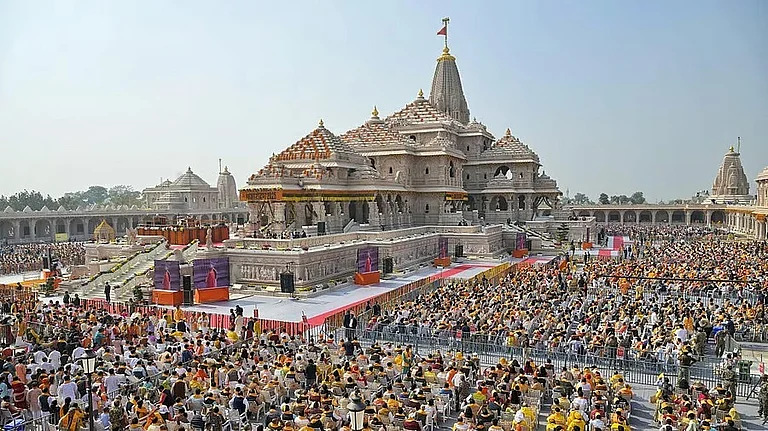
Ram Lalla Consceration Ceremony Under Investigation
The largest expenditure under scrutiny is the Rs 113 crore spent on the Ram Lalla consecration ceremony held on January 22, 2024. The event, attended by nearly 8,000 guests, including Prime Minister Narendra Modi, marked one of the most significant religious ceremonies in recent Indian history.
According to audit records cited by The Times of India, investigators are examining several heads of expenditure. These include Rs 35.97 crore on sheds and tent city infrastructure, Rs 30.85 crore on the Akshat Pujan campaign, Rs 21.77 crore on publicity and advertisements, and Rs 14.62 crore on decoration and lighting.
Other expenses include Rs 5.11 crore on food arrangements (Ann Kshetra), Rs 1.06 crore on religious rituals, Rs 93 lakh on devotional music (Raag Seva), Rs 68 lakh on sound systems, Rs 43 lakh each on electricity and Mandal Pujan, and Rs 51 lakh on miscellaneous preparations.
Advertisement
The SIT is also reviewing Rs 83 lakh spent on the first Pratishtha Dwadashi celebrations held in January 2025, including Rs 52 lakh on lighting and decoration, as well as Rs 43 lakh spent on arrangements for devotees during the Maha Kumbh.
Another event under examination is the Ram Temple flag-hoisting ceremony held on November 25, 2025. According to Trust records cited by The Times of India, the event cost Rs 10.12 crore and was attended by around 6,000 guests, including Prime Minister Modi. Investigators are examining whether approvals, payment procedures and expenditure under different heads complied with the Trust's financial rules. Sources told the newspaper that the average expenditure per guest worked out to about Rs 16,000.
Why Is SIT Looking at These Expenses?
The expenditure review is linked to the SIT's broader investigation into the alleged theft and embezzlement of donations received by the Ram Temple.
Advertisement
The investigation has already uncovered repeated instances of employees allegedly concealing cash during the donation-counting process. Preliminary findings also flagged serious lapses in security and supervisory mechanisms inside the counting room. The findings have been shared with the Shri Ram Janmabhoomi Teerth Kshetra Trust.
As part of the investigation, officials are verifying whether expenditure on major events followed the Trust's approval process and whether financial records accurately reflect how donated funds were utilised.
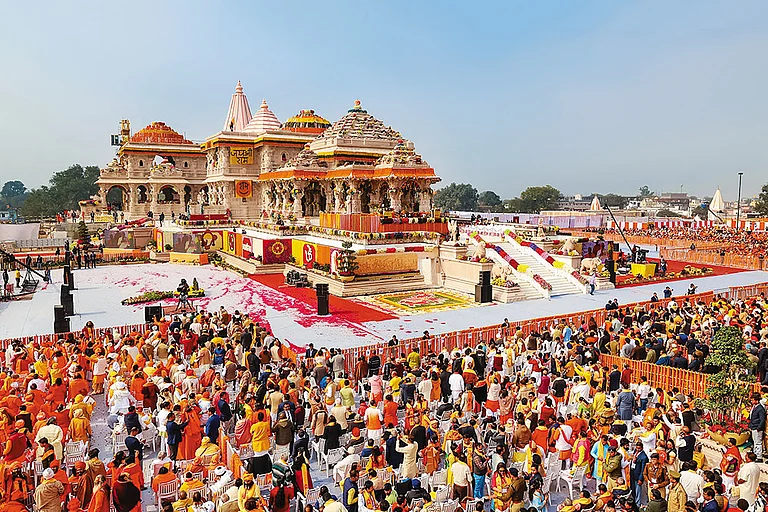
Donations of Gold and Silver Also Under Review
The probe is not limited to cash expenditure. According to Trust records, investigators are also verifying inventory and storage records relating to precious metals donated by devotees.
The records show that between November 2024 and February 2025, devotees donated 2.3 kg of gold and 83.3 kg of silver. During the Maha Kumbh, another 1.5 kg of gold and 28 kg of silver were received. The SIT is cross-checking inventory records, storage arrangements and the present status of these valuables.
Advertisement
How Do Other Major Temple Trusts Handle Donations?
The scrutiny has also drawn attention to how other prominent temple trusts manage public donations.
According to a Hindustan Times report, several major temple trusts in Uttar Pradesh follow institutionalised systems involving independent oversight.
At the Kashi Vishwanath Temple in Varanasi, 56 donation boxes are opened twice a week under the direct supervision of a subdivisional magistrate.
"Counting takes place under continuous CCTV surveillance in the presence of bank officials and an independent retired gazetted officer. Every transaction is documented, before being deposited in the government treasury," said S Rajalingam, chairman of the Shri Kashi Vishwanath Temple Trust Board and Varanasi divisional commissioner.
At Krishna Janmabhoomi in Mathura, donations are accepted through three permanently staffed receipt counters operating under CCTV surveillance, according to Kapil Sharma, secretary of the Shri Krishna Janmasthan Seva Sansthan.
Meanwhile, at the Banke Bihari Temple in Vrindavan, donation management is overseen by a high-powered committee constituted under Supreme Court directions and headed by a retired Allahabad High Court judge. Donation boxes are opened once a month in the presence of the sub-divisional magistrate and committee members before the collections are deposited into authorised bank accounts.
Advertisement
In each of these cases, an external authority oversees the counting and documentation of donations unlike the Ram Temple.

Should the Trust Come Under the RTI Act?
The developments have also reignited the debate over whether the Shri Ram Janmabhoomi Teerth Kshetra Trust should be treated as a public authority under the Right to Information (RTI) Act.
CPI(M) Rajya Sabha MP John Brittas has written to Union Home Minister Amit Shah urging the Centre to reconsider its position.
Sharing the letter on X, Brittas argued that it was not prudent to keep the Trust outside the ambit of the RTI Act merely because the government described it as an "autonomous" body, when it had been constituted through a government-approved scheme, vested with land acquired under a parliamentary law and continued to have serving IAS officers in its governing framework.
He urged the Centre to revisit its stand, stating: "Trusts that enjoy unparalleled public faith must also uphold the highest standards of public transparency and accountability."
As the SIT continues its audit, the focus remains on whether the Trust's financial procedures complied with its own regulations. While investigators have not yet concluded that any irregularities occurred in the expenditure itself, the probe has renewed broader questions about transparency, accountability and financial oversight in institutions that manage large volumes of public donations.
Published At: