The Akal Takht has given the Punjab government one month to amend the anti-sacrilege law and suspend its implementation until then.
The Sikh religious body says it supports strict punishment for sacrilege but objects to provisions it considers interference in Sikh religious affairs.
Punjab Finance Minister Harpal Singh Cheema said the government will examine the proposed amendments and take a decision within one month.
Outlook Explains | Why Has Akal Takht Given Punjab Government One Month To Amend Anti-Sacrilege Law?
The Akal Takht has asked the Punjab government to amend provisions of the anti-sacrilege law within a month and keep its implementation on hold. Here's why the Sikh religious body has objected to the legislation and what happens next.

Summary
The Akal Takht has directed the Punjab government to amend provisions of its anti-sacrilege law within one month and asked it to keep the legislation on hold until those changes are made. The direction came after 87 Sikh MLAs, including Cabinet ministers from across political parties, appeared before the highest temporal seat of Sikhism in Amritsar after being summoned over the law.
According to PTI, the dispute is not about whether those guilty of sacrilege should face strict punishment. The Akal Takht has repeatedly said it has no objection to strict punishment for those guilty of desecrating the Guru Granth Sahib. Instead, it argues that several provisions of the Jaagat Jot Sri Guru Granth Sahib Satkar (Amendment) Act, 2026 were enacted without consulting the Sikh Panth and amount to government interference in Sikh religious affairs. It has asked the Punjab government to amend those provisions within one month and to keep the implementation of the law on hold until suitable amendments are made.
Why were Punjab's Sikh MLAs summoned?
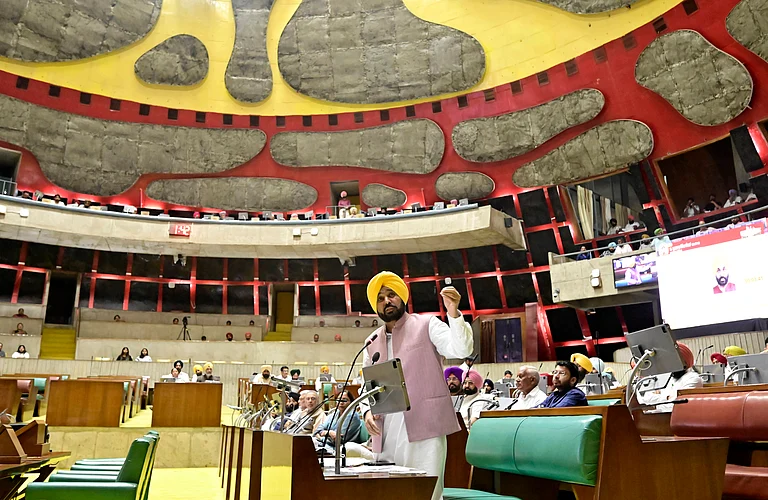
The Punjab Assembly unanimously passed the Jaagat Jot Sri Guru Granth Sahib Satkar (Amendment) Bill, 2026 on April 13. The legislation provides for stricter punishment, including life imprisonment, for any act of sacrilege against the Guru Granth Sahib.
According to PTI, the Akal Takht subsequently objected to certain provisions of the law, saying they were "against the Guru Granth Sahib, the Khalsa Panth and the sentiments of the 'Sangat' (Sikh community)."
Gargajj said Punjab Assembly Speaker Kultar Singh Sandhwan had been summoned on May 8 and given 15 days to make amendments in accordance with Sikh sentiments. Written objections from the Akal Takht were formally conveyed to the Punjab government on May 11.

"However, the state government adopted an obstinate and arrogant attitude, completely ignoring the Akal Takht and Sikh sentiments," the Jathedar had said.
Advertisement
On June 15, Gargajj directed all Sikh legislators, irrespective of party affiliation, and Sikh ministers to appear before the Akal Takht for clarification after it objected to the law, saying it had been enacted without consulting the Sikh Panth.
According to PTI, all Sikh MLAs and Cabinet ministers appeared before the Akal Takht on Monday. Non-Sikh ministers were asked to submit their views in writing, while Chief Minister Bhagwant Mann was not summoned.
Why is the Akal Takht objecting to the law?
Before the meeting, Gargajj accused the AAP government of interfering in religious affairs and the authority of the Akal Takht through the anti-sacrilege law.
"We should not go against Guru Panth and Guru Granth Sahib. We should go as per the sentiments of the Sikh Panth," he said.
According to PTI, the Akal Takht has maintained that while it has no objection to strict punishment for those guilty of sacrilege, the provisions inserted into the law place Guru Granth Sahib, Sikh sentiments and concerns related to the Guru Sahib, the internal administrative system of Sikhs, the SGPC, Sikh Sangat, granthis, pathis, gurdwara committees and other sewadars within a legal framework in the manner of "accused persons", which amounts to direct government interference in Sikh affairs.
Advertisement
Gargajj had also said that while there may be laws for those accused of sacrilege, no law can be imposed on the Guru Granth Sahib, the Sikh Sangat and 'sewadars'.
The Akal Takht has further objected to making public, on the SGPC's website, information regarding who possesses the sacred birs of the Guru Granth Sahib. According to PTI, Gargajj said this could expose the personal information of devout Sikhs and could be misused by anti-Sikh forces and mischievous elements.
What changes has the Akal Takht asked for?
After addressing the legislators, Gargajj directed the Punjab government to remove the objectionable provisions within one month by bringing suitable amendments. He also urged the state government not to interfere in religious affairs and asked it to put the implementation of the law on hold until the amendments are made.
Advertisement
According to PTI, Gargajj handed over a list of objections to the MLAs. One concerns replacing the word "Bir" with "saroop" in the legislation.
The Jathedar told the MLAs and ministers that the Punjab Assembly had no authority to decide Sikh terminology and asserted that only the Akal Takht could take a call on the matter.
He also objected to provisions concerning the word "custodians" and the unique identification number of each "saroop".
At the same time, Gargajj reiterated that he had no objection to punishing those who are guilty of desecrating the Guru Granth Sahib.
He also sought the inclusion of a provision for the registration of an FIR against a Dera chief if any follower of that Dera carries out desecration of the Guru Granth Sahib "under a conspiracy".
What happens next?
After the meeting, Gargajj said all 87 MLAs, including ministers, had attended the proceedings. He also claimed that the legislators approved bringing changes to the law by raising their hands. He reiterated that the implementation of the law should remain on hold until the amendments are carried out.
Advertisement
Before appearing before the Akal Takht, rebel Akali MLA Manpreet Singh Ayali said he would abide by whatever the Akal Takht directs. He also said the state government should have amended the law when the Jathedar had first pointed out the objections.
AAP MLA Gurdit Singh Sekhon said the legislators had appeared before the Akal Takht to present their clarification. However, Sekhon maintained that the anti-sacrilege law had been framed to ensure stricter punishment for those who desecrate the Guru Granth Sahib.
Punjab Finance Minister Harpal Singh Cheema said the Jathedar had proposed amendments that would be sent through the Punjab Assembly Speaker.
"He has proposed some amendments, which he will send through the Punjab Assembly speaker. When we get them, we will take a decision within one month after discussing the same," Cheema said.
(With inputs from PTI)
Published At: