Rural jobs fell sharply in July, with employment generation nearly halving under the new scheme.
Fewer households accessed work, raising concerns about rural incomes amid uneven monsoons and weaker kharif activity.
The new 125-day guarantee faces scrutiny over funding, seasonal restrictions and actual access to employment.
Outlook Explains | India's Rural Jobs Plunge Under New Scheme: What It Means For Workers
As VB-G RAM G replaces MGNREGS, rural employment has fallen sharply, raising questions over funding, seasonal restrictions and whether the new scheme can provide work when vulnerable households need it most

Summary
India’s rural employment guarantee programme has entered a new phase with the replacement of the Mahatma Gandhi National Rural Employment Guarantee Scheme (MGNREGS) by the Viksit Bharat–Guarantee for Rozgar and Ajeevika Mission (Gramin), or VB-G RAM G. The transition, however, comes against a backdrop of a sharp fall in employment generation in the first month of the new scheme.
As per official data available till August 9, VB-G RAM G generated 7.67 crore person-days in July 2026, 49.94% fewer than the 15.33 crore person-days generated under the Mahatma Gandhi National Rural Employment Guarantee Scheme (MGNREGS) in July last year.
The number of households that availed employment also fell by 51.45%, from 1.42 crore in July 2025 to 68.94 lakh this July.
The decline comes as the monsoon remains uneven and kharif sowing slows. The government, however, says it has completed the transition to the new scheme smoothly and offered work to more than 98% of rural households that demanded employment.
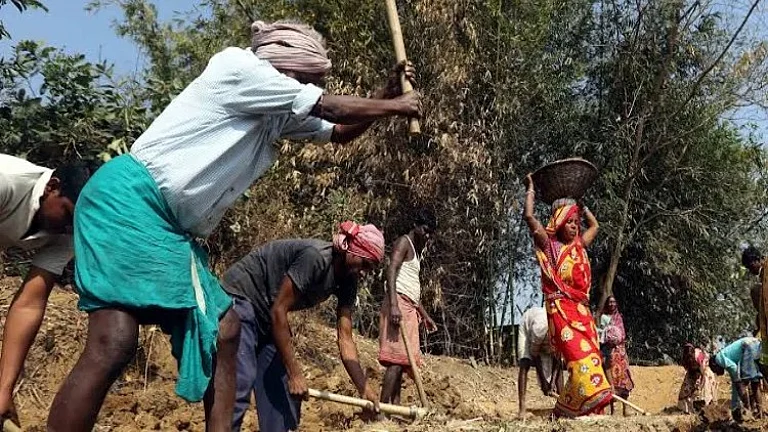
Rural Jobs Decline
The July figures show a sharp fall in both the number of households availing employment and the number of person-days generated.
Only 68.94 lakh households availed employment this July, less than 40 per cent of the 1.72 crore average over the previous four years. Similarly, VB-G RAM G generated 7.67 crore person-days, about 35 per cent of the 21.56 crore average recorded during the corresponding period.
A person-day measures the work done by one person in one working day.
The decline also began before VB-G RAM G replaced MGNREGS. The old scheme generated 17.56 crore person-days in March 2025, compared with 17.69 crore in March 2024. The year-on-year decline continued until June 2026, the last month of MGNREGS.

A New Framework
VB-G RAM G replaced MGNREGS on July 1. The government says it completed the transition across rural India without disruption.
Advertisement
As reported by The Indian Express, a Ministry of Rural Development official said the government had made the administrative and digital systems for the new programme operational from the first day. The Centre has also set aside a Budget Estimate of Rs 95,692 crore for 2026-27.
The ministry said more than 98% of rural households that demanded employment had received an offer of work. It said more than 1.33 crore rural workers had been offered employment and around nine crore person-days had been generated during the first month. More than nine lakh worksites were active, it said.
The official dashboard, however, recorded 7.67 crore person-days in July as on August 9.
The Indian Express report added that the decline may partly show a pause during the kharif sowing season. There is, however, no data to establish how much the seasonal pause contributed to the fall.
The new scheme allows states to notify periods covering peak sowing and harvesting seasons during which workers cannot seek employment under the programme.
Advertisement

Guarantee Vs Reality
On paper, VB-G RAM G offers a higher employment guarantee. MGNREGS provided 100 days of wage employment to a rural household in a financial year, while VB-G RAM G raises the guarantee to 125 days.
However, the two frameworks differ significantly in their funding and implementation. MGNREGS followed a demand-driven model and allowed workers to seek employment throughout the year. VB-G RAM G provides a normative allocation to states, with state governments required to bear expenditure beyond that allocation.
The funding pattern has also changed. Under MGNREGS, the Centre met 100 % of the wage costs, while the Centre and states shared material costs in a 75:25 ratio. Under VB-G RAM G, the Centre and states will share the overall financial burden in a 60:40 ratio in most states and 90:10 in northeastern and Himalayan states.
Advertisement
For Union Territories without legislatures, the Centre will bear the entire cost. The new arrangement therefore places a greater financial responsibility on state governments.

Rural Safety Net
The rural employment guarantee programme provides a fallback for households when agricultural or casual work dries up.
The timing of the decline therefore matters. The India Meteorological Department has reported deficit to serious-deficit rainfall in 50% of the country’s 741 districts between June 1 and August 3.
Kharif sowing has also fallen behind last year's level. According to the Union Ministry of Agriculture and Farmers Welfare, farmers had covered 894.22 lakh hectares under kharif crops as on July 31, compared with 920.72 lakh hectares during the same period last year , a decline of 26.50%.
For agricultural labourers, weaker farm activity can mean fewer employment opportunities.

Advertisement
MGNREGS Vs VB-G RAM G
The new scheme changes not only the number of guaranteed days but also the nature and planning of works. MGNREGS covered water conservation, drought-proofing, irrigation, renovation of traditional water bodies, land development and flood control.
VB-G RAM G focuses on four broad areas , water security, core rural infrastructure, livelihood-related infrastructure and mitigation of extreme weather events.
Under MGNREGS, gram panchayats played a central role in identifying works through gram sabhas or ward sabhas. Under VB-G RAM G, works will originate from Viksit Gram Panchayat Plans and link with the PM Gati Shakti National Master Plan.
The new framework also classifies panchayats into A, B and C categories based on development parameters.
Technology will also play a larger role. The scheme provides for biometric authentication, GPS or mobile-based worksite monitoring, public disclosures and the use of artificial intelligence in planning, audits and fraud-risk mitigation.
The government says it is recording attendance through the National Mobile Monitoring System using face authentication, with an exception mechanism for genuine cases.
The ministry also said women accounted for around 63% of person-days generated, well above the statutory one-third requirement.

The Real Test
The central question is whether the higher statutory guarantee will translate into more actual work.
VB-G RAM G promises 125 days against MGNREGS's 100. Yet July's figures show a sharp fall in both households availing employment and person-days generated.
The decline could also weigh on rural demand. Wages earned through public employment support household consumption, particularly when agricultural incomes remain weak.
The government says it has offered work to more than 98% of households that demanded employment. The coming months will show whether July's decline showed a temporary effect of the transition and agricultural season, or whether the new funding, administrative and seasonal provisions will reduce employment opportunities.
For rural households facing an uneven monsoon and weaker kharif activity, the real test of VB-G RAM G will not be its 125-day guarantee on paper, but whether it provides work when they need it.
Published At: