Every year on January 30, India observes the assassination of Mohandas Karamchand Gandhi.
Gandhi had survived multiple assassination attempts and threats before, targeted for his insistence on Hindu-Muslim unity.
The memory of Gandhi himself has become a site of debate.
Martyrs’ Day: A Nation That Remembers Mahatma Gandhi, Yet Struggles To Live By Him
Every year on January 30 , Shaheed Diwas, India observes the assassination of Mohandas Karamchand Gandhi, also known as the Father of the Nation.

Summary
On this day, a voice that insisted on non-violence was silenced by violence but the questions it raised refuse to die. A man who was a strong believer of ‘ahimsa’ (non- violence) would be killed for his commitment to it, and remains one of the most enduring ironies of Independent India.
Every year on January 30 , Shaheed Diwas, India observes the assassination of Mohandas Karamchand Gandhi, also known as the Father of the Nation.
It was on this day in 1948, he was shot at point-blank range by Nathuram Godse during an evening prayer meeting in Delhi.
Gandhi had survived multiple assassination attempts and threats before, targeted for his insistence on Hindu-Muslim unity, his opposition to revenge politics following the partition of India and his refusal to give in to the collective fury of the Hindu majority.

Yet, as the nation commemorates his martyrdom, the memory of Gandhi himself has become a site of debate. In recent years, his presence in public life has shifted, from the renaming of institutions to the replacement of the Mahatma Gandhi National Rural Employment Guarantee Act (MGNREGA) with a new framework that no longer carries his name. For supporters, these are administrative decisions; for critics, they signal a deeper discomfort with the moral legacy Gandhi represents.
This unease around Gandhi’s legacy has been captured sharply by political psychologist Ashis Nandy, who wrote in Outlook India earlier this month that finding someone who shares Gandhi’s political and cultural sensibilities has become not just difficult, but even hazardous in his homeland.
In what Nandy, borrowing from scholar Herbert Feith, calls a repressive developmentalist syndrome, Gandhi’s admirers are increasingly portrayed as naïve peaceniks or internal enemies obstructing the nation’s march towards a muscular, authoritarian modernity. Within this climate, as Outlook has repeatedly noted, from Seema Guha’s reporting on the Sangh Parivar’s discomfort with Gandhi to Tushar Gandhi’s account of attempts to reframe and technologically sanitise his memory, Gandhi remains too large an icon to discard, yet too inconvenient to fully embrace.
Advertisement
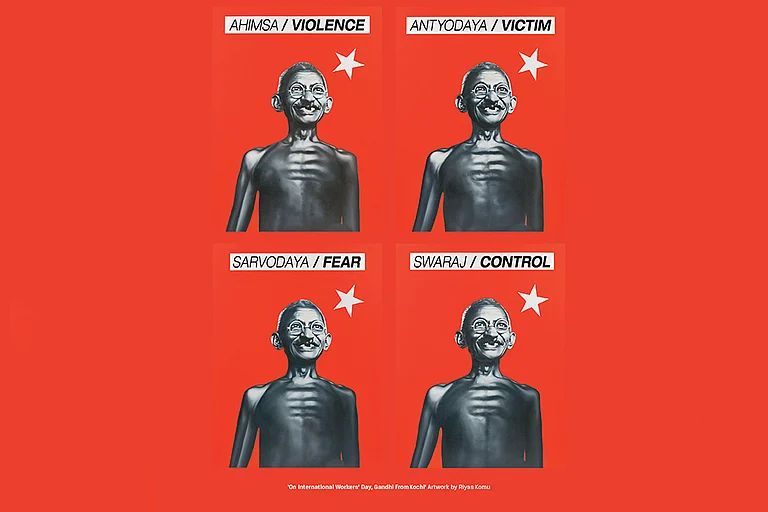
Even as some BJP leaders have publicly praised his assassin, Nathuram Godse, Prime Minister Narendra Modi continues to invoke Gandhi on the global stage, underscoring the paradox of a nation that cannot abandon Gandhi, but struggles to live by him.
At the same time, remembrance has taken quieter, more intimate forms. Away from statues and slogans, many Indians have begun revisiting Gandhi the human being and those who stood beside him. There has been renewed interest in Kasturba Gandhi, long overshadowed by the enormity of her husband’s legacy. Readers are returning to her letters and biographies, rediscovering a woman who led satyagraha movements, mobilised women, endured repeated imprisonments, and spent her final days in detention at the Aga Khan Palace, where she died in 1944. Kasturba was not merely a companion to history, but a participant in it bearing its costs with quiet resolve.
Advertisement
This turn towards personal histories suggests a nation still negotiating how to remember Gandhi: not just as an untouchable icon, nor as a political inconvenience, but as part of a broader constellation of sacrifices, of women, associates and ordinary satyagrahis, whose lives were shaped, and often broken, by the freedom struggle. On Martyrs’ Day, as India bows its head at Raj Ghat, the question lingers: in remembering Gandhi, what values are we choosing to carry forward and which ones are we willing to let fade?
Published At: