Buddhism in southern India is not talked about much in the present tense even though there are many relics and historic sites that testify to its presence—from Kanchipuram and the Ayyappa temples to Amaravati, Nagarjuna Sagar, Sannati and Brahmagiri. Several such sites have been preserved for historians or have been converted into a contemporary form of Hindu faith and mythology. The deciphering of the epigraphs and copper plates, along with studies in Indology led by scholars such as Gustav Oppert and Ferdinand Kittel, provide a nuanced view. South Indian history is rich with a Buddhist past, and its legacy has been carried forward proudly, although by a smaller number of followers. The modern movement of revival is credited to the likes of Pandit Iyothee Thass and Lakshmi Narasu. However, that revival received a boost after B. R. Ambedkar embraced Buddha’s Dhamma in 1956.
Buddhism in South India Reimagined: Ashoka-Ambedkar Dhamma Yatra and the Ambedkarite Revival
Seeking Sangha captures the contemporary perception of Buddhism in India. It gives a real-time ethnographic coverage of Buddhism being shaped beyond the sectarian conflicts of various yanas

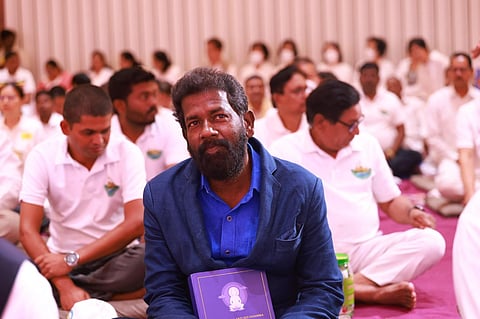
Since then, there have been pockets of devoted Ambedkarites who have taken up the Buddhist faith. Though much of it is still in its nascent stages, the practices are rooted in everyday habits and social interactions among the Buddhists of South India. However, in recent years, there has been a groundswell of Buddhist revivalism in southern India led by the Ambedkarite Buddhists of Tamil Nadu, Kerala, Karnataka, Andhra Pradesh and Telangana, along with the Maharashtrian Buddhists. The movement is under the auspices of the Buddhist Fraternity of India, an organisation formed by two eminent scholars—the playwright Bharathi Prabu and Prashant Ingole.
The Buddhist Fraternity of India movement draws much of its ideological lineage from the legacy of Ambedkar, mostly his work, The Buddha and His Dhamma. This is the standing text that is advocated and discussed throughout. To spearhead the missionary work of bringing Dhamma to the people of South India, Prabu and Ingole, along with their comrades, prepared a plan to start a heroic “Ashoka-Ambedkar Dhamma Yatra” in 2023.
The yatra began in Kerala’s Mavelikkara, a historic Buddhist site, and travelled to Tamil Nadu, Puducherry, Karnataka, Andhra Pradesh, Telangana and Maharashtra. This yatra is the topic of a new documentary, Sangha Tales—officially titled Seeking Sangha—directed by Sreerag T. K. and Sumanto Mondal. It is at once an intimate archive of the community from the perspective of an objective observer. It draws attention to the larger framework of the yatra and highlights how the thread of the languages of each state connect the travelling disciples of the Buddha and Ambedkar through a sense of learning and pride.
The documentary, Sangha Tales, stands as an important archival contribution to the history of Indian cinema, more so for its independent theme.
After experiencing what he calls the inevitability of the Dhamma, Prabu was entranced by the mission of forging an inter-state Dhammic connection in India. No one had earlier thought of doing a yatra that would cement the culture and practices of diverse Buddhist traditions. As people joined, the yatra proceeded. Ashoka, who ruled the Mauryan empire in India (268–232 BC), was a rallying point.
Ashoka piques my interest. I am very interested, almost obsessed, with this mystical figure. I have tried to access information about him wherever I could—even organised a two-day deliberation on Ashoka in Patna. We need Ashoka to reclaim his agency because he is embraced and honoured globally. Prabu pointed out that Ashoka is flying the world over through the tricolour of Indian embassies and the official Sarnath emblem.
Planning the yatra took months of online and offline coordination across the states. I was invited to participate in a few online meetings. As meetings continued, the fundraising began. An idea emerged to instal the statue of Ashoka as a Dhamma Vijayan—the victor of Dhamma—instead of identifying him as an emperor. As Prabu explains in the extraordinary documentary, an emperor is assessed by how many wars he has won, while a Dhamma Vijayan is one who has earned victory through love.
One of the chief organisers, Mrudula Vanangamudi, explains in the film that discipline and devotion came to the yatris as each of them observed the Eight-fold Path, not losing sight of the fact that the act of Dhamma has to adhere to its intrinsic values. Thus, they adopted the role of a “travelling sangha”.
A replica of Ashoka’s statue was cast in a golden palette, signifying Tamil artistic influence. However, the original—weighing over 1,500 kg and moulded in brass—is waiting to be installed in Deekshabhoomi, Nagpur, where Ambedkar embraced Buddhism. The yatra is an outcome of a man with hopes that occasionally sound wild. As the chief organiser, Prabu is wholly devoted to Ambedkar’s Buddhist mission. His energy comes from the activities and ideas constantly churning in his mind. Sometimes he refuses to pause, making those who consider themselves hardworking feel lazy and inept. In his expansive vocabulary, there is no place for slowing down. And that has taken a toll on his health. One of the striking aspects of the documentary is the agency and prominence accorded to the voices of the women folk. One protagonist, Vishaka, a sixth grader, was brought to the yatra by her father, Dhamma Dharmendra. Her eloquence, vulnerability and nervousness were captured with such sensitivity that the audience can relate to her with an almost natural familiarity. Sangha Tales captures the modern perception of Buddhism in India. It gives a real-time ethnographic coverage of contemporary Buddhism that is being shaped beyond the sectarian conflicts of various yanas (spiritual practices in Buddhism).
To understand Ambedkar is to get under his skin and feel the rush of urgency while wiping off the sweat flowing from the forehead. No one has ownership over the Bodhisattva; he is in everyone. Therefore, scholastically, Ambedkar continues to be studied and reinterpreted, with explorations of his ideas animating classrooms as much as political movements. Consider how Prabu frames Ambedkar’s conversion to Buddhism: “Ambedkar embraced Buddhism just like a child embracing its mother”. This line sheds light on the misunderstood nature of Ambedkar’s embrace of the Buddha and his Dhamma. Prabu singles out two texts produced by Ambedkar. The Constitution of India, he claims, was for the nation, while The Buddha and His Dhamma was for the world.
As we delve deeper into the quieter spaces of the Ambedkarite Buddhist community, we tend to learn more about our raison d’être. In Tamil Nadu, the classic Thirukkural by Thiruvalluvar has long been considered a text that established Dravidian authority. However, in the Buddhist community of Tamil Nadu, Thiru—the trinity of the Buddha, Dhamma and Sangha—is re-presented from the matted Thiruvalluvar into an ascetic, shaved-head monk. Such moments help deepen our understanding of the Ambedkarite Buddhist movement, aided by Prabu’s experiential political acumen.
He has no qualms with people who have different political views or affiliations. That is why scores of leaders in Tamil Nadu and beyond vouch for him. He is a people’s man and knows how to cultivate and nurture relationships despite cultural and linguistic differences. He sees through people’s masks and forgives them easily. Yet, there is little investment in material and organisational needs. It is the outcome of an eager person who is keen to finish the task that Ambedkar exhorted, “[M]y people will sacrifice everything to establish Buddhism in India”. Prabu took this as a message delivered directly to him.
The documentary stands as an important archival contribution to the history of Indian cinema, more so for its independent theme. It seeks to resurrect the art of storytelling exercised with such dexterity that it becomes an art of labour.
(Views expressed are personal)
Suraj Yengde is a contributing editor at Outlook. He curates ‘artality’ about travel, art & culture. He is the author of Caste: A Global Story
Tags