Manoj Prabhakar accused a teammate of offering him Rs 25 lakhs to perform poorly
Staying away from the easy lure of sensationalism, Outlook stayed true to facts
Almost three decades later, India's obsession with cricket is as strong as ever
Caught At Point: Three Decades Of Outlook's Parley With Cricket
For three years, between 1997 and 2000, Outlook took out a series of issues that probed match-fixing and betting scandals and exposed fault lines in Indian cricket.

Summary
Irreverence isn't an easy word to throw around in a country like ours. Where institutions and traditions not only define the past but also shape the present - immune from questions and criticism. In 1997, a still blooming publication, nestled in Delhi, dared to question and shake the foundation of one such institution - cricket. What inspired the journalists at Outlook, to touch an almost sacred obsession - was probably then a question of national intrigue, and now, a moment of quiet retrospection.
Over the course of three years, between 1997 and 2000, Outlook took out a series of issues, which probed match-fixing and betting scandals that poisoned Indian cricket from within and brought to surface groundbreaking revelations. A country, suddenly deprived of its pride and obsession, demanded answers and accountability. And Outlook was at the forefront, asking the difficult questions, before others dared to.
In a conversation with Outlook for its 1997 issue, India's Worst Kept Secret, all-rounder Manoj Prabhakar accused an unnamed teammate of offering him Rs 25 lakhs to perform poorly in the India-Pakistan encounter of the 1994 Singer Cup in Colombo. This triggered Outlook's series of daring investigations into the scandal, steadily presenting facts against shaken faith. With the Chandrachur Commission failing to unearth the skeletons, the country remained dissatisfied with the attack on cricket, carefully keeping an eye on the magazine's exposé.
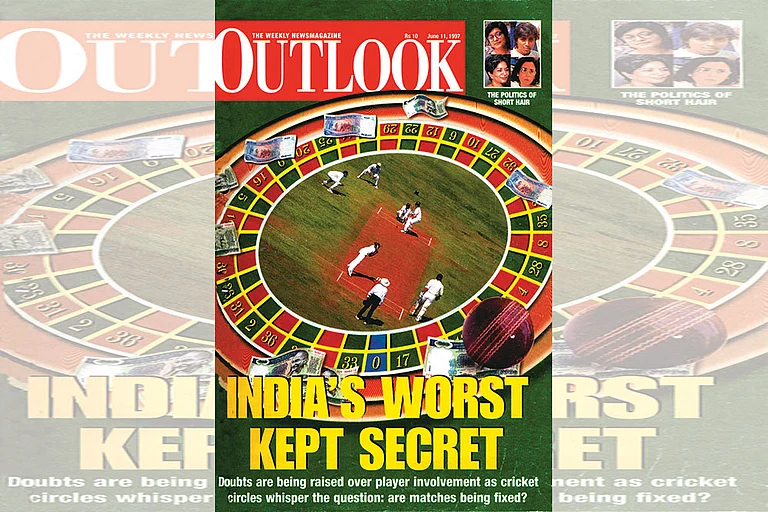
Staying away from the easy lure of sensationalism, Outlook stayed true to facts and divorced from bias. It looked at the labyrinthine nexus from its very rotten core. In the issue dated June 5, 2000, the magazine reported that Prabhakar who had earlier put his teammates under the bus, was also equally involved in the scandal. The investigative report said Prabhakar's name cropped up in conversations that were tapped by the Mumbai Police's crime branch in November 1996 during the Titan Cup. Though Prabhakar did not figure in the team, he was allegedly the key person in organising bets with the bookies.
Outlook's reports brought clarity to the haze, as the country witnessed a series of events rounding up the fiasco. With Kapil Dev breaking down in an interview with allegations levelled against him by Prabhakar, and the then captain Mohammed Azharuddin finding himself in the eye of the storm, cricket was shaken, as was the country, suddenly bereft of its heroes.
Advertisement
Outlook followed the trail, untying knots and navigating the complex network and the underworld till the very end as Prabhakar's words in the 1997 interview tipped the domino.
Almost three decades later, the fallen religion stands taller than ever. Boasting of the richest cricket board in the world, the biggest of names with sky-scraping records and almost unparalleled cha-ching, Indian cricket rose to the top with dignity, gradually shedding past the skin of inordinate wear and tear. Manoj Prabhakar, after his ban, held domestic coaching positions before becoming the bowling coach of Afghanistan in 2015 and the head coach of Nepal in 2020, both of which proved to be uneventful. Ajay Jadeja, who also had coaching stints is now a cricket pundit, and - wait a minute- the heir to the throne of Jamnagar, with a fortune of Rs 1450 crores to his name, while Azharuddin has recently been inducted back into the top Congress fold in Telangana, becoming the first Muslim face in CM Revanth Reddy's cabinet.
Advertisement
Cricket in India, in 2025, is insulated. Questions rarely reach the top, with the system comfortably distanced from the mumble and buzz. Thirty years down the line it is a currency of power - a global show-off. Before the rise, Outlook had asked the questions, loudly and confidently. Confident in its irreverence - of making a difference, triggering changes, and shaping a brand of journalism that would not think twice before asking the difficult questions.
Published At: