Advertisement
X

AI Impact Summit 2026: The Promise, Power and Pitfalls

Delhi’s message is that AI governance must not become an exclusive club of the already powerful.

In this image received on Feb. 16, 2026, Prime Minister Narendra Modi during the inauguration of India AI Impact Expo, at Bharat Mandapam in New Delhi. Bharti Enterprises Chairman Sunil Bharti Mittal also seen. (PMO via PTI Photo) Source: PTI
Summary
  • AI promises efficiencies in healthcare where diagnostic gaps remain acute.

  • AI offers predictive tools for agriculture in a country still dependent on monsoon rhythms

  • AI-enabled facial recognition and predictive analytics can enhance security, but they can also erode privacy.
 

There are summits that pass like seasons, and there are summits that seek to mark an era. On 16 January 2026, at Bharat Mandapam in New Delhi, the AI Summit India 2026 opened under the banner of ‘Bringing the world together,’ clearly aspiring to the latter. Prime Minister Narendra Modi, inaugurating the summit, declared that ‘AI must be anchored in human values and aligned with humanity’s collective progress.’ It was a line crafted not merely for applause, but for positioning.

The staging was not ceremonial. It was declarative. India was not content to be a market for artificial intelligence. It wished to be a shaper of its meaning.

The language was expansive. The theme, Sarvajana Hitaya, Sarvajana Sukhaya, invoked civilisational memory to frame a technological future. Artificial intelligence, the summit proposed, must be human-centric, inclusive and oriented toward welfare. It was a phrase designed to soften the steel edges of algorithmic ambition. Yet beneath the cadence lay hard realities. AI today is not only a tool of innovation but also a theatre of geopolitical rivalry, economic concentration and ethical anxiety.

Delhi, for a week, becomes that theatre.

A Summit of Possibilities

Leaders from Europe, Latin America and Asia joined Indian policymakers and global technology firms in as the largest AI congregation hosted in the Global South. The Prime Minister also announced the creation of a National AI Research Grid aimed at strengthening compute infrastructure and enabling collaboration between universities, startups and public institutions. Whether this becomes transformative will depend less on the announcement and more on allocation and implementation.

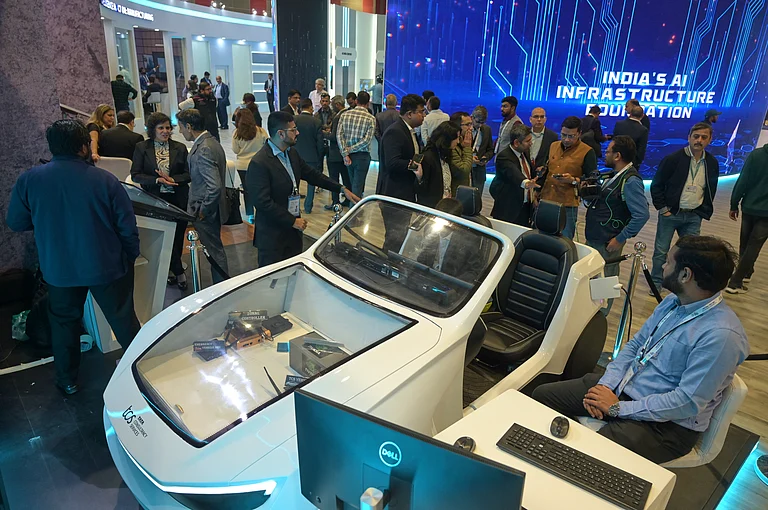
Exhibition halls displayed diagnostic tools powered by machine learning, agritech platforms promising precision for small farmers, multilingual language models tuned to India’s linguistic diversity, and public service dashboards designed to streamline governance. Panels discussed infrastructure, safety, digital public goods and cross-border cooperation.

The scale mattered. India, home to over 1.4 billion people and one of the world’s largest digital user bases, is not a marginal player in the AI economy. Its startup ecosystem is among the most vibrant globally. Its public digital infrastructure, from identity systems to payments platforms, has often been cited as a template for emerging economies. The summit projected confidence that India could leverage these foundations to craft an AI pathway distinct from Western and Chinese models.

Advertisement

Opportunity, in this telling, is abundant.

AI promises efficiencies in healthcare where diagnostic gaps remain acute. It offers predictive tools for agriculture in a country still dependent on monsoon rhythms. It suggests personalised education models for millions of first-generation learners. It enables translation across hundreds of languages and dialects, potentially democratising access to knowledge. For a nation of India’s scale, the incremental gains of AI, multiplied across millions, could become transformative.

There is also the diplomatic dividend. By hosting such a summit, India positions itself as a convenor between North and South, between capital-rich technology producers and data-rich developing economies. Optics matter in a world in which digital governance debates are often shaped in Washington, Brussels or Beijing. Delhi’s message is that AI governance must not become an exclusive club of the already powerful.

The Burden of Expectations

Yet ambition carries its own burdens.

For every promise AI holds, it also harbours risk. Automation, even when gradual, unsettles labour markets. In India, where employment remains heavily informal and social security nets are uneven, disruption can be unforgiving. The rhetoric of reskilling and upskilling is compelling, but execution is arduous. Can the state and private sector together build training ecosystems that keep pace with algorithmic acceleration? Or will productivity gains accrue unevenly, widening economic fault lines?

Advertisement

There is also the question of data. AI systems are nourished by data, and India’s population generates it in staggering quantities. But who owns this data, who governs it, and who profits from it remain contested terrains. Policies that encourage data localisation and sovereign AI models aim to retain strategic control. Yet the global AI supply chain is deeply interconnected. Foundation models are trained across borders, cloud infrastructure is multinational, and venture capital is transnational. The desire for sovereignty must negotiate with the reality of interdependence.

Ethics, too, cannot be confined to keynote speeches. Bias in algorithms is not an abstraction. It shapes hiring decisions, credit allocation, policing tools and welfare targeting. In a society as stratified as India’s, algorithmic bias can reproduce historical inequities with mathematical efficiency. Ensuring fairness requires transparent datasets, independent audits, regulatory oversight and a public conversation that extends beyond technical elites.

The summit acknowledged such concerns. Sessions on AI safety, child protection online, misinformation and responsible deployment suggested awareness of darker undercurrents. Yet awareness must mature into enforceable frameworks. India’s data protection law, though significant, is still in early implementation. Sector-specific AI regulation remains a work in progress. The temptation in moments of technological enthusiasm is to privilege speed over scrutiny. History counsels caution.

Advertisement

Technology as Public Discourse

There is also the geopolitical dimension. AI is fast becoming the grammar of power in the 21st century. Nations compete for semiconductor supply chains, compute capacity, research talent and standard-setting influence. By hosting the summit, India signalled that it seeks a seat at the high table. But leadership in AI is not merely convening leaders. It is investing in research ecosystems, nurturing homegrown models, building robust public institutions and safeguarding civil liberties.

The summit’s framing around welfare for all gestures toward a moral compass. But moral compasses must navigate stormy seas. Consider surveillance. AI-enabled facial recognition and predictive analytics can enhance security, but they can also erode privacy. In democracies, the line between legitimate state use and overreach is delicate. Public trust, once fractured, is difficult to restore. Balancing innovation with civil liberties will test the maturity of India’s institutions.

Advertisement

AI cannot remain a conversation confined to technocrats and executives. It must become a matter of public discourse. Universities, courts, legislatures and civil society organisations must debate not only what AI can do, but what it should be allowed to do. Transparency in procurement, clarity in accountability and independent oversight mechanisms will determine whether AI strengthens democratic culture or strains it.

From Expo Floors to Everyday Life

And yet, it would be disingenuous to dwell only on caution. India’s digital trajectory over the past decade has demonstrated an ability to scale technology in service of public goods. If similar imagination is applied to AI, particularly in health, education and climate resilience, the dividends could be substantial.

The expo floors at Bharat Mandapam offered glimpses of such futures. AI-assisted tuberculosis screening in remote districts. Crop advisory systems that blend satellite imagery with localised weather data. Speech-to-text tools enabling legal documentation in regional languages. These are not speculative fantasies. They are prototypes in motion.

The deeper question is sustainability. Will these innovations remain pilot projects showcased at summits, or will they integrate into policy and budgets? Will startups nurtured in the glow of global attention secure long-term capital? Will research collaborations forged in conference halls translate into shared intellectual property and co-created standards?

Opportunity Meets Responsibility

Perhaps the most significant achievement of the summit is symbolic. It asserts that the Global South need not be a passive recipient of technological norms. It can host, frame and influence the conversation. But symbolism without institutional follow-through is spectacle.

Artificial intelligence is neither salvation nor doom. It is a tool shaped by human intention, political will and economic structures. The Delhi summit underscored both the magnitude of the opportunity and the gravity of the responsibility. To bring the world together is an act of convening. To bring it forward, equitably and ethically, is an act of governance.

Summits end. Headlines fade. Code continues to evolve.

The question is whether governance will keep pace.


(Ashutosh Kumar Thakur writes on society, technology, literature and the arts, reflecting on the shared histories and cultures of South Asia.)

Views expressed are personal

Published At:
US