Balendra Shah, a 35-year-old rapper-turned-politician, took oath as Nepal’s prime minister following the collapse of KP Sharma Oli’s government amid a youth-led protest movement.
India’s Narendra Modi congratulated Shah, highlighting strong bilateral ties, while a new cabinet was sworn in alongside him following the March 5 elections.
Nepal Swears In Balendra Shah As Youngest Prime Minister
The Rastriya Swatantra Party secured a landslide victory, with Shah becoming the youngest democratically elected leader and the first from the Madhes region to hold the post.

Summary
Rapper-turned-politician Balendra Shah — popularly known as ‘Balen’ — was on Thursday sworn in as Nepal’s new prime minister, around six months after the dramatic collapse of the KP Sharma Oli government in an unprecedented youth movement.
The 35-year-old Rastriya Swatantra Party (RSP) leader took the oath of office at the President’s Office, administered by President Ram Chandra Paudel. The RSP secured a landslide victory in this month’s parliamentary elections.
A former mayor of Kathmandu, Shah is the youngest democratically elected leader to assume the country’s top office and the first from the Madhes region to become prime minister.
India’s Prime Minister Narendra Modi congratulated Shah after the ceremony and expressed his intent to strengthen bilateral ties.

“Your appointment reflects the trust reposed in your leadership by the people of Nepal. I look forward to working closely with you to take India-Nepal friendship and cooperation to even greater heights for the mutual benefit of our two peoples,” Modi posted on X.
Nepal holds strategic importance for India, with leaders from both countries often referring to their longstanding "Roti Beti" relationship. As a landlocked country, Nepal depends heavily on India for transit and trade, with most of its imports routed through Indian territory.
Shah is the first democratically elected prime minister since the coalition government led by Oli was ousted in September last year, following a youth-led Gen Z protest against corruption, nepotism, and a social media ban that escalated into violence.
After Oli’s removal, former chief justice Sushila Karki assumed charge as interim prime minister on the recommendation of the Gen Z movement.
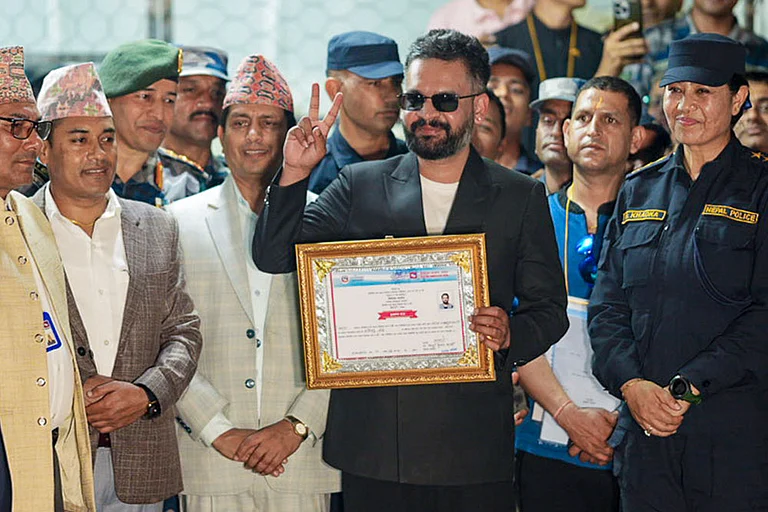
Though widely seen as a popular choice to lead the interim administration, Shah declined at the time, saying he preferred to seek a full mandate through parliamentary elections.
“Congratulations to the newly appointed Prime Minister, Balendra Shah. I feel all the more elated that a 35-year-old young man is my successor. I extend my best wishes to him. I wish him success in pushing forward the people's mandate with vigour and rigour,” Karki posted on X after the ceremony.
Advertisement
Alongside Shah, several ministers were sworn in. Swarnim Wagle took charge of Finance, Shisir Khanal of Foreign Affairs, and Sudan Gurung of Home Affairs.
Shah will also oversee the Defence Ministry and the Industry, Commerce and Supplies Ministry.
Biraj Bhakta Shrestha will handle Energy, Water Resources and Irrigation, while Bikram Timilsina takes charge of Communications and Information Technology.
Pratibha Rawal has been appointed Minister of Federal Affairs and General Administration, Ganesh Paudel as Minister of Culture, Tourism and Civil Aviation, and Sunil Lamsal as Minister of Physical Infrastructure and Transport.
Among others, Gita Chaudhary took oath as Agriculture and Livestock Development Minister, Sasmit Pokharel as Minister for Education, Science and Technology, Nisha Mehata as Minister for Health and Population, Sita Badi as Minister of Women, Children and Senior Citizens, and Sobita Gautam as Minister for Law, Justice and Parliamentary Affairs.
In the March 5 general elections, Shah defeated Oli by a wide margin in the Jhapa-5 constituency, a long-time stronghold of the Communist Party of Nepal (Unified Marxist–Leninist).
Advertisement
(with PTI inputs)
Published At: