Shipki La border trade between India and China resumes after a six-year suspension due to COVID-19.
Sixteen local traders began the first expedition carrying goods through the historic Himalayan trade route.
Revival aims to boost border livelihoods, cultural links, tourism and rural economy in Kinnaur.
Indo-China Border Trade Resumes Through Shipki La After Six-Year Break
After six years, India-China border trade resumes through Himachal Pradesh’s Shipki La pass, reviving an ancient Himalayan barter route and local livelihoods

Summary
After a six-year gap, Indo-China border trade—the centuries-old trade based on the old ‘barter’ system resumed on Saturday through the historic Shipki La pass in the high-altitude tribal district of Kinnaur in Himachal Pradesh.
This marks a significant revival of a vital cross-border business and cultural linkage between the border communities of India and the Tibet Autonomous Region of China.
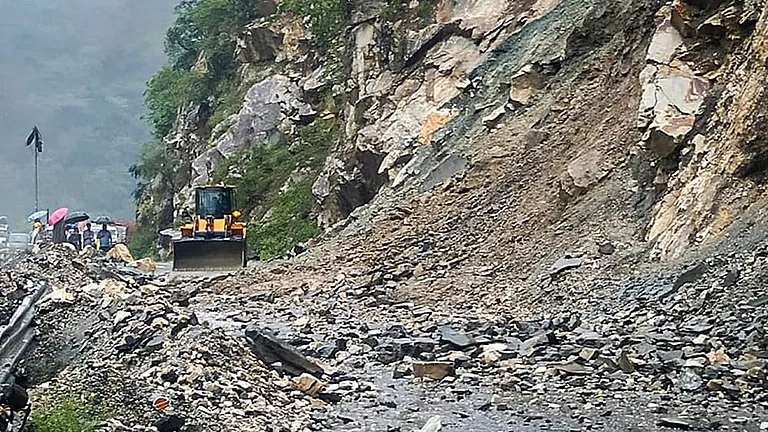
The cross-border trade with China via the Shipki La pass was suspended after the COVID-19 pandemic in 2020, which was seen as a blow to the local villagers, many of whom depend on annual trade, as the region remains under snow for most of the year.
In the first batch, 16 traders from local villages, mainly Namgia, Chuppan, Nako, and Chango, remote highland settlements, set off for a 72-hour trade expedition carrying goods on 14 mules, confirmed Hishey Negi, president of the Kinnaur Indo-China Trade Association.
"Resumption of the Shipki La trade, part of an ancient trans-Himalayan trade route, is a significant step at the initiative of the Himachal Pradesh government and the Indian government. It also brings hope to small traders, whose livelihoods in the remote tribal belt were linked across the Himalayan barter trade."
Negi also underlines that many traders in the villages on the Indian side had a lot of cultural affinities with their counterparts on the other side for three to four generations. “Once they return, we will get a lot of feedback on their reunion and business deals."
Echoing the optimism, Kinnaur Deputy Commissioner Amit Kumar Sharma said the traders set off with great enthusiasm. The export consignments were first transported in pickup vehicles up to Shipki La and then happened to be on mules—the traditional mode of transport in this Himalayan terrain, widely used across Kinnaur and other mountainous parts of Himachal Pradesh.
"The feedback from this first trading expedition will be invaluable," Sharma said. "It will help us understand which items are in demand, the quantities required, and the preferred forms of trade. That will enable us to further strengthen and expand cross-border commerce."
Located along the Sutlej Valley, Shipki La looked like a happening place after a six-year break as family members and local officials gathered to bid farewell to the traders, while the mule caravan, laden with traditional Indian goods, slowly climbed the mountain track. It was a long-standing demand of the villagers to revive the trade from Shipki La, at an elevation of 12,895 feet.
Advertisement
The district administration had received 95 applications from the traders seeking "permits," which are issued after getting clearances from the MEA, New Delhi.
Only approved Indian traders are allowed to leave, and they get 72 hours to complete their transactions. A newly built Trade Mart at Shipki La handles trader registration, customs clearance, and import-export procedures.
"We will process more applications as and when necessary clearances come from New Delhi," said Sharma, DC Kinnaur.
The traders are permitted to export 36 designated items and import 20 approved goods from Tibet. Live animal trading (such as horses, sheep, and goats), which earlier used to be part of the export list, has been stopped. It is because no local quarantine facility has been built in Kinnaur, informs Negi.
The items covered under the trade license are spices, pulses, biscuits, Refined oil, dry fruits, tea, sugar, walnuts, turmeric, while traders from China are permitted to trade silk, leather footwear, asafoetida, thermos flasks and glassware.
Advertisement
The resumption of the trade is also seen as significant in light of the Indian government’s Vibrant Villages Programme and move to allow the border villages to be opened to tourists.
"Two developments will not only create new opportunities for the villagers and traders, strengthening their businesses, but also help in the revival of tourism and the rural economy," says Jagat Singh Negi, Himachal minister for revenue and tribal development, who flagged off the first consignment of traders on Saturday.
He also inaugurated the Rs 1.7-crore Trade Mart at Chhappan, built by the Himachal Pradesh government to facilitate border trade. Urging traders to adhere strictly to the Centre's import-export guidelines for authorised goods, he said compliance would be crucial for ensuring the long-term sustainability of the trade and strengthening mutual ties.
Negi recalls that Chief Minister Sukhwinder Singh Sukhu had taken personal initiative and had convinced Union Home Minister Amit Shah about the need for diplomatic efforts between India and China to restore traditional border trade routes.
Advertisement
The trade route was closed after the 1962 India-China war and later reopened in 1994 before being suspended again in 2019 due to the COVID-19 pandemic.
Published At: