From rural Tamil Nadu to international film festivals and Hollywood sets, production designer Bala Govind Kumar’s journey reflects a rare synthesis of architectural discipline, cultural sensitivity, and cinematic imagination. In this interview, he reflects on his roots, his philosophy of production design, and the evolving role of visual storytelling in global cinema.
From Tamil Nadu To Hollywood Sets: How Bala Govind Kumar Designs Cinematic Worlds Across Cultures
In this interview, Bala Govind Kumar he reflects on his roots, his philosophy of production design, and the evolving role of visual storytelling in global cinema.

Q: You were born and raised in Tirunelveli, Tamil Nadu—a place far removed from the global film industry. How did your early environment shape your artistic sensibility?
Ans. Growing up in Tirunelveli meant growing up with limitations—limited access to global art, limited exposure to cinema beyond the mainstream, and very rigid social structures. But those limitations also sharpened my awareness. I became deeply observant of spaces, rituals, textures, and human behaviour. Rural life has its own architecture—emotional and physical—and that stayed with me.
Art became a way to question boundaries. My father firmly believed education could level social hierarchies, and that belief gave me the confidence to pursue creative knowledge seriously. My brother’s work in animation introduced me to filmmaking as a career path. Still, more importantly, it revealed cinema as a collaborative art form that could absorb everything I loved—drawing, architecture, history, storytelling.
Q: You chose architecture before entering cinema. How has that training influenced your work as a production designer?
Ans. Architecture gave me discipline. It trained me to think structurally, spatially, and conceptually at the same time. As a production designer, I don’t just think about how a set looks—I think about how it functions emotionally, how actors move through it, how the camera perceives it, and how the audience subconsciously reads it.
Architecture also instilled respect for realism. Even when a design is stylized, it must feel believable. That foundation allows me to design worlds that feel lived-in rather than decorative. For me, production design is invisible when done right—it supports the story without calling attention to itself.
Q: Your early professional work in India included large-scale feature films such as Indian 2, Bigil, Ayalaan, and Seema Raja. What did those experiences teach you?
Ans. On these productions, Kumar served in critical roles in the art department, contributing to the visual development and execution of large-scale cinematic environments while working closely with directors, cinematographers, and senior production designers. Those films taught me scale, responsibility, and collaboration. Working on large productions with established actors and directors means you’re part of a massive machine. Every design choice affects budgets, schedules, and hundreds of people on set.
Advertisement
In those environments, precision matters. You learn how to problem-solve quickly, how to communicate across departments, and how to deliver creative solutions under pressure. That experience gave me a strong professional backbone, which later helped me transition into the U.S. industry with confidence.
Q: Alongside mainstream cinema, you’ve built a strong presence in independent and festival-driven films. Why is that balance important to you?
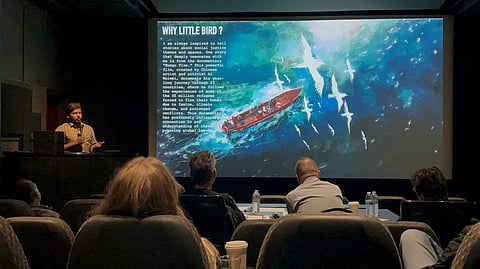
Ans. As a production designer and Art Department Head, I find that independent cinema gives me space to explore intimacy and nuance. Films like Little Bird, The Stand, and Binge required a different kind of sensitivity—stories driven by emotion, identity, and internal conflict rather than spectacle.
With Little Bird, which received the Jury Award at Cinequest and screened at festivals like AFI Fest and HollyShorts, the design had to support themes of displacement and healing. The Stand, which screened at Tribeca and later received Academy Awards consideration, demanded restraint. Sometimes the most powerful design choice is what you choose not to show.
Advertisement
Balancing large-scale productions and independent films keeps me grounded. One teaches logistics and scale; the other teaches humanity.
Q: The Stand entering Oscar consideration is a major milestone. What did that recognition mean to you personally?
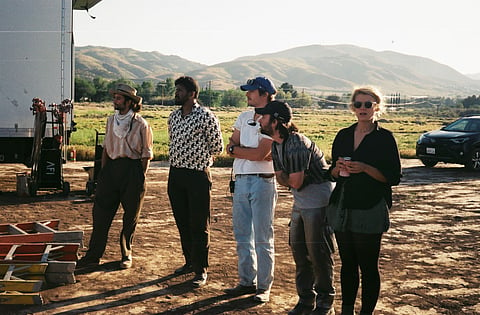
Ans. It was deeply validating—not only for me, but for everyone who poured themselves into the film. Short films are often made with limited resources, but they require the same level of discipline, creative rigour, and problem-solving as larger productions. Having The Stand reach Oscar consideration signaled that our work met a very high professional standard—and that the film’s storytelling connected beyond its immediate community.
Personally, it reinforced something I’ve always believed: production design is not decoration—it’s narrative. Even within a minimal story, the environment has to communicate character, tension, and meaning. On The Stand, I approached the design with the same seriousness I would bring to a feature—developing a clear visual language from early concept through execution, collaborating closely with the director and cinematography team, and ensuring every detail served the emotional arc. That recognition affirmed that intention and craft can elevate a story regardless of scale, and it strengthened my commitment to delivering that level of work consistently in future productions.
Advertisement
Q: You later pursued an MFA in Production Design at the American Film Institute. Why was AFI a vital step in your journey?
Ans. AFI represented both challenge and opportunity. It’s one of the most rigorous film programs in the world, and entering that space meant redefining myself in a global context. The program forced me to articulate my design philosophy, collaborate across cultures, and work under intense creative scrutiny.
Completing AFI wasn’t easy—financially or emotionally—but it sharpened my voice. It helped me transition from being technically strong to being conceptually precise. That distinction is crucial in the U.S. industry.
Q: You are now a Production Design Initiative member of the Art Directors Guild, IATSE Local 800. How significant is that recognition?
Ans. It’s incredibly meaningful. The Art Directors Guild represents the highest professional standards in production design in the U.S. Becoming part of that community is a form of peer validation—it means your work meets industry expectations at a national level.
Advertisement
More than status, it brings responsibility. It pushes me to maintain consistency, professionalism, and leadership on every project I take on.
Q: Beyond design, you’re known for leadership within the art department. How do you approach that role?
Ans. Leadership in the art department is about clarity and trust. I oversee teams, manage budgets, and ensure that creative vision aligns with production realities. But most importantly, I create an environment where collaboration thrives.
I believe a production designer must listen to directors, cinematographers, art directors, and even interns. Cinema is collective authorship. When everyone feels ownership, the work becomes stronger.
Q: Looking ahead, how do you see your role evolving within global cinema?
Ans. I don’t see my work as confined to one medium or geography. Cinema is expanding—into micro-dramas, streaming platforms, animation, and hybrid formats. Projects like Road Between Us, produced for GammaTime, reflect that evolution.
Artistically, I’m inspired by Hayao Miyazaki’s idea of the “never-ending artist.” I want to explore comics, children’s literature, and installations—spaces where visual storytelling can reach broader and younger audiences. My goal is to amplify underrepresented voices through culturally rooted yet globally resonant design.
Q: Finally, how would you define extraordinary ability in your field?
Ans. Extraordinary ability isn’t about spectacle—it’s about consistency, responsibility, and vision. It’s the ability to adapt across cultures, scales, and formats while maintaining artistic integrity. It’s about designing worlds that serve stories honestly.
If my work resonates, it’s because it comes from lived experience, discipline, and respect for storytelling. That’s what I continue to strive for.
Published At:
Tags