Scholar, philosopher and patron of the arts, Dara Shukoh was known for his profound interest in mysticism and his efforts to bridge the gap between Hinduism and Islam.
This book explores Dara's philosophy and the drama of his downfall.
It asks the tantalising question: what might have been—had Dara, not Aurangzeb, steered the course of history?
The Poet-Prince: Excerpt from Amit Ranjan's 'Dara Shukoh'
Offering a nuanced portrait of Shahjahan’s eldest son, 'Dara Shukoh: The Faqir and The Throne of Thorns' resurrects Dara's legacy of syncretism

Summary
Dancing Head of the Dead: Faqir
Magnified, sanctified
Be the holy name
Vilified, crucified
In the human frame
A million candles burning
For the help that never came
You want it darker
We kill the flame
—Mister Leonard Cohen,
‘You Want it Darker’ (2016)
Caesar – The Ides of March are come
Soothsayer – Ay, But not gone
—William Shakespeare’s Julius Caesar, Act 3, Sc 1
Will Dara dead turn out more powerful than Dara alive? That is a question that haunts Aurangzeb. To kill or not to kill, that is not the question. Kill he must, whoever needs to be, for he wills to be the undisputed monarch.
It is 1661 ce. Dara is dead, and it’s the turn for Sarmad’s head. Sarmad is past seventy, but Alamgir has to make an example by punishing the mendicant.
The naked fakir, friend and mentor of Dara, had prophesied during the succession battle that raged between Shah Jahan’s sons, that Dara would become king.
Aurangzeb knows that someone as popular as Sarmad cannot be beheaded just like that—a charge of heresy, apostasy must be proved. Aurangzeb also knows that once Sarmad is brought to trial, the rest will be cakewalk—the Faqir will go in an auto-destruct mode.
The Faqir is brought to a trial, and Aurangzeb asks him about his prophecy of Dara’s victory:
‘You said so and so, and the opposite has happened. What have you to say?’
‘I did not say he would be king of this transitory world; I meant the world to come, and that is his portion.’
That is enough to sever the head of the naked mendicant and savour the flavour of victory. But that is not enough to do that in public view. It needs heresy. Like Joan of Arc was accused of having consorted with the devil, having heard him and heeded his voice—in her battle against England. Sarmad is asked to recite the kalma, the declaration of faith—la ilaha il’allah Muhammad ur rasul’allah—‘There is no God except Allah, and Muhammad is his messenger.’
Advertisement
The Faqir utters ‘laa ilaaha’—‘There is no God,’ and goes silent.
‘There is no Allah, your renowned Faqir says. Look how he is the shaitaan himself,’ thunders the Qazi. Sarmad is dragged through the streets to the gallows and beheaded in full public view.
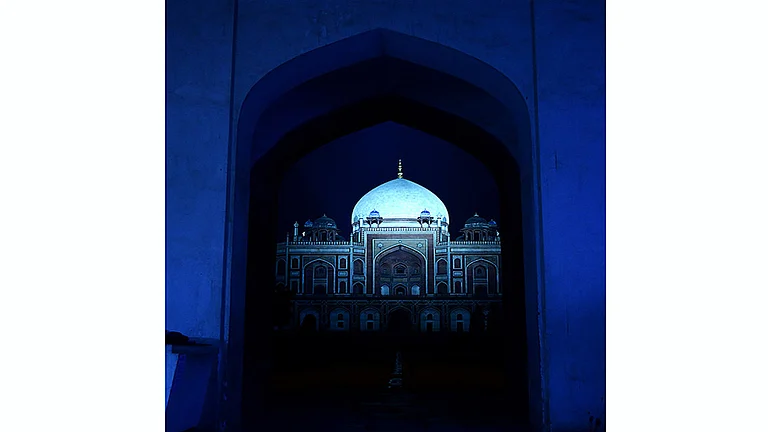
Legend has it that Sarmad’s body took the severed head in its hand, started dancing, and then his mouth uttered the full kalma. In leaving his final earthly attachment, he had found his Allah. Just as he was about to enter the Jama Masjid, a voice called out to him from Hare Bhare Shah’s grave. Shah entreated him—that Sarmad, having found his God, should relent and come to rest near him. He walked down, head in his hand, to Shah’s grave, where he fell and was buried there.
The legend of Sarmad dancing with his own head and uttering the kalma is an appropriation from a later time—for it is difficult for the faithful to reconcile either that their saint uttered only half of the kalma, or that perhaps he made a statement of atheism/or agnosticism. The complete kalma has to be a part of the legend so that Sarmad can be brought into the modern Islamicate fold. Interestingly, this imagery is reminiscent of the deity Ma Chhinnamastika dancing with her head in her hand, blood sprouting from the severed neck.
Advertisement
This goes on to demonstrate the inter-borrowings and syncretic nature of folk imagery in India.
There were two other charges that the courtiers of Aurangzeb had hoped to pin down Sarmad with. One was that he roamed around naked.
Francois Bernier, the royal physician in the court of Shah Jahan, and later in the court of Aurangzeb, is often quoted, with regard to Sarmad’s nudity: ‘I was for a long time disgusted with a celebrated Fakir, named Sarmet; who walked in the streets of Delhi as naked as he came to the world. He equally despised the threats and persuasions of Aurangzebe, and underwent at length the punishment of decapitation for his obstinate refusal to put on his wearing apparel.’
From Bernier’s own account, we understand that the phenomenon of naked Faqirs at this time was fairly common, and that they constantly were around royalty, and that this charge could not really have been held against Sarmad. He writes:
Advertisement
I have often met in the field, especially upon the lands of the Rajas, whole squadrons of these faquires, naked, dreadful to behold. Some held their arms lifted up in the posture mention’d; others had their terrible hair hanging about them, or else they had wreathed them about their head, some had a kind of Hercules’s club in their hand, others had dry and stiff tiger-skins over their shoulders. I saw them pass thus quite naked, without any shame, through the midst of a great burrough, I admired how men, women, and children could look upon them so indifferently, without being moved on more than if we should see pass some Eremite through our streets; and how the women brought them almes with much devotion, taking them for very holy men, much wiser and better than others.
Published At: