Tabish Khair is a well-known poet, novelist and critic. His books include The Things About Thugs, How to Fight Islamist Terror from the Missionary Position and The Bus Stopped. He lives in a village outside Aarhus, Denmark where he teaches English literature at Aarhus University. During his recent visit to Delhi, Khair spoke to Vineetha Mokkil about his new novel, Drown All the Refugees, a work of Gothic horror that paints a stark portrait of a world in which refugees are either forgotten or left to fend for themselves under the most brutal circumstances. The novel asks: what happens to someone who goes away? What is the kind of space they leave behind? What becomes of the people they leave behind?
'The Only Way To Evade Difference Is To Ignore It Or To Murder It': Tabish Khair
Poet, novelist and critic Tabish Khair spoke to Vineetha Mokkil about his new novel 'Drown All the Refugees' and the searing questions it explores

What draws you to fiction?
Non-fiction has its uses, but there are certain things you can’t explore with it. I’m aware of the data about displacement: we know that there are 43 million refugees in the world, and there are about 85 million others who are not even refugees but are internally displaced. Non-fiction can talk about this. But then there are other elements: what happens to someone who goes away? What is the kind of space they leave behind? What happens to the people they leave behind? I’m more interested in exploring the human elements. To do that, I think you need to revert to fiction. Fiction is not just a question of imagination; it’s also a question of language. Fiction uses language in a different way.
Do you feel there is more freedom to use language in a certain way when you are writing fiction?
There is freedom but with that comes responsibility. When you are writing a novel, you have to ask yourself, ‘are you going to put your words in someone else’s mouth?’ You have to be aware that if you have a character who comes from a different class or a different background, she might not think or talk like you. The other thing about literature in general is that it is not premised on the transparency of language, which all disciplines are. Whether it is sociology or physics or journalism for that matter, they all need disciplined language to communicate. On the other hand, there are a lot of things that escape language. Things that cannot be discussed in a certain period of time, or sometimes forever; ontologically vague issues. But someone needs to discuss them because they are what make us human, too. Literature has that space. It’s not just language that matters in literature, but also gaps, silences, paradoxes, irony. These enable you to talk about things that are tough or even impossible to speak about clearly.
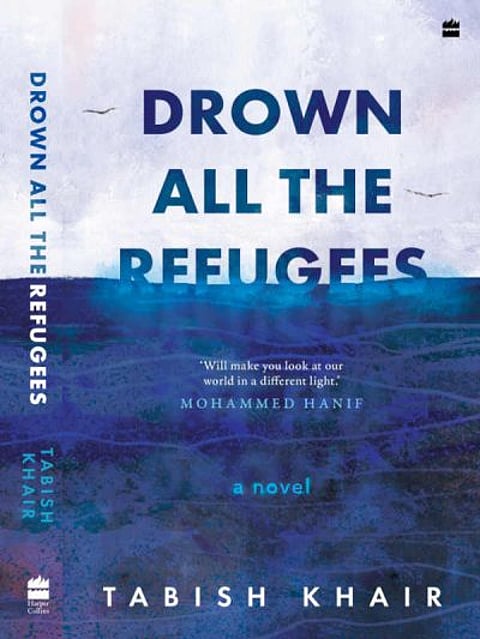
Drown All the Refugees (HarperCollins India, 2026) by Tabish Khair
Why did you feel compelled to write this novel at this particular moment?
I’m very interested in, first of all, in the negotiation of difference. Because for me, every identity is based on negotiating difference. And how we negotiate difference affects not just us but also the society we live in. At the moment, all over the world, not just in India, people have become quite bad at negotiating difference. Does it have to do with the fact that we have been living under a capitalist way of thinking for so long that we cannot face people who are different? I’ve always been interested in difference, and that has obviously brought me to topics like alienation and displacement. Difference is essential to the ways in which we live. And the only way to evade difference is to ignore it or to murder it. In recent years, like most of us, I have been worried about the ease with which we ignore those who are different from us. Sometimes we even ignore the fact that they have been murdered...
Advertisement
The narrator says at one point in your novel that it is better to kill human beings than to pity them.
I share the narrator’s skepticism about pity. Empathy is a necessary human attribute, but it is not a political solution. It is not enough. Because empathy means identification: I empathise with you. Identification can slip very easily into totalitarianism. So, political tools have to be based on difference. The fact that you are different, I am different, but we can work out something that would enable both of us. That’s what politics is all about. It’s not that I identify with you and you identify with me. This is what I am trying to explore in my novel in some ways.
Who are some of the writers whose work you like to read?
I read very widely, but increasingly translation. Lots of translation from Spanish, French, Portuguese and from Indian languages. I think some of the most exciting work is being done in other languages. English mainstream publishing has become so commercial, so big, that there are very few really exciting writers in the language.
Advertisement
Does it alarm you when you hear that reading habits are in decline?
It does disturb me to see that fewer people read books. But I don’t think there’s anything we can do as it is a part of a larger ethos. It can’t be changed by suddenly publishing better books or more accessible books. It’s linked to the way people connect to each other. And again, it’s connected to difference. To time as well. Everything has been speeded up. Reading cannot be speeded up; it takes its own time.
We are under pressure to constantly multi-task. There’s a wise Korean philosopher called Byung-Chul Han who writes in German. In one of his books, he wrote that multi-tasking is something all animals do in hostile environments. For instance, think of a deer. It’s grazing, looking after its kid, and also keeping an eye out for predators… Han said that the distinctive thing about human civilisation is that we can focus on one thing. If that ability disappears, something human about us disappears.
Advertisement
How do you see artificial intelligence (AI) impacting creative writing?
The problem didn’t start with AI. It began a long way back with the heavy commercialisation of literature. I’m talking about the kind of literature in which writers are not pushing the borders of the genre, of language, of thought. That kind of literature, AI will be able to write very well. And AI will spread and make it easier for people to produce it cheaply. But would it be able to write the kind of stories that depend on what is not being said, on contradictions, gaps, silences? That literature will still be there. But it has been ignored for the last 60, 70 years. And I feel that it’s a part of what’s been going on. AI is not the problem. What is behind AI is the problem.
How challenging is it to be a writer in our time?
Advertisement
It’s hard to have an inner life if you don’t give up on what the world wants you to achieve. For instance, as an academic, I’m happy I have a job. Many years ago, I decided I don’t want any academic power. No sitting on committees that appoint PhD students. I don’t want to become head of the department. I just want to do my teaching and have time for my research and my writing. You can make time for your writing, but you have to give up on something. In that sense you can do it. But in some other ways, it’s difficult to write because the kind of attention that writers used to get at least in culture circles has disappeared.
A lot of what passes for writerly attention now on social media is not really focused on writing. The focus is on personality, on attitudes, etc. So that might make some writers who don’t want to play that game—or cannot play that game—feel lost. Because not all writers are performers. I’ve learnt to perform to some extent but to be honest, I feel like, hey, I set out to write which means I wanted to sit in a corner and read. I didn’t want to come up and perform to a public.
Published At: