The Calf Doll had its world premiere at CPH:DOX 2026.
The film screened in NEXT:WAVE Competition.
It's the debut feature of Ankur Hooda.
The Calf Doll Review | Ankur Hooda’s Elegiac Debut Weaves Between Loss And Letting Go
CPH:DOX 2026 | Stunningly shot by Anish Sarai, the doc mingles design and freestyle in an atmospheric evocation.

Summary
The village and city collide in a fugue-like state in Ankur Hooda’s debut feature, The Calf Doll. Though the film is anchored by rural centrality, urbanisation lurks as a constant framing force. With a certain inevitability, city-driven compulsions encroach on the lives, dreams and apprehensions filling the Haryanvi film. Premiering at CPH:DOX (Copenhagen International Documentary Film Festival) 2026, as part of the NEXT:WAVE competition, The Calf Doll juxtaposes realism with imaginative intervention to carve a higher degree of truth and immersion. Hooda’s pursuit of authenticity is beguiling because it’s forged in an apparent make-believe.

Gorgeously shot with a sharp eye for ambient excavation, the film is as repressed as restless for release. We’re placed in Dayalpur, a village in Haryana, where we meet the central subject/character, a retired professor who’s devoted to his cow, at a sort of crossroads while he might not admit that himself. The film opens with two losses. The young farm hand declares he’s finally leaving for a guard’s job in the industrial town. The deeper crisis is the professor’s cow has delivered a stillborn. It brings tragedy and misery to the present family of two, their children having long gone away to cities. The couple has stayed behind, mostly on the husband’s resolve not to buckle and chase social mobility. The Calf Doll lingers through those misgivings and the weight of major decisions. Someone suggests crafting a calf doll to help the cow lactate. The professor agrees. His wife doesn’t look kindly at the calf doll, believing it to be a curse. Yet, he holds out on it, hoping it will induce some positive change.
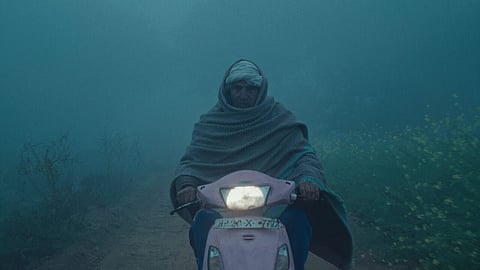
Still Anish Sarai
Hooda creates a brooding inner landscape, crisscrossed with doubt, fear and insecurity. Interspersed are little delicate sketches tracing a tale’s beats. The professor’s dilemma occupies the film’s fraught centre. Glum and quiet, he wrestles with a tough decision. His wife urges him to sell the cow, so do others. People insist that he move with the times, allow more rational circumstances, follow the lead of his own ex-colleagues. How long can he swim in denial, a sense of the past that’s no more viable? With time, a desperate rush for self-preservation takes primacy. Hooda doesn’t go for a wide canvas corralling many individuals—rather, he envelops us in a life’s singular intensity. What the professor endures and is felled by nevertheless mirrors countless untold, un-mourned, sidelined stories and woes. An intimate, at times sensory, chronicle of basic sustenance being shorn, there’s regret and guilt here, gradually leaking under the skin. The narrative scaffolding is spare. As the calf doll is ushered in the household, it unleashes its own cycle, instead of drawing in peace.
Advertisement
Cinematographer Anish Sarai’s striking compositions hold The Calf Doll together, lending atmosphere and mystery to even the most daily, mundane image. The film opens in a dense cover of smog that slowly parts to reveal a tree’s mighty arms. Blueness drenches the visual palette. Scenes are awash in spectacular beauty, like the professor walking through a field, where popping orange and yellow hues encrust a blanket of green. Best of all are a couple of fractured monochrome interpellated sequences, jutting out as a series of hauntings. The effects are ghostly, disorienting—a subliminal rush through disturbed visions and heightened anxieties. Arriving as spectral splits of imagination, dream and projection, these sequences remind us of the orchestrations happening behind the observed. We’re receiving these images and moments via a certain layer. This mediation renders import and authenticity, instead of snapping a thread of credibility.

Advertisement
Reality has been transposed only slightly to a fictionalised, staged sphere. Scenes aren’t hyper-constructed, but a steady reflection of the villagers’ vicissitudes. Bigyna Dahal’s intricate sound design embeds us in the environment, crafting frameworks within which the professor anguishes over decisions. Factories edging the village, trains scurrying most people away to cities for better lives—they infuse the soundscape with urgency, underlining choices one has ducked. It’s this constant vast murmur appealing to the professor to hurry towards a decision. It’s tinged with a preceding sense of failure, especially since he had taken the less travelled route.
Hooda gently guides the path to a heartbreaking, seemingly inescapable culmination. It’s the cruel cost of modernity and ‘progress’, stripping those with natural resources to nothing, siphoning it all into skewed structures. Milk now comes from cities to villages, instead of the natural way. This is aggravated by a complete reliance on processed milk. The world is collapsing, the professor’s ways of life fast vanishing, being swallowed by profiteering mechanisms. He’s just another of the endless casualties. Hooda illustrates this through a parable’s prism. Reality can be more arresting and tangible at times, if seen through a slant. The Calf Doll drives this with becalmed, playful introspection. The doll, stitched from the dead calf, increasingly manifests the things the professor evades—his silent, ruggedly private mourning that shadows the lead up. This quietly compelling film bears wisdom and contained ache, which linger long after images fade.
Advertisement
Published At:
Tags