Lust Stories 3 brings together four directors and a strong ensemble cast.
The anthology explores desire, marriage and intimacy from different perspectives.
Konkona Sen Sharma, Radhika Apte and Aditi Rao Hydari lead memorable stories.
Lust Stories 3 Review | Four Directors, Four Takes On Desire, Marriage And Modern Intimacy
Directed by Vikramaditya Motwane, Kiran Rao, Shakun Batra and Vishal Bhardwaj, Lust Stories 3 explores desire, marriage and intimacy through four very different stories.

Summary
Lust Stories 3 approaches sex differently than its predecessors. The first two films often treated desire as something that had to be spoken about openly, sometimes provocatively. This time, the conversation feels less interested in making sex the headline and more interested in what intimacy reveals about people. Across four stories directed by Vikramaditya Motwane, Kiran Rao, Shakun Batra and Vishal Bhardwaj, desire becomes a way of talking about marriage, loneliness, control, fantasy and the things people struggle to say to each other.
The anthology brings together Konkona Sen Sharma, Radhika Apte, Vijay Varma, Abhishek Banerjee, Radhika Madan, Ali Fazal, Gurfateh Pirzada, Sana Thampi, Aditi Rao Hydari and Siddharth. What holds the film together isn't the similarity between these stories, but the very different ways these actors inhabit people trying to figure out what they want. At 164 minutes, Lust Stories 3 is not always equally sharp, but its strongest stretches understand that sexual desire is rarely just about sex.
Vikramaditya Motwane opens the anthology with Konkona Sen Sharma and Radhika Apte as two friends whose marriages have left their sex lives in a frustratingly familiar place. Both women watch a Korean drama in which the characters face similar problems, which becomes the starting point for an idea that is funny precisely because of how desperate it is. The possibility of swapping partners is treated with enough humour to keep the story from becoming a sermon about unhappy marriages.
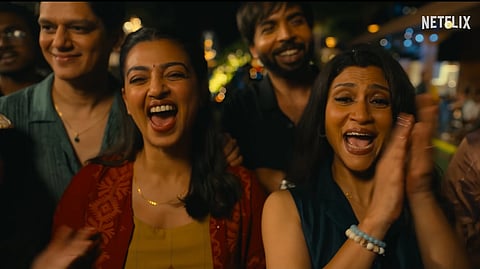
A Still From Lust Stories 3 YouTube
There is something particularly enjoyable about the way Motwane observes these women. Shonali and Padma are friends and colleagues, yet a subtle undercurrent of comparison runs between them. It never becomes the main point, which makes it more believable. Their friendship also lets the story explore female desire without turning it into a performance for the men around them. The women talk, speculate, encourage each other and then have to confront what they actually feel. Radhika Apte and Konkona Sen Sharma make that dynamic work beautifully. Vijay Varma brings an interesting hesitation to Hemu, who loves his wife and does not simply become the cheating husband the story could have easily written him as. Abhishek Banerjee, meanwhile, plays Debu as a slightly ridiculous man-child whose presence adds to the comedy.
Advertisement

Shakun Batra takes a more emotionally complicated route with Radhika Madan and Ali Fazal. Their story begins with a marriage that is already coming apart, yet the physical connection between Sailee and Varun refuses to disappear with it. In fact, intimacy becomes the one thing they still understand about each other. They are heading towards separation but keep finding their way back to the bedroom, partly because sex allows them to communicate without having to confront the mess their marriage has become.
What makes the story more interesting is the difference between what Sailee and Varun want from that intimacy. For Sailee, sex becomes a rare space where she feels in control of herself, away from the arguments, expectations and emotional chaos surrounding the marriage. Varun, meanwhile, is stuck trying to keep everyone happy, especially his mother, while protecting the image of the family he has built. He loves Sailee but cannot seem to separate that love from his need to keep the marriage looking intact. Batra uses this conflict to look at a familiar Indian idea of marriage as duty, where staying together can become more important than asking whether two people are actually happy.
Advertisement

A Still From Lust Stories 3 YouTube
The presence of Varun's mother adds another layer to the story. Sailee is not simply dealing with a husband who cannot make up his mind; she is also dealing with the expectation that a woman must adjust, compromise and find her place within her husband's family. There is a real sense of suffocation in the way her marriage has been organised around everyone else's comfort. Radhika Madan brings that frustration out without turning Sailee into a victim, while Ali Fazal gives Varun an awkward vulnerability that makes his indecision more believable. Their chemistry is crucial because the story depends on the strange reality that two people can still want each other physically even when they no longer know how to live together.
Kiran Rao's story moves into a very different register. Set in Mumbai and centred on (Gurfateh Pirzada's) Karan and (Sana Thampi's) Lisa, it initially plays like a fast, Gen-Z romance. Their attraction develops through messages, flowers and quick exchanges, with the camera and lighting matching the rush of a new relationship. There is something deliberately impulsive about the way they fall for each other, as if neither has the time or patience to ask what the relationship actually is. The soundtrack adds to that youthful energy, giving the early part of their romance a breezy, almost weightless quality.
Advertisement
Rao then starts pulling at that fantasy. What looks like a straightforward situationship becomes harder to define once money, drugs and personal motives enter the picture. The story keeps asking how much of a relationship is genuine when both people are trying to get something out of it. Even attraction begins to feel like a negotiation, with trust becoming increasingly difficult to separate from self-interest. The introduction of Karan's twin also gives the story a playful complication, allowing Rao to turn mistaken identity into another way of looking at how easily people can project their desires onto someone.

A Still From Lust Stories 3 YouTube
Gurfateh Pirzada and Sana Thampi carry this shift well. Their chemistry is immediate enough to make the romance believable, but there is also a looseness to their performances that suits characters living very much in the present. Lisa, in particular, is more perceptive than she initially appears, and Sana brings a mischievous edge to her choices without overplaying them. Gurfateh gives Karan the charm needed to make his increasingly questionable decisions watchable. The Mumbai setting is also important here. Rao uses cramped homes, quick movement and the city's constant sense of transaction to give the story its rhythm. By the time romance, survival and money begin occupying the same space, the film has moved far beyond the simple love story it first appears to be.
Advertisement
Vishal Bhardwaj's segment is perhaps the most distinctive. Set in 1987, it follows Aditi Rao Hydari as Saira, a Hindi literature teacher in Hyderabad, and Siddharth as her doctor husband, Badru. Their marriage appears settled from the outside but there is a clear disconnect between the two when it comes to intimacy. Saira sees romance through literature and poetry, while Badru approaches his relationship with the same practicality and routine that seems to define the rest of his life. The contrast gives the story its humour, but there is also something sad about watching a woman who knows exactly what she wants struggle to find a way of saying it.
This is where Lust Stories part three makes its most interesting argument about the female gaze. Saira is not simply looking for physical pleasure. She wants to be noticed, desired and understood as a woman with her own imagination. Her students, the books they introduce her to and the world of romantic fiction gradually open up a vocabulary for feelings she has never been encouraged to articulate. Bhardwaj uses that literary world to show the difference between imagining intimacy and actually experiencing it. For Saira, imagination becomes less an escape from her marriage and more a way of recognising a part of herself that has been neglected.

A Still From Lust Stories 3 YouTube
The period setting makes this especially effective. In a world where conversations around female sexuality are far less open, Saira's curiosity feels both daring and completely natural. The fact that she is a teacher in a women's college also allows Bhardwaj to create a space where women can speak more freely about romance, desire and the expectations placed on them. There is a playful quality to these exchanges, but underneath the humour is a simple frustration: women have always had desires, even when society has given them very little room to express them.
Aditi Rao Hydari is excellent because she brings intelligence and restraint to Saira rather than playing her as someone suddenly discovering sexuality. There is a sense that these feelings have existed for a long time and she is only now finding the language to acknowledge them. Siddharth's Badru works as her opposite, with his clinical attitude towards intimacy becoming increasingly frustrating precisely because he does not seem to understand what Saira is asking for. Rekha Bhardwaj's “Aye Miya Khatpat, Gaye Miya Jhatpat” adds another layer of wit to the segment, turning the gap between what women want and what men assume they want into a wonderfully playful musical observation.

A Still From Lust Stories 3 YouTube

The four directors do not always land their ideas with the same force. Some sections feel more complete than others, and the anthology occasionally mistakes a clever premise for emotional depth. Yet the performances consistently keep the film watchable. Lust Stories 3 works best when it stops treating lust as a scandal and starts looking at what desire says about the lives people have built around it. Its most interesting characters are not asking simply for sex.
Published At:
Tags