Katharina Rivilis' gently perceptive debut, I'll Be Gone in June, had its world premiere at Cannes 2026.
The film is selected in Un Certain Regard.
Led by a revelatory Naomi Cosma, the film taps a sense of youth finding its feet in a splintering world.
I’ll Be Gone In June Review | Katharina Rivilis’ Staggering Debut Captures The Frayed Heartbeat Of An Entire Generation
Cannes 2026 | This standout Un Certain Regard title poses sharp reflections on the young, stranded between idealism, political binaries and adults who’ve long cast away humanity

Summary
Katharina Rivilis’ resplendently perceptive debut, I’ll Be Gone in June, finds an isolation so quietly overwhelming, all-encompassing you’ll shake a little. Its wistfulness surges all over, lit by the hesitant footing of youth amidst great change, disarray and political instability. Premiering in Un Certain Regard at the ongoing Cannes Film Festival, the film sees through a particular emotional temperature, how a calcified place receives strangers and outsiders, how the lines slowly dissolve. There’s despair, a swinging between being on quicksand and looking for some rescue, but also tinges of delight and escape. Meanwhile, the political and personal are tightly knit, informing every other observation and interaction that the 16-year-old Franny (Naomi Cosma), an exchange student from Germany, has in New Mexico.

Still Luxbox
Deeply tender and sensitive, I’ll Be Gone in June assembles its sobering power through evanescent encounters. There’s an aching fragility to these episodes as Franny drifts through the city, hoping for anchorage. Rivilis locates a plangent listlessness, an ennui sitting within an in-between-ness of inner reckoning. In the city of Las Cruces, she cannot quite find steady moorings. She’s dislodged, cast afloat. She may have arrived from Germany bearing all sorts of expectations. Those are quickly ripped asunder even as Franny’s relationship with an alien place shifts in contours. She envisages Las Cruces as a stop-gap, on the way between her eventual return to Germany and the ultimate New York ambition.
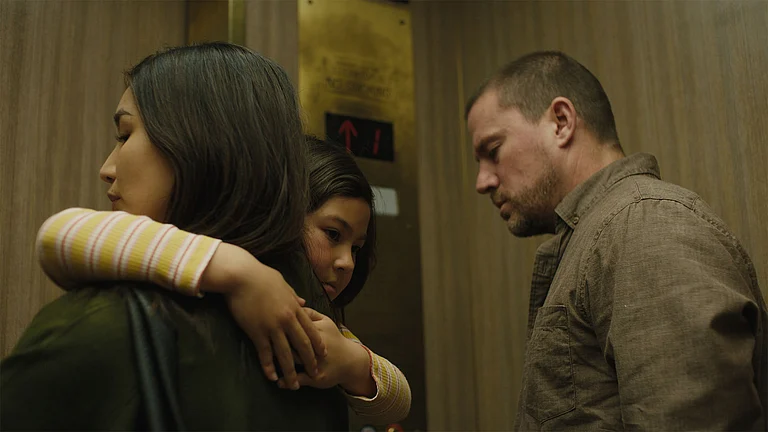
Set in 2001, it’s a very particular time Rivilis is zeroing in on, yet which perfectly bounces off all our contemporary anxieties. In a sense, she achieves a timeless register, wafting through a liminal phase of youth which also coincides with a growing understanding of the wider political reality. Rivilis enormously respects her teenage characters, never diminishing the youthful flush of emotion. Wisely, she situates them within a distinctly, politically accented sense of both immediate surroundings, the world beyond. In a refreshing sea change for a film with a younger lot, characters actually do have something to say and interject about the collapsing geopolitics. A brilliantly challenging classroom scene poses the urgent thought that we should all maybe just wait before darting to slapdash aggressions. The teenagers demonstrate more capacity for introspection and resistant attitude than militaristic adults, one that acknowledges the need to pause before hitting out.
Advertisement
The specific setting of I’ll Be Gone in June, with its proximity to the border, heightens the ever-vivid tension around outsiders, who’s allowed in and who left out. Franny wrestles with being left on the lurch. The new host family implicitly keeps her on the periphery. A precise moment underlines it. When the family’s grandfather dies, they come together in shared emotion while Franny remains at a corner. The chasm intensifies with the attack on the twin towers. Border insecurities tighten, rippling into families in Las Cruces who band together more firmly than ever. Conversations around the war on terror pulse everywhere, throbbing with panic, paranoia and doom. By dint of being a foreigner, Franny finds herself edged out. She’s also arriving on the heels of the fall of the Berlin Wall.

Still Luxbox
Rivilis threads in these anxieties, both past and the hovering, into an uneasy, individual negotiation. DP Giulia Schelhas hones the desert landscapes, the pink sunset tones, the conflicted, fumbling visages into a radiant symphony. Alienated and lost, Franny discovers a kindred connection in Elliott (David Flores packing an irresistible, low-glow charisma), a disaffected, emotionally plummeting musician. He too feels a bit severed from those around him, a stray flicker in the dark. Sparks fly. But she may be bringing more assumptions to the table than he prefers. Gradually, she begins to infuse more intensity in the relationship, an anticipation of a reciprocation to which he can only step up in half-measures. This lack of commitment, which she desperately seeks, a sense of being thwarted, naturally incites heartbreak.
Advertisement

However, Rivilis handles these usual rites of passage with characteristic elegance. The melancholy, both existential and romantic, softly seeps under the skin. Cosma’s beautifully guileless, transparent presence moves us through the painful, lyrical motions of the film. Rivilis does gesture toward spaces where Franny stumbles on friendship and connection, but they have the constant undertow of impermanence. Despite popping up fleetingly, Logan Sage is also striking. There’s such repressed hope, anticipation in his eyes. When there’s a snub, it’s crushing. Rivilis reveals the most unerring eye for the smallest of hesitation, gauging the dip in someone’s face, the desiring direction in which a gaze travels.
Nevertheless, Rivilis doesn’t let her characters welter through misery and abasement, no matter their resignation, hopelessness. There’s always a turning somewhere if we hold on. I’ll Be Gone in June may be steered for a predictable denouement, a familiar tide of ache and loss. But this is an incredibly self-assured vision. It knows its exact anguish, disorientation and effortlessly sweeps us along. This is a breezily stunning debut signalling a gigantic wave of possibilities in its fresh, confident voice.
Advertisement

Published At: