Written and directed by Kishor Pandurang Belekar, Gandhi Talks (2026) is an Indian silent film.
It features an ensemble cast including Vijay Sethupathi, Arvind Swamy, Aditi Rao Hydari and Siddharth Jadhav, with a soundtrack composed by A. R. Rahman.
Set in Mumbai, the narrative follows the intersecting journeys of two men whose lives cross in a way that raises questions about morality, survival and the cost of choices in a bustling city.
Gandhi Talks Review | Belekar’s Poetry In Motion Explores The Quietude Of Mumbai, Morality And Money
When the common man and separatist powers constantly distort the idea of being Indian, does the Gandhian note still retain a spine of its own?

Summary
To capture the literal city of dreams—a place brimming with constant roar and motion — through a silent film might sound ironic, but it feels perfectly justifiable. At its core the city is a flurry of unending construction, throngs of people and the clang of trains, yet beneath that constant churn lies a deeper quietude shaped by the solitude of individuals struggling in a system that seems to work against its own design. Kishor Pandurang Belekar’s Gandhi Talks (2026) aims to reflect on how across eras, a single force has sparked suffering and hardship—money. It feels astonishing at first — hard to trust one’s own eyes (or ears) that a silent film can command the big screen with such pleasure and forward-moving energy.
In Gandhi Talks, everyone else remains mute, yet money exerts absolute influence. Though lifeless, it speaks in a language everyone knows and clings to, shaping a world that cannot operate without it. One could ask, how does a film manage to stretch a narrative about destiny, ethics and accountability inside a flawed world with no dialogues? Delightfully, the film returns to handwritten notes, text messages and even flowcharts to logically depict where the story is pivoting. Some may call it lazy exposition but in the logic of the film’s world—it almost certainly comes across as charming and even creative.
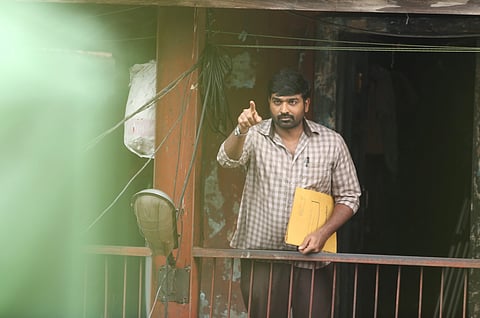
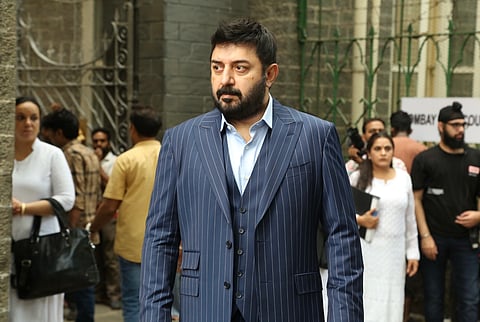
The central story is built around two central characters Mahadev and Boseman. Mahadev (Vijay Sethupathi), a B.A. graduate and a resident of a crowded Mumbai chawl trying to build a secure future for himself and his sick mother amid relentless chaos. Developer Boseman (Arvind Swamy) on the other hand, confronts deep personal loss that drives him toward emotional (and financial) collapse. Both men are shaped by systemic decay and forces beyond their control. When their lives intersect they soon recognize that suffering does not discriminate between wealth and struggle.
A still from ‘Gandhi Talks’ (2026) X
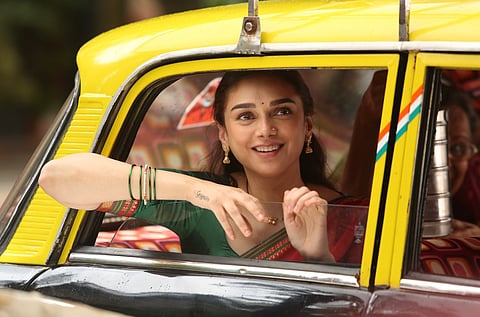
There is an unspoken recognition that choosing a fair and upright life becomes futile inside a structure that offers no way to survive honestly. Mahadev finds himself boxed in by predatory middlemen who dictate access to work, daily groceries he cannot afford and the swelling hospital expenses of his sick mother. In this landscape, the absence of financial worth strips a person of voice and even keeps lovers silent even when they live opposite each other. Aditi Rao Hydari plays his neighbor who is soon to be married to somebody but has a genuine connection with Mahadev. Their differences and Mahadev’s quicksand-like financial condition keeps them from being together.
Advertisement
One would imagine the world of such a film as entirely gloomy although it also produces rare flashes of human connection, humour and hope. Siddharth Jadhav plays a quirky pickpocket in this film and crosses paths with Mahadev several times. Unaware of Boseman’s financial condition, Mahadev plots to rob him and as fate has it, trouble arrives in a buy-one-get-one deal, with Jadhav’s thief-character tailing him straight into the mess. The film consistently explores the interplay of morality, impulse and the lure of easy money. Mahadev confronts extremely complex choices that reveal his character—whether to steal or resist—leaving the audience to witness his decisions unfold.
A still from ‘Gandhi Talks’ (2026) X
Choosing to step outside familiar theatrical patterns deserves praise, especially when it asks performers to discover unfamiliar rhythms in their craft. Belekar pulls off a striking achievement in holding the first half with near-constant momentum, while the latter stretch eases into a gentler pace that still sustains interest.
Advertisement
The visual grammar and cutting are designed to keep curiosity alive through imaginative bridges. Smoke curling up from sizzling food dissolves into clouds, the clouds escorts us elsewhere and minor gestures ripple into wider meaning. Movement between scenes carries a buoyant flow, aided by A R Rahman’s integrated score, which negotiates silence and melody with care. Songs such as “Zara Zara” and “Inquilabi Ziddi” slip in without strain, giving emotion a voice where dialogue recedes.
A still from ‘Gandhi Talks’ (2026) X
Formally, the film operates on shifting frequencies. It drifts like a reverie, plots with the tension of a crime story, flirts with romantic comedy and sharpens itself with comic observation. These modes coexist without collapsing into clutter, creating a cinematic space that feels alert, playful and confident in its own unusual pulse.
The film shines in its exploration of Indian identity, using one of the country’s most recognizable figures as a lens. Once seen internationally as the emblem of non-violence within India’s independence movement, he is now associated with modern ideas of purchasing power and dignity of life.
Advertisement

A still from ‘Gandhi Talks’ (2026) IMDb
A striking moment features Sethupathi standing before a board displaying images of Bhagat Singh, Babasaheb Ambedkar, Gandhi amongst other freedom fighters, creating a subtle dialogue between history and the present. At its core, it really asks- When the common man and separatist powers constantly distort the idea of being Indian, does the Gandhian note still retain a spine of its own? The film succeeds in connecting political themes with simple human truths, showing how honesty and compassion persist across time. It encourages viewers to reflect on those who fought for rights and to consider what being Indian means in today’s world.
Published At: