Santosh Davakhar says he saved for six months to fund Gondhal's Oscar campaign.
The filmmaker explains how Ilaiyaraaja's minimalistic musical approach suited the 1960s setting.
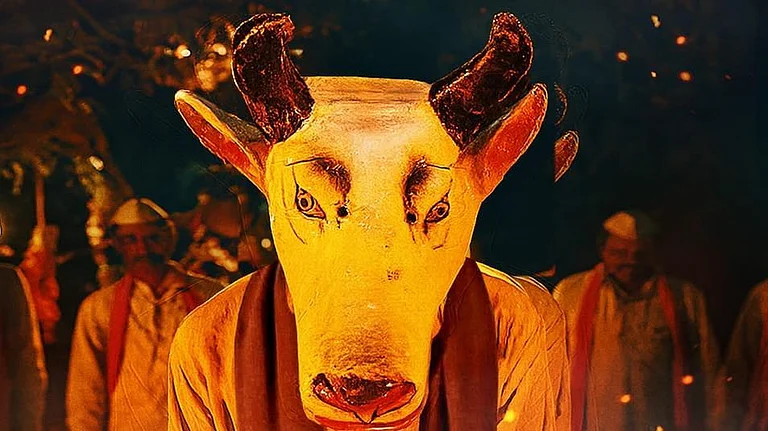
Gondhal draws on century-old Maharashtrian rituals and explores universal human conflicts.
Gondhal Director Says His Film And Ramayana Present India's Cinematic Diversity At Oscars 2027
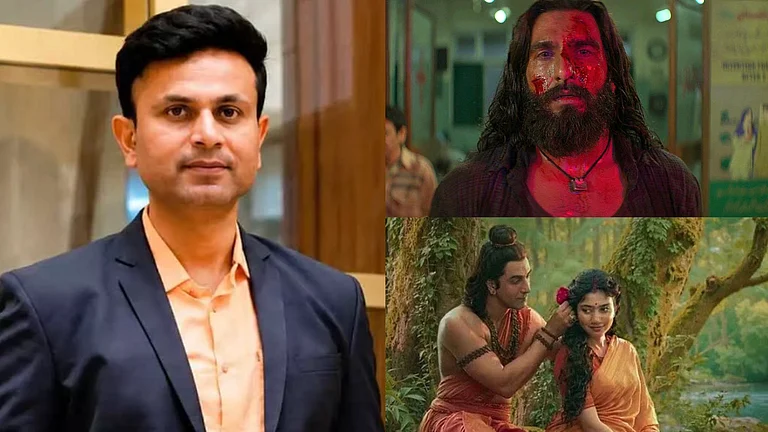
In an exclusive conversation with Outlook India, Gondhal's director Santosh Davakhar opens up on not going through the usual Oscar campaigning route for his film and competing with Nitesh Tiwari's Ramayana

Summary
Santosh Davakhar's Gondhal has taken an unusual route to the Academy Awards by not going through various film festivals to showcase the film, something that other filmmakers usually do. Selected as India's official submission for the 2027 Oscars in the Best International Feature Film category, the Marathi film brings a century-old folk ritual to an international audience. While Gondhal remains to be India's only official entry at the 99th Oscars, filmmaker Nitesh Tiwari has also submitted recently released Ramayana Part 1 independently in the general category. Davakhar looks at this as a win for India as two different styles of storytelling get to be showcased to the interenational audience.
Made on a reported budget of ₹4.5 crore, Gondhal draws from Davakhar's childhood memories of accompanying his grandfather to all-night Gondhal performances in Nashik. But the filmmaker insists that the story is not simply about the ritual. At its centre are human conflicts, personal desires and characters whose choices are rarely easy to judge.
In an exclusive interview with Outlook India, Davakhar spoke about preparing for the Oscar campaign, financing it independently and working with legendary composer Ilaiyaraaja. He also discussed the making of the character Suman, played by Ishita Deshmukh, the film's portrayal of village hierarchies and why he deliberately left one of its most difficult storylines without closure.
Edited excerpts from the conversation:
Most films entering the Best International Feature Film race rely on major festival premieres, such as Cannes or Venice, to build momentum. Gondhal has taken a different route. How are you introducing a deeply rooted Maharashtrian folk ritual to Academy voters who may be encountering this culture for the first time?
Academy voters and American audiences are very keen to know about Indian culture. At the same time, we have created a story that can connect with audiences across the world through its human conflicts. The obsession and desire in the film are universal. I was worried about how people would respond, but when we held our first screening, the reaction was tremendous. The film connected with the audience.
Advertisement
You made Gondhal on a reported budget of around ₹4.5 crore, making it one of the smallest-budget films among the 33 Indian contenders. How are you financing the Oscar campaign as an independent filmmaker?
I had been preparing myself for this for the last year. For the past six months, I had been saving money to fund the campaign. I knew what we were getting into because I understood the difference between international filmmaking and filmmaking for Indian audiences. I have followed the last ten years of Oscar selections and researched how the process works. The approach required to compete internationally can be very different from making a film to please an audience in India. I did my homework and prepared myself for it.
Your connection to Gondhal goes back to watching all-night rituals with your grandfather in Nashik. What was the biggest challenge in translating those memories into a two-hour film? And what made Ilaiyaraaja the right composer for it?
Advertisement
The biggest challenge was blending the ritual with the story. Gondhal is a century-old ritual that begins in the evening and continues until morning. I wanted to document it, but the challenge was to summarise the entire experience in a two-hour film. It is also a sensitive subject. When you make a film around a ritual or a centuries-old culture, people can be offended if they feel something has been misrepresented. What we have shown is based on my own experience, and I am happy that audiences have responded positively.
I felt Ilaiyaraaja was the right person because he understands the importance of minimalistic sound. He comes from a small village and began his musical journey around small performing groups that used only three or four instruments. He has been in the industry for 50 years and has witnessed how music has changed. Since Gondhal is set in the 1960s, I was confident that he would understand the film's world and do justice to it.
Advertisement
What can Gondhal, both as a film and as a ritual, tell international audiences about India and Maharashtra?
The story is not about Gondhal. It is about human conflict. Every character has their own motive and is selfish in their own way. I wanted to approach them realistically, without making it clear who the hero or the villain is. I also wanted to portray people as they were in the 1960s.
Take Suman, for instance. You may feel that she is clever, manipulative and selfish. But she is also a 17-year-old girl who does not understand the consequences of her choices. She is not openly challenging patriarchy. She is experiencing it, and she is simply making choices because she wants to be with the person she loves. At that time, women did not have many rights, especially when it came to love and marriage.
Anand is kind-hearted but surrounded by greedy people. Vibhaba, meanwhile, carries a lot of pain and anger. He feels that an injustice has been done to him, particularly after the death of his son. He represents someone who feels helpless in front of powerful people. I wanted all these characters to have their own battles.
Advertisement
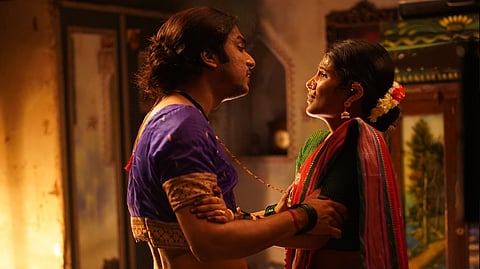
A Still From Gondhal Special Arrangement
You have described India's Oscar selection as comparable to representing the country at the Olympics. How are you processing the responsibility, particularly for Marathi cinema?
Representing Marathi cinema on a global platform is a great feeling. The entire team is happy, and we are grateful to the FFI jury and the Indian government. Yes, I experienced anxiety for a few nights. When you are representing India, you feel responsible for getting everything right. The submissions have to be professional and sent on time. If I make a mistake, it could also create an impression about my country. That is why I was anxious initially. But I am completely confident now, and we are preparing for the screenings and the campaign.
With Nitesh Tiwari's big-budget Ramayana: Part 1 also looking at the Oscars in the general categories, Gondhal represents a very different kind of Indian cinema. How do you see the two films being part of the international conversation?
Ramayana has grand visuals, and it makes us proud. It is a film that can compete in categories such as visual effects and other general categories. But the Best International Feature Film category is different. It is meant for films selected by their respective countries. Other Indian films can also enter the general categories.
If good Indian cinema is being presented and celebrated internationally, I will be happier than anyone. When I was at Cannes, (for a different film) I realised that the global perception of Indian cinema was very limited. I think we are doing the right thing by presenting two very different films on an international platform. They represent different aspects of India, its culture and its mythology.
Can a film like Gondhal, with its cultural history and specific setting, be remade for an international audience? Are its themes universal?
I have already dubbed the film into different languages, including English. People are interested in knowing about these rituals and the drama around them. Similar night-long rituals are performed in other parts of India, including North India and Tamil Nadu. These traditions emerged at a time when people did not have television, radio, YouTube or other forms of entertainment. They also carry myths and beliefs, and reflect how people lived and understood the world around them.
I wanted to document this ritual and preserve it for the next 50, 100 or even 150 years. Future generations should be able to watch it and keep the tradition alive. I believe we have given our hundred per cent to telling this story.
Suman, played by Ishita Deshmukh, is a fascinating character. She can appear manipulative and even evoke shades of Lady Macbeth. Did you imagine these qualities while writing her, and how much did Ishita bring to the performance?
The character and the sequences were completely pre-written. But Ishita brought a good understanding of the role. When I saw her first audition, I realised she had caught the character. There was a problem with her diction, so I asked her to return for a second audition a week later. She performed again, and I was convinced.
Her eyes and facial expressions had the quality I was looking for. We went through more than 55 auditions with my casting director, Romy, before finding her. I wanted Suman to appear wily and manipulative, so that the audience would initially see her that way. But by the end, you understand that she is only trying to be with her lover. I think Ishita portrayed that character very well.
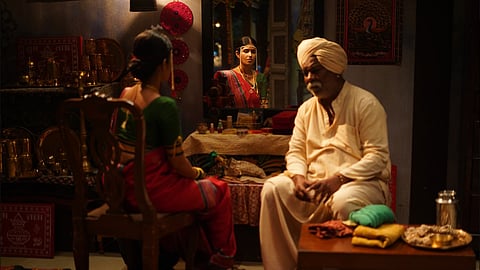
A Still Of Suman Played By Ishita Deshmukh Special Arrangement
Kishore Kadam's Vibhaba also seems central to the film's emotional and moral landscape. What went into building his character?
These are memories from my childhood. I used to attend the rituals with my grandfather, but when you bring those memories into a film, you need subplots that can drive the story. Vibhaba has lost his son and is fighting his own battle. He has his own way of looking at people and situations.
There are people like him in every village. There are helpless people, children like Vishnu who are abused, powerful people and those who work around them. These characters exist in villages everywhere. Vibhaba was important because he is part of the ritual and also represents the power held by influential people. His character helps bring those different layers of village life into the story.
Maharashtra has traditions such as Gondhali and the Varkari Sampradaya. Does Gondhal consciously challenge dominant caste narratives within the village?
No, caste is never mentioned or portrayed in the film. It is a hierarchy system. The question is about who will become the next chief. What I have shown comes from what I experienced in my childhood when I visited my native place with my grandfather. I have portrayed what I saw there.
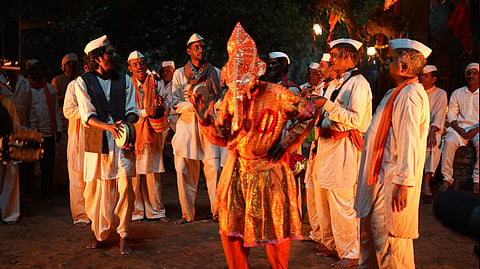
A Still of Gondhal Special Arrangement
The scene involving Vishnu's abuse is particularly difficult to watch. How did you approach filming it with the child actor, Dhruv Thoke? And why did you choose not to give that storyline a clear resolution?
We sat with the child actor and his mother and father and explained that this was a scene we needed to portray. The incident is not shown directly in our film. I wanted to handle it in a subtle way. This is an issue that happens in every corner of the world, not just in India. Children who are seven or eight years old may not even understand what is happening to them. I felt it was important to highlight this reality.
I deliberately did not give the storyline a closure. If I had provided an answer, people might have stopped thinking about it. I want the audience to discuss what happened and have their own conflicts and conversations about it. There are things that I have intentionally left open.
Is there anything you would like to tell audiences before the film's Oscar campaign progresses?
I am an honest filmmaker, and I want to continue making films. I really need people's support. Please watch Gondhal in theatres. It is not a film made for OTT. When you watch it in a theatre, you will feel that you are part of that world. The opening 25-minute shot is breathtaking, and I want audiences to experience it on the big screen. Supporting the film in theatres will also help our Oscar campaign.
Published At: