A nation's progress is written not only in economic indicators but also in the infrastructure connecting people, regions and opportunity. In little more than two decades, Rail Vikas Nigam Limited (RVNL) has evolved from a railway development agency into a diversified enterprise spanning railways, metros, bridges, tunnels, digital infrastructure, power, renewable energy and rolling stock.
RVNL: Building Connections, Creating Possibilities
From a railway project implementation agency to a diversified infrastructure enterprise.
Emerging From A National Vision
RVNL was born from a national imperative when Prime Minister Atal Bihari Vajpayee announced the National Rail Vikas Yojana on 15 August 2002. Incorporated on 24 January 2003 under the Ministry of Railways, it began operations in March 2005, later achieving Mini Ratna status (2013), a BSE/NSE listing (2019), and Navratna status (2023).
From Rail Infra To All Infra
The defining feature of RVNL's evolution is its shift from a railway agency to a broader platform - "from Rail Infra to All Infra" - built on strengths in engineering, project management, tunnelling and electrification. Its portfolio now spans railways, metros, roads, bridges, ports, power, telecommunications, renewable energy and rolling-stock manufacturing, with an FY2025-26 order book of approximately ₹99,262 crore.

Engineering Landmarks
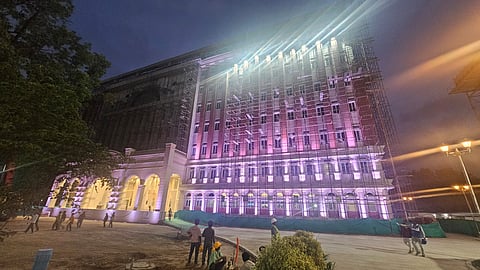
RVNL's story is best told through what it has built. The New Pamban Bridge in Tamil Nadu combines railway connectivity with a navigational opening for marine traffic, while the Rishikesh-Karnaprayag Rail Link runs about 125 km through challenging Himalayan terrain, testing tunnelling and execution capability. Its metro portfolio includes Indore's Yellow Line and Kolkata's Majerhat Metro Station, built over an existing railway yard, plus the Vallarpadam-Idappally rail link in Kerala – and, internationally, the Ekta Harbour project in the Maldives.
Digital And Sustainable Infrastructure
RVNL's role in BharatNet's Middle-Mile Network extends high-speed digital infrastructure into rural India, while sustainability is increasingly built into execution through renewable energy, energy-efficient design and recycled materials.
Hydro-Irrigation: A New Frontier
RVNL is also entering water infrastructure, linking civil works and tunnelling expertise with hydropower and irrigation. It is executing major works, including part of the Head Race Tunnel on the Rammam-III Hydroelectric Project for NTPC in the Teesta Basin, and, in Rajasthan, building the Upper High-Level Canal of the Mahi Bajaj Sagar Project via an RVNL-SCC joint venture, designed to irrigate about 41,903 hectares.
A Global Infrastructure Player
RVNL's international footprint spans the Middle East, Central Asia and Africa. The Ekta Harbour project and the Kyrgyzindustry-RVNL joint venture (2022) mark its outward journey, carrying Indian engineering and project-management discipline into expanding markets.
Partnerships And Technology
Special Purpose Vehicles, Joint Ventures and Public-Private Partnerships have driven RVNL's growth, broadening from port-connectivity links into logistics, roads, overseas ventures and rolling-stock manufacturing, including the Vande Bharat sleeper programme. Technology - BIM, GIS, drone surveys and real-time monitoring - is a growing force multiplier, exemplified by India's first ROBO SMART cylindrical bearings on a major railway bridge.
Advertisement

Scale And FY2025-26 Performance
RVNL recorded consolidated revenue of ₹20,412.12 crore and consolidated profit after tax of ₹870.66 crore in FY2025-26, with an order book of approximately ₹99,262 crore spanning railways, signalling, metros, ports, roads, power and hydro-irrigation.
Building Communities Beyond Infrastructure
Infrastructure exists to improve lives, and RVNL's CSR initiatives in healthcare, education, sanitation, skill development and sports complement this wider purpose.
The Next Track
RVNL's journey from railway agency to Navratna infrastructure enterprise mirrors India's own aspirations. As India moves towards Viksit Bharat 2047, RVNL remains rooted in the engineering traditions of Indian Railways while growing more diversified, technology-enabled and outward-looking - building connections, creating possibilities, and helping shape the infrastructure of a more connected, capable and confident India.
Published At: