Change For A Twenty?
No one dares argue with the money. Will T20 end up changing the game forever...

- The IPL kicks off on April 18, with the Bangalore Royal Challengers taking on the Kolkata Knight Riders in Bangalore
- The eight teams will play each other twice on home and away basis, and the top four teams will play in the semifinals
- The final will be played at the Wankhede stadium, Mumbai, on June 1
- There will be 59 matches in 45 days
Moolah Count
- Total prize money: Rs 12 crore
- Winners: Rs 4.8 crore
- Runners-up: Rs 2.4 crore
- Semifinalists: Rs 1.2 crore
- 5th place: Rs 80 lakh
- 6th place: Rs 70 lakh
- 7th place: Rs 50 lakh
- 8th place: Rs 40 lakh
- Player of the Tournament:Rs 10 lakh
The Five Most Expensive Players
- Mahendra Singh Dhoni, ChennaiRs 6 crore
- Andrew Symonds,HyderabadRs 5.4 crore
- Sanath Jayasuriya, MumbaiRs 3.9 crore
- Ishant Sharma, KolkataRs 3.8 crore
- Irfan Pathan, MohaliRs 3.7 crore
Five Icon Players
They were not auctioned. Their fees were fixed at 15 per centhigher than the most expensive player in the team...
- Sachin Tendulkar, MumbaiRs 4.49 crore
- Saurav Ganguly, KolkataRs 4.37 crore
- Yuvraj Singh, MohaliRs 4.26 crore
- Rahul Dravid, BangaloreRs 4.14 crore
- Virender Sehwag, DelhiRs 3.34 crore
- Chennai|Super Kings--India Cements Ltd, Rs 364 crore
- Bangalore Royal Challengers--Vijay Mallya/UB Group, Rs 446 crore
- Mumbai Indians--Mukesh Ambani/Reliance Industries, Rs 448 crore
- Kolkata Knight Riders -- Shahrukh Khan/Red Chillies Entertainment, Rs 300 crore
- Kings XI Punjab -- Ness Wadia/Preity Zinta/Karan Paul/Mohit Burman, Rs 300 crore
- Hyderabad Deccan Chargers -- Deccan Chronicle Rs 428 crore
- Delhi Daredevils-- GMR Sports, Rs 336 crore
- Jaipur Royals -- Emerging Media, Rs 268 crore
***
"I'm glad I played most of my cricket before T20 came along. I'm not sure what relevance Tests will have in the future."
—A current senior Indian player who's a Test cricket loyalist

With the IPL, set up by the Indian cricket board, placing a mountain of gold before them, it's equally probable that the dazzled cricketers are having the same thoughts themselves. Bowled out for 76 in exactly 20 overs, India lost the Ahmedabad Test to South Africa in three days, thus providing the Indian players two extra days to promote their respective teams in the IPL. It provoked Sunil Gavaskar to write that the cricketers "could have done with an extra session at the nets rather than dancing at the launch of their franchise". Gavaskar, also a member of the IPL's governing council, added: "It's about time they realised they are what they are because of cricket."
But no one dares argue with money. IPL franchise owners have bought their eight city teams for incredible amounts and the players must pay with their time. The BCCI raked in nearly Rs 7,000 crore from the sale of TV rights (Rs 3,632 crore), promotion (Rs 432 crore) and franchises (Rs 2,800 crore). Six players were signed up for fees in excess of a million dollars each. Australian players, who used to complain plaintively against excessive cricket, are fighting their own board to play in the IPL. A survey by the Australian Cricketers' Association showed that almost half the players contracted with Cricket Australia and the six states would consider early retirement to play T20 cricket in India. The Englishmen too are clamouring for the rupee. In New Zealand, where cricket doesn't pay much, it's as if some famished tramps had walked into a feast of kings. Ex-Kiwi captain Stephen Fleming said, "I saw the amounts of money being thrown around and I thought: wow, I hope they keep trading! It was incredible to be involved in it."
The IPL auction of cricketers in February was called the 'Mumbai cattle market' by those horrified by the tamasha of industrialists and filmstars throwing dollars at players (Adam Gilchrist did say that he, for one, felt like a cow). But it was only a public manifestation of a practice that separates the best athletes and rewards them most. The premium has always been on the quickest feet, the sharpest eye, the strongest arm—it's only that the IPL process had to be exposed in such a distasteful sale.

No one blames the cricketers for accepting money from industrialists willing to throw it around. But the blend of money and sport, without the attendant sentiments of nobility and patriotism, does seem to lack something essential. There are now murmurs that some players are faking injuries to stay off Test cricket while ensuring participation in the IPL.
Grave are the fears that the shortest version of the game poses the biggest dangers. Former Pakistan captain Imran Khan feels T20 has the potential to kill Test cricket. "Fast bowling has been destroyed by one-day cricket...on top of it if we have T20 cricket, it will definitely impact the standards of Test cricket," he told Outlook. "If you play too much of it, Test cricket will become devalued and the quality of skills which cricket requires, and which are really tested only in Test cricket, will go down." Bowlers will take more pride in bowling dot balls than taking wickets, batsmen will unlearn the art of staying at the wicket, and bit players will gain primacy over geniuses. "A Gavaskar or Dravid will matter less than someone who can just hit the ball hard," Javed Miandad, another ex-Pakistan captain, says.
Imran feels the game's interests can't be measured in terms as crude as the profitability of a concept. "If you cater only to people's demand and not to the value that's put on quality cricket, then eventually people won't even watch 50-over matches, they'll just watch T20 matches," he says. Former Indian captain Bishen Singh Bedi warns that "the same fire which cooks your food can also burn down your house. Excess cricket is bad, and you can't call T20 cricket at all."

Conservatives at all times have resisted novelty. There was similar resistance to one-day cricket and Kerry Packer's World Series; so too was there resistance to T20 cricket (most strongly from India). A year before the Mumbai auction, BCCI president Sharad Pawar had said: "India does not support a T20 world tournament. We feel it dilutes the importance of international cricket."
Then Zee TV floated the Indian Cricket League (ICL); months later, India won the T20 World Cup in South Africa. On such sleights of fortune hang billions of rupees. The euphoria of an international triumph after the summer of 1983 altered the minds of those running cricket in India. Kapil Dev, India's original World Cup hero and now chairman of the ICL executive board, wonders what prompted the BCCI's somersault. "Why are they doing it?" Kapil asked in a chat with Outlook. "Are they doing it for money? If they're doing it for money, good luck to them. But for me as a cricketer, the growth of cricket is important. For any young, good cricketer, there should be a life to be made. It's not just for the top 10 people, or only for those who organise cricket. They are talking about millions of dollars, but what's the point if the cricketing fraternity is languishing?"
"It's born out of necessity," accepts M.A.K. Pataudi, former Indian captain and a member of the IPL's governing council. "India wasn't happy with it (T20) to begin with. But this (IPL) has been in the pipeline for almost 10 years. And once you accept something, you must try to make a success of it."

Former Australian captain Ian Chappell, who helped shape the Packer circus, says there's little in common between those heady days and now apart from the money. "In fact, it's the (rebel) ICL that has more in common with (the Packer) World Series because they both came about because you had a TV magnate who was very annoyed at the treatment he was getting from a cricket board over TV rights...and he decided to go off on his own path."
IPL, though, is an inside job—a cricket board pouring resources into an unproven format which, critics say, can only damage Test cricket. The IPL could still flounder on a crucial issue—club affiliations require heritage, history can't be built in a day. Cricket has traditionally been a sport played among nations. Mercenaries who visit for 45 days can't possibly inflame support that, say, an Arsenal player does in the English football league. Writer Mike Marqusee gets to the heart of the matter, "English football loyalties have been created over many generations, and reflect the history of the clubs and the areas they draw support from. The new IPL clubs are starting from scratch. They will try to market a local identity but even expensive advertising and glamorous merchandising cannot create this kind of long-term affinity."
One plus is that city-based clubs with stars from many countries can dilute nationalist chauvinism, which has happened to some extent with English football. Marqusee adds, "But again, remember that a French or African or Brazilian star who plays for an English football team spends most of each year in England, whereas the IPL stars will merely be passing through."
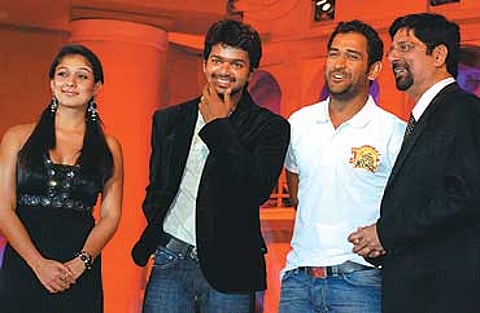
Historian Mukul Kesavan says, at least in principle, there's no reason why the IPL shouldn't work as well as the English football league. But he adds, "The only reason it may not work in India is that all these English football clubs have a history, vastly predating commercialisation. The trouble with the IPL is that you're starting a brand new set of teams which have no historical roots. The IPL's money is going into the most recent, shortest and historically the most trivial form of the game." The rewards for this new, unproven form of cricket, he says, are so huge that the ambitions of young players might become limited to the IPL.
The most expensive IPL star, M.S. Dhoni, says he won't be bothered about Bollywood distractions, insisting the cricket will be very competitive. "Since cricketers are getting the money, they have a responsibility towards their franchises," he told Outlook. "We'll also look to enjoy ourselves because it's a form of the game that you have to enjoy...it's entertainment for the spectators." But aren't business houses exploiting cricket to line their pockets? "The way I look at it, it's using sport in the right way to make money for themselves, for cricketers, loads of other people. It's using sport to generate money, job opportunities. It can't be called exploitation."
Diehard traditional cricket fans, who incidentally dominate the Outlook office, would want the IPL to fail, to save the game as they know it. Kesavan though provides a pragmatic insight, "I'd like the IPL to succeed simply because world cricket needs a domestic tier of cricket that makes money. It's unhealthy for any sport to depend only on international matches for its earnings. India is about the only country that can do it and should do it. Except that I'd rather that this principle be applied to first-class cricket. Because if we don't have first-class cricket, we don't have Test cricket. That would be a pity."
Tags