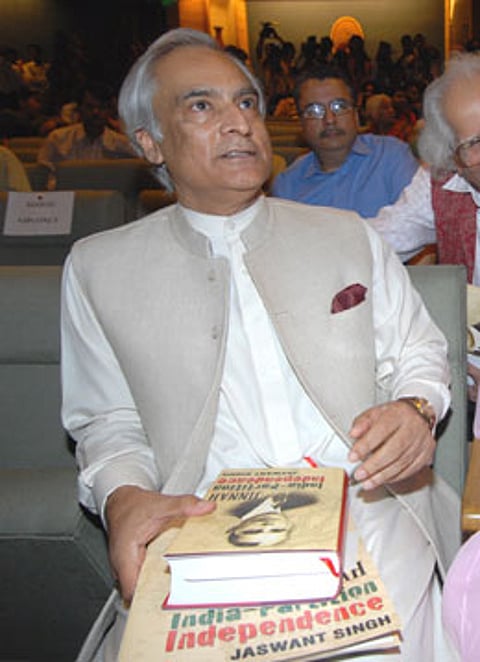
Ambassador Shahid Malik with the book |
Words That Melt Ice
Pakistan warms to Jaswant, waits to turn the pages of his work
A
s Jaswant Singh gets pilloried and praised in India for his book on Jinnah, and the debate over Partition history continues to gather intensity, the chattering classes of Pakistan have embraced the ‘amateur’ historian, summarily expelled from the BJP, as their new celebrity. They applaud Jaswant’s thesis, inquire about the availability of Jinnah: India-Partition-Independence, and speculate breathlessly: will the former foreign minister visit Karachi and Lahore? Such is the warmth for Jaswant that should he fly down to Pakistan, he’s bound to receive the reception that was accorded to the Indian cricket team on its tour of this country in 2004.The chattering classes apart, Jaswant has also touched a chord among those fortunate to have read his book. They ask: will it help break the icy Indo-Pak bilateral relations and bring the two countries closer? The consensus is the book will have little impact in the immediate future, but could influence Indo-Pak relations in the long term.
Hameed Haroon, chief executive officer of the Dawn Media Group, who’s among the few to have read the book, says it “has a populist touch to it while making a microanalysis that allows you to look at events in a more philosophical manner. We will first see an impact inside India and on the BJP”. He says the book has opened the door to Jinnah in India, where he’s now a valid subject for research. “Most important, this book now makes it imperative for both countries to look and study the roots of communalism,” Haroon told Outlook. He suggests a joint commission to study communalism in the 20th century and the impact it has had on our foreign policy. “The book has now given us a chance to wake up and shed our monolithic view about Partition. Over time, this book should have an impact on the textbooks of both countries as well,” he adds.
Advertisement
Jaswant’s book has already prompted some to underscore the importance of not looking at past heroes with rose-tinted glasses, suggesting a realistic appraisal of their mistakes. But human rights activist I.R. Rehman says, “What’s necessary today is an acceptance of history without reservations and to look for the possibilities of glory that India and Pakistan can achieve by cooperating with one another. This will do a good turn to the disadvantaged—those who have been denied the fruits of freedom for six long decades.”
Analyst and writer Ayesha Siddiqa feels the book’s impact in Pakistan in the short run will be mixed. For one, India will be seen as intolerant, because of the BJP’s summary dismissal of Jaswant for deviating from the received wisdom. Yet, simultaneously, “Pakistanis see India having a system where it’s possible to write in the mainstream about a historical decision and challenge the historical mindset,” she told Outlook.
Advertisement
But Siddiqa is certain Jaswant’s book will ultimately influence India’s perception about Pakistan. “This book comes from India’s heartland. In the long term, Indians will look at the book with greater interest. In Pakistan, it will soften minds since this fresh appraisal of Jinnah comes from a hardline Indian who is also a Hindu leader. They see Jaswant’s effort as an attempt, a willingness, to review Partition.”
Former ambassador Khalid Mehmood, who’s writing a book on foreign policy with former foreign minister Khurshid Kasuri, says Jaswant’s tome won’t have an impact on the frosty neighbourly relations, largely because of India’s insistence on holding talks as and when it wants. “But in the long run,” Mehmood argues, “scholars will find it difficult to maintain ‘hate’ propaganda in textbooks. Books like this, from such a strong personality, will have an impact. It will give everyone something to think about, especially young Indians,” he says.
Advertisement
Published At:
Tags