Inspector General Seema Dhundhia chaired an internal review on July 22 following the Sansad Chalo march in New Delhi where three people sustained pellet gun injuries.
The assessment revealed that Rapid Action Force personnel used a force gradient that deviated from prescribed crowd-control standards and training.
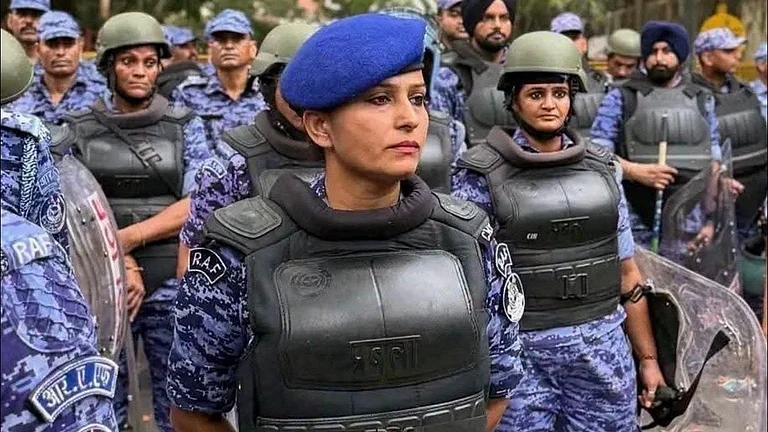
Several personnel were found deployed without mandatory safety gear, including helmets and body protectors, prompting directives for strict compliance.
Sansad Chalo March: Internal Review Flags Force Gradient Flaws and Lapses by Rapid Action Force
An internal review by RAF IG Seema Dhundhia has flagged serious force gradient and briefing lapses during the July 20 Sansad Chalo march in New Delhi.

Summary
An internal review of the July 20 Sansad Chalo march has flagged that the Rapid Action Force (RAF) used a force gradient that did not accord with prescribed standards and training. Three persons received pellet gun injuries during the protest march towards Parliament.
In policing, a force gradient refers to the different levels of force used depending on the threat or resistance faced.
Inspector General (RAF) Seema Dhundhia held a video conference meeting on July 22 with company commanders and commandants to direct corrective measures. "The meeting reviewed the role, deployment and conduct of RAF personnel during the protest at Jantar Mantar and the Sansad Chalo march. A series of corrective measures were laid down for future law and order duties," according to a source reported by The Indian Express.
Briefing And Gear Lapses
Dhundhia told officers that they failed to brief their personnel properly and on time before deploying around Jantar Mantar and Parliament on July 20, according to sources. She also said Sector Headquarters did not receive timely information on the actual deployment, location and operational activities of the companies, directing that future reports must include these details for each company.
Senior officers appreciated the RAF's role at the sector level, but the internal assessment showed "serious shortcomings" in several aspects of the deployment that required immediate correction. "Some personnel deployed during the protest were seen in social media videos and mobile footage performing duty without body protectors and helmets. All the senior officers were directed that all personnel must be fully equipped with prescribed safety gear before every deployment. Particular emphasis was placed on helmets, visors, protective equipment and the serviceability of gear," the source added.
"Commandants were told to ensure that every personnel is clearly briefed on their role, responsibility, crowd control strategy, use of equipment, safety gear and weapons before being sent for duty," the source said to The Indian Express.
Restrictions On Special Personnel
The RAF is a specialised unit of the Central Reserve Police Force (CRPF) raised in 1992 to deal with riots and public disturbances. Following the review, sources said Dhundhia directed that officers should not immediately deploy personnel recently transferred from special operations zones, including Jammu and Kashmir, in crowd control duties in Delhi.
Advertisement
"Dhundia emphasised that personnel transferred from the special operations zone such as Jammu & Kashmir, or other operational areas, possess a different work environment and operational perspective, but sectors such as Delhi, Bihar, Assam and Maharashtra require a distinct and balanced approach to crowd control and public order management," the source said.
Weaponry And Training Rules
Until further orders, the RAF will not issue PAG, Anti-Riot Gun, Electric Shock Weapon and Electric Shield to personnel in the present Delhi situation, sources said. "Officers were instructed that force must be used only to the extent necessary, in a judicious, fair, balanced and sensitive manner. They were also told that before using force, personnel should issue necessary warnings and use graded crowd-control measures such as lathicharge, tear smoke and other approved methods only according to the situation," the source added.
"No personnel should be deployed for crowd control or operational duties unless they have undergone RAF conversion training. If personnel have to be sent on duty due to shortage of manpower, they must be briefed in detail and made fully sensitive to crowd-control requirements," the source said.
Advertisement
"Personnel should not respond to provocation, abusive language or personal remarks, and must maintain restraint, patience and professional conduct in all situations," the source added to The Indian Express.
Director General (CRPF) Gyanendra Pratap Singh said, "Now, since the protest has been called off, and once assembled people disperse, we would make a professional post-event assessment, like we do after every major assignment."
Published At: