How To Filter This
Renal Code
Will a revamp of the organ transplant act help prevent Gurgaon-type rackets?

- Plug loopholes in the existing law to stop non-related transplants
- Support organ removal from brain-dead patients
- Provide incentives to those who pledge their organs after death
- Crack down on all 'transplant' clinics
- Monitor all transplant operations
***
A

Prakash was lucky. Even by conservative estimates, there are close to 1,50,000 patients who desperately require donors. Many of them end up at unregistered clinics run by unscrupulous doctors like Amit Kumar, alleged kingpin of the multi-crore kidney racket unearthed last fortnight in Delhi's booming suburb, Gurgaon. Police investigations revealed that the doctor (believed to have fled the country) ran the operation through a network of touts who preyed on the poor, luring them to part with their kidneys for anything between Rs 10,000-Rs 50,000. The doctor and his clinic, on the other hand, charged patients Rs 20 lakh for sourcing the donor and carrying out the transplant. A CBI probe has now been ordered into the whole gory affair.
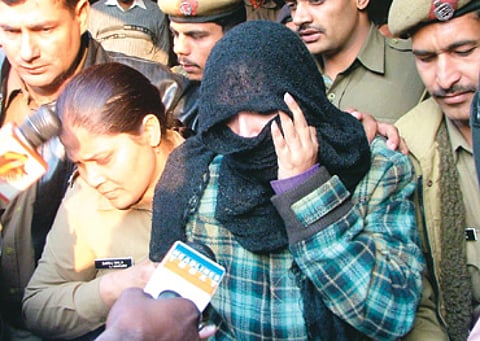
Jeevan's wife Pooja under arrest
More than anything else, the Gurgaon case has brought the focus back on what should be done on the legal front to curb such malpractices. Going by the increasing number of illegal transplant cases being reported across the country, it's evident the Transplantation of Human Organs Act, 1994, has not been an effective enough deterrent. Now, several solutions are being offered—from the simplistic "legalise the trade" to putting in place a system which allows the removal of organs from cadavers in hospitals.
Outlook spoke to doctors and medico-legal experts to see how organ transplants can be made less commercial and more humane. Some recommendations:
- Encourage relatives to donate organs. If the donor is related, the chances of the recipient surviving longer is higher.
- Plug loopholes in the existing law; as of now it allows unrelated donors to part with an organ as an act of benevolence.
- Hospitals could have a system in place to maintain and preserve cadavers till such time as the organs are harvested.
- A sustained campaign to dispel the widely held notion that the body will be mutilated if organs of a brain-dead person are removed.
Advertisement

Dr Amit's Gurgaon clinic
The Act stipulates that every non-related donor has to be screened by an ethics committee constituted by the hospital that undertakes the transplants. Other than doctors, the Act does not specify who should be on the committee. Besides, how is it to be established that the donor is being altruistic and not selling an organ for money? As things stand now, as soon as the committee gives its okay, the hospital can go ahead with the transplant. There have been instances in private hospitals where the donor has been cleared as a mere formality. Of course, in the Gurgaon case, the clinic did not even go through the charade of having an ethics committee. Now there is a proposal to have a centrally-appointed panel to look into non-related donors instead of committees set up by individual hospitals.
Needless to say, it's the huge supply-demand gap which drives the racket. At any point in time, there are at least 1,50,000 patients looking for donors. But no more than 3,500 kidney transplant operations are carried out in a year. This shortage pushes wealthy Indians/ foreigners to "pay whatever price" and look for a donor from among the poor.
So can the government legalise non-related donors and fix a price for an organ? Doctors say it's impossible since there can be no price tag for the loss of an organ like the kidney which the body cannot regenerate. Also, the value a prospective donor attaches to a body part is subjective and can't have a reserve price.
Which is why experts say harvesting organs from brain-dead patients and cadavers is the answer. Dr S.K. Mathur, liver transplant surgeon at Wockhardt Hospital, Mumbai, who did a survey some years ago on the number of cadavers with "harvestable" vital organs arriving at city hospitals, says: "The problem is two-fold. First, there is a total lack of public awareness and acceptance of a brain-dead patient as a potential donor. Second, there is general apathy in the medical fraternity to identify a brain-dead person (as such) and maintain cadavers like patients till such time as the organs have been harvested."
Liver transplant surgeon Amrinder Soin of Delhi's Gangaram Hospital says health NGOs and social organisations must conduct a sustained campaign to popularise the concept of sourcing organs from brain-dead persons. "It takes time for relatives to acknowledge that despite the heart beating the patient is dead and that organ removal for transplant is a neat operation that does not disfigure the body, unlike post-mortems," says Soin.
There are few organisations now working towards persuading people to donate organs after death. One such is the Chennai-based Multiple-Organ Harvesting Aid Network (MOHAN). The agency's Dr Sumana says persuading people to donate organs from the body of a relative is often a painstaking process. A team of counsellors has to work on the relatives explaining to them the importance of donating organs. Ganadarpan does similar work in Calcutta.
One fact seldom acknowledged is the reluctance of the rich to donate their organs, indirectly fuelling the pressure on the poor to donate. In a country like India, the poor are a tradable commodity and the rich come preying on them even from abroad. Loopholes in the law and shoddy monitoring of hospitals and clinics has made it easy for the likes of Dr Amit Kumar to carry on with their racket. But will things change? Or will Gurgaon be forgotten like earlier cases in Chennai, Mumbai, Jaipur....
Advertisement
Published At:
Tags