Putin receives a grand ceremonial welcome at Rashtrapati Bhavan, pays homage at Rajghat, and holds marathon delegation-level talks with PM Modi, underscoring India–Russia defence, energy, and geopolitical cooperation.
India and Russia sign a key MoU on port and shipping cooperation, review long-term energy contracts, and chart a roadmap to expand bilateral trade toward $100 billion by 2030.
Discussions focus on student exchanges, cultural initiatives, AI, space, and 6G, alongside India reaffirming support for a peaceful resolution in Ukraine, signalling strategic autonomy in global affairs.
Putin’s India Visit: A New Chapter In The 'Special & Privileged' Partnership
This is Putin’s first state visit to India in six years and comes at a time when Moscow faces a sustained diplomatic freeze from Western nations.

Summary
Russian President Vladimir Putin began the Day 2 of his India visit with a grand state welcome at Rashtrapati Bhavan, complete with a 21-gun salute, mounted cavalry escort, and a full guard of honour. President Droupadi Murmu and Prime Minister Narendra Modi received him personally. This is Putin’s first state visit to India in six years and comes at a time when Moscow faces a sustained diplomatic freeze from Western nations. The optics of such a ceremonial reception reassert New Delhi’s commitment to its “Special and Privileged Strategic Partnership” with Russia, signalling that India will not let global geopolitical pressures dictate its bilateral priorities.
Homage at Rajghat and the Message of Multipolarity
Putin then visited Rajghat to lay a wreath at Mahatma Gandhi’s memorial. In the visitors’ book, he wrote that Gandhi’s ideals of peace, non-violence, equality, and mutual respect remain deeply relevant today, especially as India and Russia “work together for a just multipolar world order.” The message, while framed in Gandhian language, was a deliberate geopolitical signal — tying India–Russia cooperation to a shared vision of multipolarity and subtly countering Western narratives of liberal dominance and sanctions-driven isolation.
Marathon Talks at Hyderabad House
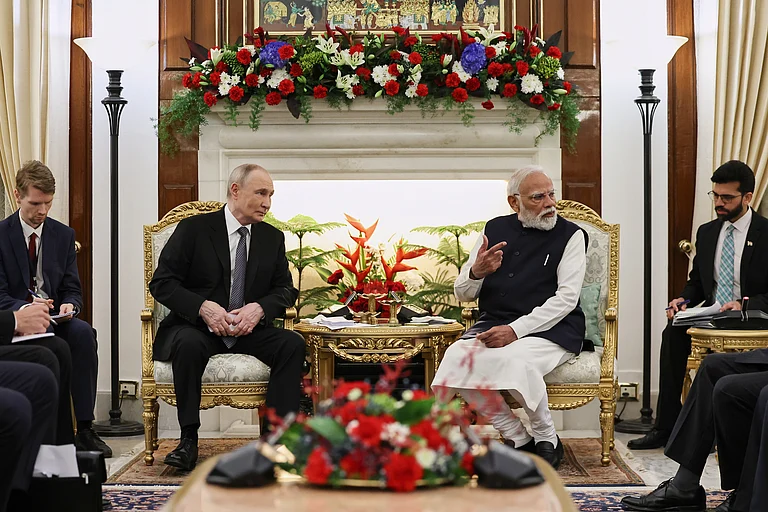
Putin and Modi held extensive restricted and delegation-level talks at Hyderabad House, lasting over four hours and covering almost every major pillar of the relationship. The Indian delegation included External Affairs Minister Dr S. Jaishankar, NSA Ajit Doval, the Defence and Petroleum Secretaries, Commerce and Science officials, and CEOs of leading PSUs. The breadth of representation underscored that this visit is not merely about defence procurement but about resetting and widening the entire strategic framework — defence, energy, technology, trade, education, and logistics.
Deepening Defence and Security Cooperation
The discussions on defence focused on continuity, expansion, and co-development. India and Russia reviewed the progress of S-400 deliveries and the joint production of AK-203 rifles in Uttar Pradesh, while exploring deeper cooperation on the Su-57 fighter aircraft programme, Ka-226T helicopters, and BrahMos exports to third countries. A major strategic shift came with the operationalisation of the Reciprocal Exchange of Logistics Agreement (RELOS), giving both nations access to each other’s military bases, ports, and airfields. For India, this opens pathways into the Arctic and northern sea routes; for Russia, it strengthens access to Indian Ocean facilities — marking a quiet but significant upgrade in military-to-military interoperability.
Advertisement

Long-Term Energy Security and Nuclear Cooperation
Energy formed one of the strongest pillars of the day’s discussions. India sought long-term crude and LNG supply contracts spanning 10–20 years at stable or discounted prices, insulating its energy basket from global volatility. Both sides explored expanding rupee–rouble trade and integrating Indian digital payment systems for commerce under sanctions. Talks also progressed on Units 5 and 6 of the Kudankulam Nuclear Power Plant, along with the possibility of jointly developing Small Modular Reactors (SMRs) — both for domestic use and for export to third countries. With Russia consistently emerging as India’s largest crude supplier in recent years, these discussions anchor India’s long-term energy resilience.
Economic Roadmap and the Push for $100 Billion Trade
Modi and Putin tasked their teams with finalising a long-term economic cooperation roadmap extending to 2030. Current bilateral trade, driven mainly by discounted Russian oil, stands at roughly $68–70 billion. The new roadmap aims to diversify and balance this trade structure. For India, the focus is on boosting exports in pharmaceuticals, machinery, auto components, tea, coffee, and marine products, while also pushing for greater market access for IT services and skilled professionals. Connectivity initiatives — including the Chennai–Vladivostok corridor and the International North-South Transport Corridor (INSTC) — were reviewed as key enablers of this long-term trade vision.
Advertisement
Connectivity Breakthroughs and the New Maritime Map
The two leaders also advanced a set of major connectivity proposals. MoUs under discussion include cooperation on Arctic shipping, the Northern Sea Route, and the development of a Chabahar–Astrakhan multimodal corridor linking India to Russia through Iran. Operationalisation of the new India–Russia maritime shipping agreement could reduce transit time between India and Russia or Europe by nearly 40%, while reducing dependence on the Suez Canal. These discussions reflect an evolving maritime synergy with deep geopolitical weight.
Future Tech, Education, and Cultural Exchanges
Beyond geopolitics, the visit also emphasised soft power and future technologies. Both nations agreed to expand student exchanges, mutually recognise university degrees, and establish direct institutional collaborations. In the strategic tech domain, cooperation is expected to grow in space, including potential Gaganyaan–Roscosmos docking modules, as well as artificial intelligence, quantum computing, cybersecurity, and next-generation telecommunications like 6G. A major cultural season for 2025–26, featuring over 100 events across both countries, was also announced.
Advertisement
Published At: