I
Preying Hard
Borders blur between the state and the anti-Christian aggressors


The damaged crucifix at Mangalore's Milagres Church |
Protest marches and demonstrations against the notices left the government unmoved. In fact, the minister in his public utterances was stubbornly against making any concessions. This, in a way, formed the backdrop to Sunday's events, but neither the government nor the Sangh parivar is willing to concede that.
State home minister V.S. Acharya told Outlook there was no need to read much into the notice. "To issue a showcause notice was a normal thing," he said. "All Christian institutions are grant-in-aid institutions of the government and they should have had the courtesy to inform us before declaring a holiday. Their decision to act unilaterally cannot be tolerated." The Christian organisations in the state feel differently. They think the government's "intolerance" towards the community served as a signal to the parivar outfits "to do what they please", the fallout being the attacks last fortnight.
In a petition it sent to the National Human Rights Commission, the Global Council of Indian Christians said: "It is not difficult to understand why only institutions in Karnataka are being treated in this fashion, while they were just a few among the 45,000 institutions in India which participated in this day (Aug 29) of prayer for peace and communal harmony. When a bandh call was given by the VHP in the cause of the Sri Amarnath Sangharsh Samiti, several of these same institutions had indeed been closed in deference to the bandh call."
H
owever, BJP legislator from Dakshina Kannada, Ganesh Karnik, insists: "We may have to own up to the attacks, but then they were not planned and had no linkages to anything that happened earlier. The attacks were also not on mainstream churches but prayer halls that were blatantly proselytising poor Hindus." What Karnik says may be true as the attacks specifically targeted the centres of the New Life evangelical order, allegedly into "forcible proselytisation". The parivar claims it didn't target Roman Catholic churches, except for one case of "mistaken identity" when the nuns of the Adoration Monastery, near the Milagres Church in Mangalore, were attacked.But the state's Christian population is not buying the parivar's fine distinction. The attacks are seen as a move to bring pressure on the entire community. In fact, the church bells of all the churches were rung in panic in Mangalore when the attacks took place on Sunday and all retaliation was claimed to be in self-defence. The pent-up hostility and mistrust between the community and the state showed on Sunday when the people congregated at the churches perceived the police as "aggressors" and pelted stones. The police, in turn, entered the sanctum sanctorum of the churches to pull out the assaulters.
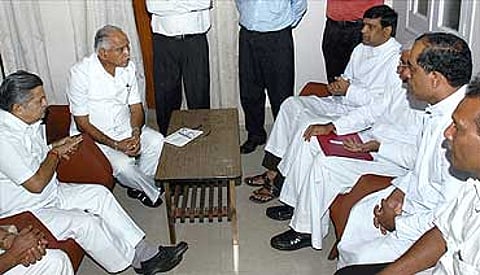
Empty gestures? The Karnataka CM meets a Christian delegation in Bangalore
"We were seen as educators and respected, but the honeymoon period for Christians in Mangalore is over," says Fr Prashant Madtha, the former principal of the century-old St Aloysius College in Mangalore. "The retaliation from the Christian community you saw was happening for the very first time in the history of the state," he adds. "It was not the correct response, I condemn it, but then our youth have started imitating the enemy." The nervousness that has set in the community is evident in what one schoolteacher said: "There is a lot of fear. We don't know when stones will rain on our roofs. We are even scared to talk."
For now, the Catholic establishment in the state has distanced itself from evangelical orders like New Life. The Bishop of Mangalore Diocese, Aloysius Paul D'Souza, told the media that the 158 churches under the diocese or the educational institutions were in no way connected with religious conversions. But for local engineering college professor and rights activist Phaniraj, who interviewed many of those attacked by parivar men, the phrase "forcible conversions" itself appears problematic. "The state should define what it means by forcible conversions," he says. "Because many of those whom we interviewed said they went to these prayer halls only to seek some emotional solace and had not actually converted. One should check if the police, who tried to proactively implement law and order by barging into churches this time, have booked any cases of forcible conversions in recent years?"
Asked the question, home minister Acharya said the police had not registered any case. "People don't come to the police station to register cases," he declared. "But in the last few days our police have collected plenty of very derogatory material pertaining to conversions. We will look into it and initiate action."
The minister may find a lot of material on conversions but can he establish cases of "forcible conversions", which he and his chief minister have been harping on? When Acharya was asked if his government was contemplating an anti-conversion law, he said he'd seek "legal opinion" after things settle down. But before that happens, there is the VHP and Bajrang Dal itching to settle scores with the Church.
Advertisement
Published At:
Tags