T
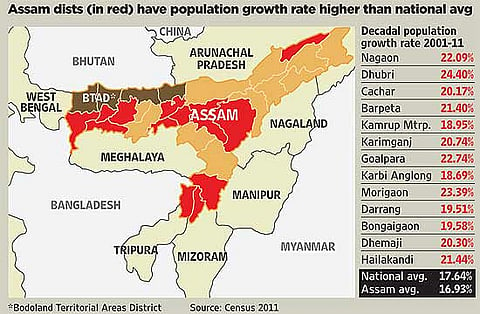
here’s so much despair in the makeshift relief camps in the Bodo heartland. Tensions run high, and talk at all the camps hew close to the same script—of pain and loss that came without warning. In the districts of Kokrajhar, Chirang, Bongaigaon, Dhubri and now Baksa in lower Assam, it’s as if the entire hinterland is huddled in separate ‘ethnic’ camps. Sporadic clashes over the last week between Bodos and Bangla-speaking Muslims have left 44 dead till now and over two lakh homeless—the casualties and the suffering distributed evenly. And it’s not over yet.Maps Of Hatred, Redrawn
Violence comes in cyclical waves in the Bodo areas. This time, it’s a tsunami.

By now, 13 army columns have moved into the four districts, carried out flag marches and cleared rail tracks for the resumption of train movement. The conflict has hit train traffic, Kokrajhar and Bongaigaon being on the main artery of the rail route in Assam to neighbouring states. All inbound and outbound trains were halted at various stations between Guwahati and Alipurduar, leaving thousands of passengers stranded. Escorted by the army, eight of the 37 trains resumed their forward journey on July 25.

Bodo women and children at a relief camp in Kambari Beel, Kokrajhar dist, Jul 25
Ethnic conflict is not a new phenomenon in the Bodoland Territorial Areas Districts (BTAD), administered by the non-autonomous Bodoland Territorial Council (BTC) formed in 2003. Almost in cyclical fashion, clashes have broken out at regular intervals between Bodos and non-Bodo communities, like the adivasis and the Muslim population. In May ’96, a vicious adivasi-Bodo conflict was sparked off with the killing of three Bodo girls, allegedly by the Santhals. It continued till 1998. A major clash between the present participants, Bodos and the Bangla-speaking Muslims, took place earlier in 1993-94. In ’94, a brutal battle between the two left some 100 dead and over 60,000 homeless.
This time, the spark was the shooting to death of two All Bodoland Minority Students Union (ABMSU) members by unidentified gunmen at Anthihara in Kokrajhar on July 6. This led to clashes which gained momentum with elements from both communities attacking each other, accusing each other of orchestrating ethnic cleansing.
As the violence continued unabated, Bodoland Territorial Council (BTC) chief Hagrama Mahilary came out with the serious allegation that the whole thing was being instigated by infiltrators from Bangladesh. The BJP lost no time in playing up these allegations. Party MP Vijay Goel, who had flown in to the state as part of a fact-finding mission, resorted to tautology: “Illegal Bangladeshi Muslim infiltrators armed with weapons have come from a neighbouring country”. Union home secretary R.K. Singh, though, has dismissed such allegations. “The international border is sealed. It is simply impossible for any organised group to cross over to India to carry out such attacks,” Singh told newspersons.
Advertisement
Meanwhile, civil society groups from both communities have been working overtime to find a peaceful solution to the crisis. But it won’t be easy. Pramod Boro, president of the All Bodo Students Union (ABSU), says that in the past 2-3 years the government has been neglecting the internal law and order situation and vested interests have been taking advantage of the situation. He rues the fact that the government has done little to find a lasting solution to the old, festering issue of so-called illegal migration from Bangladesh. This has led to suspicions and simmering discontent among the people on rights over land, identity and culture.
The fact that these areas have witnessed armed insurgency for decades now has not helped matters. Even now, armed groups move around with impunity and there have been no attempts to ‘deweaponise’ them. Civil society groups have been asking for long that ex-Bodo militants be confined to their designated camps and all illegal arms be seized.
Advertisement
ABSU’s Boro says, “We need both long-term and short-term policies in order to defuse the present tension and to ensure that such clashes are not repeated in future. As a short-term measure, we need immediate security and confidence-building measures and reconciliation among the people. In the long-term, we need an impartial inquiry into the incident.”
Hafiz Ahmed of the Char Sapori Sahitya Parishad, a literary organisation, has urged the authorities to provide relief and rehabilitation and also repatriate the victims back to their villages as soon as possible—but with army protection. He added, “In future, only those villages which have over 50 per cent Bodo population should be included in the BTAD. Also, non-Bodos should get equal rights and opportunities.”
K
ameswar Brahma, president of the Bodo Sahitya Sabha, the literary organisation of the Bodos, says, “The key is citizen awareness. There are some miscreants involved who should be properly investigated. Muslims, Bodos, adivasis have been living together peacefully in same or adjoining villages for years now.”Advertisement
The state administration, after some initial inertia, has started working towards dousing the fire. A week on, Assam chief minister Tarun Gogoi visited Kokrajhar to take stock of the situation. So did a 20-member all-party delegation led by deputy speaker of the Assam assembly Bhimananda Tanti, who visited the trouble-torn areas of lower Assam and met local leaders and even some of the affected people.

Paramilitary soldiers inspect a burnt-out home in Kokrajhar town, Jul 24. (Photograph by Reuters, From Outlook 06 August 2012)
But it’s not nearly enough, says Abdur Rahim Ahmed, president, All Assam Minority Students Union (AAMSU), who blames the administration for not bringing the situation under control sooner. “We have been used as pawns by the politicians. The minorities have always been deprived and denied basic amenities in the BTC. Unless the central government curbs this with a strong hand and an impartial inquiry is conducted, such violence will continue in the future,” he says, pessimistically.
Advertisement
So the blame game continues. In all this, of course, it is the ordinary villagers who bear the brunt, losing their lives, property. In the relief camps, it’s the usual sordid stories with inmates struggling for basic amenities like food, drinking water, sanitation and medicine. Salma Begum struggles to feed some khichdi to her three-year-old son who is down with fever at the makeshift relief camp—an open field at the Borpothar LP School, Dhaligaon, in Chirang district. She is inconsolable. “I haven’t taken a bath for the past three days. I want to go home as my baby is suffering,” she says.
The conditions are about the same at the Bodo relief camps. Mamata Brahma, 35, is in one at the Owabari LP School under Kokrajhar sub-division in Kokrajhar district. “We are making do with two urinals and one handpump. It is becoming increasingly difficult to cope with the sanitation needs of our adolescent girls,” she says.
Mithinga Rani Basumatary, president of the All Bodo Women Welfare Federation, has urged all the communities to maintain calm. “I think this is a conspiracy by a political party to disturb the peace in the Bodoland areas. We had been forging ahead till now, with all communities living in harmony,” she says. She also urged the media to exercise restraint in its coverage.
In the end, some or all of these people may be able to go back home and resume normal lives. But unless the authorities move on to the next stage of reconciliation and trust-building between the communities, the cyclical spate of conflicts in Bodoland will continue.
Open Up The BTC Knot?
A short history of the tensions in the Bodoland areas
Where in Assam is the violence occurring?
Mainly across the Bodoland Territorial Areas Districts that have been governed by the Bodoland Territorial Council (BTC) since 2003. Affected btad districts include Kokrajhar, Chirang and Dhubri. Violence between the indigenous Bodo tribal community and Muslim settlers has also spread to adjoining Bongaigaon and Baksa districts.
What is at the root of tension between these two communities?
Non-Bodos complain that their rights have been subjugated in Bodoland. Many non-Bodo majority areas are included in Bodoland to give it a territorial contiguity. The “disproportionate” allocation of seats in BTC is also a grouse. At present, of the total 46 seats, 30 are meant for the tribals, five for non-tribals, five for members of all communities and candidates to the remaining six are nominated by the Assam governor. Non-Bodos also accuse Bodo outfits of regular extortion. Bodos, on the other hand, complain that increasing migration, often allegedly illegal, has taken away their land and resources from them.
What are the main reasons for the conflagration this time?
The area was tense after unidentified persons killed a Muslim labourer on May 30 in Kokrajhar. Things worsened on July 6, when two members of the All Bodoland Minority Students Union were shot dead by unidentified gunmen in Kokrajhar.
Is this the first time ethnic clashes have occurred?
No. In October 2008, violence over land had claimed 55 lives. It was caused by the killing of a Bodo youth by a Muslim. Since then, there have been sporadic clashes, including in May this year, which have been provoked by demands for exclusion of non-Bodo majority villages from Bodoland and, on the other side, full-fledged statehood for Bodoland.
Is the state government to be blamed?
Assam Pradesh Congress Committee’s Y.L. Karna had warned in a report on July 10 that “any negligence can create serious communal tension and disharmony”. “That this has happened is a failure of the administration, especially the local administration,” he says.
Published At:
Tags