Q. What should Patil wear to the cabinet meeting?
A. Sackcloth and ashes.
—Overheard on Raisina Hill
Knights In White Satin
Patil hangs on by a thread, the UPA vacillates on the tough talk

U
Outlook
The fact that Patil has survived thus far is, of course, as much a tribute to his tenacity as it is to the Congress leadership’s touching faith in "loyalists". The case against Patil has been building up for four years now. Within the party, impatience with his ineptitude has been growing. As a senior party functionary puts it, "We have major achievements in the social sector, the N-deal is almost through and even on the economic front, the problems relate more to the global situation. We have addressed both rural India as well as the middle class...Patil’s record alone could derail all that." The Congress is well aware the BJP will soon be beating down the door with "soft state" accusations. And that it could prove damaging in the elections, especially with its new-found ‘nuclear’ admirers in the middle class.
In recent weeks, Patil has been under almost constant fire. First, it was his clumsy handling of Kashmir, then the inert response to Orissa and Karnataka as Bajrang Dal hoodlums vented their anger on the Christian community. So when bombs exploded across Delhi, it seemed like the last straw. "It’s not a question of admission of guilt if Patil steps down; it’s about taking moral responsibility," a senior party functionary explained. "Publicly, we can say Advani’s record was worse than Patil’s. But that’s not the point. People are going to ask us: what lessons did we learn from the NDA’s mistakes?" Congress general secretary Digvijay Singh was among the few who went public: "The home minister is wise enough to understand the seriousness of the situation. He will take appropriate action."
Patil was quite unfazed. He even admitted in an interview that he knew he was "not in much demand" and that he was there "just because of them (the leadership)". Earlier, on September 4, Patil had faced the wrath of ministerial colleagues at a cabinet meeting. Union ministers Vayalar Ravi, Priyaranjan Das Munshi and Kapil Sibal had blasted him after he described the situation in Orissa’s Kandhamal district as "neither volatile nor normal", but "something in between". A.R. Antulay quizzed Patil on what exactly he meant and whether the state administration was complicit in the attacks? Others wanted to know how the Orissa administration prevented MoS for home S. Jaiswal from entering Kandhamal even as the VHP’s Praveen Togadia was allowed to do so. There was also some outrage when Patil underplayed the VHP/Bajrang Dal role and sidetracked ministers’ suggestions by claiming he had already implemented these.
Meanwhile, as the violence spread to other parts of the state, the Orissa chief secretary asked the Centre to send out the army. Surprisingly, the home ministry threw the rule book at the state, saying it was the district magistrate who was empowered to requisition the army, not the chief secretary. An official told Outlook: "Technically, that’s right. But it’s a serious situation, the home ministry should have found a way out."
Advertisement
Post the bomb blasts, UPA ally and rail minister Laloo Prasad Yadav demanded a special cabinet meeting to evolve a national response to the terror threat. Criticism from Laloo and other allies came after Congress president Sonia Gandhi met senior party leaders to discuss the internal security situation: significantly, the home minister was not present.
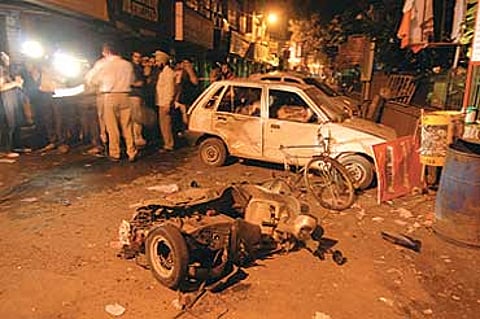
The posh Greater Kailash-I maket was a target in Delhi
As the attacks on Patil mounted, the government went into damage control mode. On September 16, Administrative Reforms Commission chairperson Veerappa Moily dusted his report on "Combating Terrorism" (submitted in June) and introduced a new element at a press meet—the need to strengthen anti-terror laws. It conveyed the impression of a government ready to act. But official sources told Outlook later that "the report’s suggestions have not yet been considered".
Then, on September 17, Manmohan told a conference of state governors, "Our government has no inflexible or ideological view in this regard. We are actively considering legislation to further strengthen the anti-terrorism law in line with the global consensus...." He also spoke of a central agency, distinct from a federal agency, and the need to plug the gaps in intelligence. But he confused the issue by saying, in the same breath, that perhaps there was no need to have a central agency, just better coordination among the agencies, the Centre and states.
Advertisement
At the cabinet meeting later that day, the consensus was that the UPA would close ranks. A minister told Outlook: "The meeting was pointless. All Patil announced were the usual institutional measures to combat terrorism". No changes in the law were discussed; once again ministers vociferously argued against a pota-like law. The federal agency idea was discussed fleetingly. Antulay, though, trained his guns on NSA M.K. Narayanan. "You are telling us what is already in the newspapers," he said. Clearly, the government just wanted to get Patil’s ineptitude off the front pages. The next day the government announced a new research and technology wing at the IB, additional manpower to the agency and Delhi Police, metro policing and CCTVs/metal detectors at the capital’s busy markets. At the time of writing, late on September 18, it looked like the Centre had decided to act against Orissa and Karnataka, issue "warnings" under Article 355. This enjoins the Union, among other things, "to ensure that the government of every state is carried on in accordance with the provisions of the Constitution". But it’s just an advisory, unless followed by Article 356—President’s Rule.
Advertisement
Patil may think the media’s obsession with his sartorial preoccupations is typical. But what else can be said about him? Perhaps, it wouldn’t be inaccurate to say the emperor of North Block wears no clothes at all.
Published At:
Tags