The BJP's nationwide campaign has renewed focus on Guru Ravidas's enduring influence on religion, politics and Dalit identity.
Guru Ravidas's vision of Begumpura championed equality, dignity of labour and a society free from caste oppression.
His legacy continues to shape electoral politics, particularly in Uttar Pradesh and Punjab through the influential Ravidassia community.
Guru Ravidas At 650: Why Political Parties Are Competing Over His Legacy
From Begumpura to electoral politics, Ravidas remains a powerful symbol in India's contest over Dalit identity, social justice and political representation

Summary
“Aisa chahun raj main, jahan mile saban ko ann. Chhot-bado sab sam basain, Ravidas rahe prasann.”
“I wish for such a kingdom, where everyone has enough food, Where small and big all live as equals, and Ravidas remains content." : Guru Ravidas
Bharatiya Janata Party has launched a year-long nationwide campaign to celebrate the 650th birth anniversary of Guru Ravidas, beginning from his birthplace at Seer Govardhanpur in Varanasi on Guru Purnima. The 'Shri Guru Ravidas Maharaj Samrasta Sankalp Abhiyan' will culminate on Maghi Purnima in February 2027, with programmes across the country promoting the saint's message of social harmony and equality.
Coinciding with the launch, Uttar Pradesh Chief Minister Yogi Adityanath announced that Bhadohi district would once again be renamed Sant Ravidas Nagar, reviving a name first given by the Bahujan Samaj Party government before it was reversed by the Samajwadi Party in 2014.
The twin announcements underline how Guru Ravidas, five centuries after his lifetime, remains at the centre of India's political contest over social justice, Dalit identity and religious symbolism.
Guru Ravidas
Guru Ravidas was a Bhakti saint, poet and social reformer who is generally believed to have lived during the 15th and 16th centuries in the Varanasi region. Although reliable biographical details are limited, his own verses identify him as belonging to the Chamar community of leather workers, and he continued practising his hereditary occupation throughout his life.
His teachings rejected caste hierarchy, untouchability and ritualism while emphasising devotion to one formless God. Unlike many religious reformers, Ravidas did not renounce ordinary life. Instead, he transformed the dignity of labour into a spiritual principle, arguing that one's worth was determined not by birth but by devotion and conduct.
His compositions, written in the vernacular Sadhukari language, gained followers across caste boundaries. Forty hymns and a shloka attributed to Bhagat Ravidas are included in the Guru Granth Sahib, placing him among the most revered Bhakti saints within the Sikh tradition.
Advertisement
The Idea Of Begumpura
Perhaps Guru Ravidas's most enduring contribution is his vision of Begumpura, the "city without sorrow".
In the famous hymn preserved in the Guru Granth Sahib, Begumpura is imagined not merely as a heavenly abode but as an ideal society. It is free from caste hierarchy, fear, arbitrary authority and oppressive taxation. People move without restriction, enjoy material security and live as equals, regardless of birth or occupation.
The poem concludes with Ravidas describing himself as a liberated tanner, transforming an occupation regarded as "polluting" under the caste order into a symbol of dignity. Modern scholars regard Begumpura as one of the earliest and most compelling visions of an egalitarian social order in South Asian thought.
Guru Ravidas And Dalit politics
Guru Ravidas occupies a distinctive place in Dalit social and political consciousness because his challenge to caste discrimination emerged directly from lived experience. Rather than advocating confrontation or revenge, he articulated equality through devotion, fraternity and human dignity.
Advertisement
His influence became particularly significant during Punjab's Ad Dharm movement in the 1920s, when Dalit leaders adopted him as a symbol of independent social and political identity. His teachings continue to inspire movements seeking dignity, representation and social justice.
Why Are Political Parties Competing Over His Legacy
Few historical figures command reverence across as many social and political constituencies as Guru Ravidas. His message of equality resonates with Dalit communities, while his place in the Bhakti tradition and the Guru Granth Sahib gives him wider religious significance.
The BJP's nationwide campaign comes months after the AAP government in Punjab launched its own year-long programme to commemorate Guru Ravidas's 650th birth anniversary, underscoring how political parties across the spectrum seek to invoke the saint's legacy.
Symbolic gestures—from renaming districts and developing memorials to organising pilgrimages and commemorative events—have increasingly become part of electoral politics, particularly in Uttar Pradesh and Punjab, where Guru Ravidas's social and political influence remains especially significant.
Advertisement
The Ravidassia community
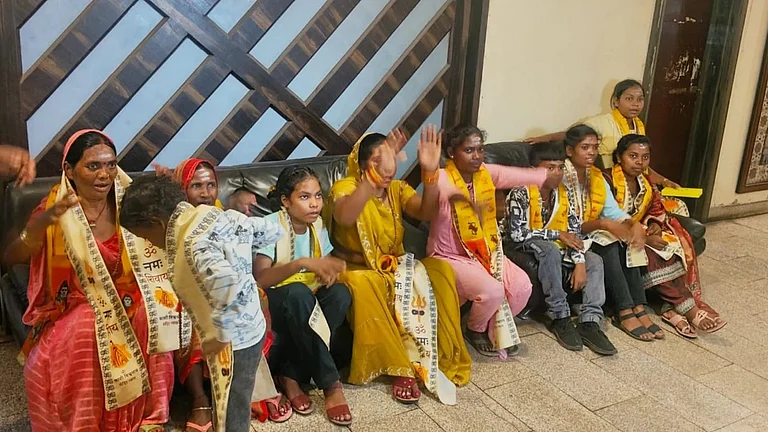
Guru Ravidas remains the foremost spiritual figure for the Ravidassia community, whose largest concentration is in Punjab's Doaba region. The community is widely estimated to number around 1.2 million people in the state and formally asserted a separate religious identity in 2010 following the 2009 Vienna attack on leaders of Dera Sachkhand Ballan. It follows its own scripture while continuing to revere Guru Ravidas as its central spiritual guide.
As one of Punjab's largest Dalit communities, particularly in the Doaba region, the Ravidassias are regarded as an influential electoral constituency. Institutions such as Dera Sachkhand Ballan wield considerable religious and social influence, making the community an important political constituency. Successive governments and national leaders have therefore maintained close engagement with Ravidassia institutions.
Why Does Guru Ravidas Remain Politically Relevant
Guru Ravidas's enduring relevance lies in the continued resonance of the questions he raised five centuries ago. His critique of caste hierarchy, insistence on the dignity of labour and vision of Begumpura continue to inform debates on equality, social justice and inclusion.
Advertisement
The BJP's anniversary campaign and the renewed contest over Guru Ravidas's legacy illustrate how a medieval Bhakti saint continues to shape contemporary debates on caste, equality, religion and electoral politics.
Published At: