I
Elephant MustRemember
Growth story, yes, but there are over 300 million yet to see it

No one, not even the worst pessimists, can deny that several segments of the Indian economy are shining. There’s a certain exuberance and excitement; there’s a growing feeling that India, with its 9 per cent plus growth, is ready to take on the world and make a mark on the global map. The recent high-profile takeovers by Indian businessmen like Ratan Tata and Kumarmanglam Birla has added to that confidence. Not to forget the fact that the services epicentre has shifted to India’s Bangalore and Hyderabad.
But still, there’s a huge chunk of population—250-300 million people—who have been categorised as poor. The numbers will swell if one includes the households whose earnings are below Rs 10,000 a year. This is the "Other India", the India that’s neither talked about nor discussed. This is the dark and ugly face of the country, which stands out in stark contrast with the one that’s glowing. This is the India that silently suffers, even as it sees the other half prospering. This is the "nearly-forgotten" India.
Most experts are convinced that the future of India depends on her ability to uplift the poor and downtrodden, and better their lives. Not just for economic reasons, but also for political ones(see Ashutosh Varshney’s column ). This explains why the UPA government, and its chairperson Sonia Gandhi, is focusing on "inclusive growth". Says Jaipal Reddy, Union information and broadcasting minister, "Growth without equity is fruitless, and equity without growth is rootless."
It’s for this reason that Outlook decided to focus on "The Other India" in its annual State of the Nation Survey. We realised that the best way to capture this segment(s) was to go where it lived, and find out how it survived. We also conducted a poll among villagers in one of India’s poorest district—Bolangir (Orissa). What we found was surprising, to say the least. There were a number of success stories but, unfortunately, there were many more failures. The elephant, it seems, has a long way to go; he has to run faster to catch up with the developed economies.
Advertisement
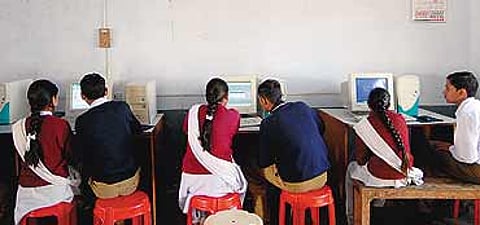
Computers have touched far-flung places, like this school in Solan, HP
Some of us take pride in the fact that poverty levels have come down in the reforms era. But others think it’s still a matter of shame that hundreds of millions of people are poor (see Kaushik Basu’scolumn). They maintain that statistics cannot deny that at least a third of India’s population lies outside the periphery of the ongoing economic boom. A few question the credibility of the latest government’s data that seems to indicate that while rural poverty is down, urban poverty is a problem area.
"Higher percentages of urban poverty in some states implies that more people are running away from the villages to the cities in search of livelihoods," explains Ashok Khosla, chairman, Development Alternatives. Adds Veena Jha, India’s programme coordinator atUNCTAD (United Nations Conference on Trade and Development): "While the urban poor may be better off than the rural one, the former face space constraints, more health problems due to lack of civic amenities, and spend more on transportation."
Advertisement
There’s no denying that the biggest stumbling block in this area is the lack of an efficient delivery system that can ensure that the huge budgetary allocations for welfare schemes reach the people they’re meant for (see the article on panchayati raj). Says Harish C. Saxena, member, National Advisory Council, "There’s enough evidence to show that the government’s capacity to deliver has declined over the years. Weak governance resulting in poor services delivery, excessive regulation, and uncoordinated and wasteful expenditure are factors impinging on social indicators." Although there is an intense discussion on new and innovative delivery systems, no one has come up with concrete ideas.
Add to the above factors, others like rampant corruption, leakages and lack of political will. The late prime minister, Rajiv Gandhi, had once said that only 15 paise out of every rupee spent on the poor reaches them. He was probably right because, even today, many policy makers feel that 85 per cent of the funds are spent on the delivery infrastructure—on teachers, doctors, contractors etc (see Jairam Ramesh’s column).
Advertisement
One has to admit that the UPA government is striving hard to correct some wrongs. It’s initiating policies—and hiking budgetary allocations—to help the poor. The National Rural Employment Guarantee (NREG) scheme is a huge step in this direction. But as we found, this too is saddled with implementation problems (see the article on NREG Act). Like in most cases, there are both success stories and failures. Even the chief economic advisor to the finance ministry, Ashok Lahiri , admits that the NREG scheme can only serve a short-term purpose.
For this government, the panacea lies in the Right To Information (RTI) Act. Politicians (see Raghuvansh Prasad’s column) and bureaucrats believe that it will empower people, who will then be able to pressurise governments to become accountable. The Act will help the poor to question the powers-that-be on the various welfare schemes, and force the latter to show results. Maybe, maybe not. As we found, the policymakers are still trying to scuttle RTI .
Advertisement
No country can ever become an economic superpower if it cannot quickly climb up the social indicators’ ladder. Whether it’s in education, primary health, or access to basic amenities (water and sanitation), India is way behind other nations. In fact, it ranks 126, behind Sri Lanka, on the Human Development Index. Unless we can scale up in these areas (see Azim Premji’s column ) and provide them to every Indian, millions will lag behind. The result: growing disparities between the rich and the poor, and an era of high economic growth coupled with increasing unemployment.
This is something the nation has to avoid—at any cost.
By Alam Srinivas and Lola Nayar
Published At:
Tags