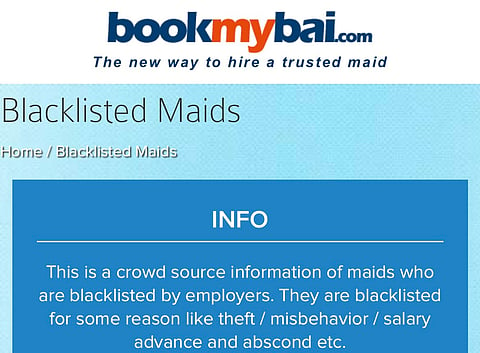
A platform providing domestic help services across nine cities in the country as well as in foreign nations has inserted a tab—‘blacklisted maids’—on its website
Putting names and faces of “blacklisted maids”, along with unverified information about the “crimes” committed by them, amounts to criminalisation of domestic workers, say experts
Domestic workers’ unions and labour rights experts have demanded legal action against the platform that is “violating the fundamental constitutional right of privacy of domestic workers”
Criminalisation Of Domestic Workers: Platform Providing Domestic ‘Help’ Services Faces Backlash
The ‘blacklisted maids’ tab on the platform’s website carries close-up images of eight women and one man, along with their names, locations, their “crimes” and testimonials from customers warning others not to hire them, all based on unverified information provided by employers

Summary
The website opens to the image of a woman and a customer testimonial, satisfied with the service provided by the platform. The tagline on the website says: “The new way to hire a trusted maid”.
The platform provides ‘housemaids’, cooks, babysitters and senior citizen care across Mumbai and Pune, Delhi, Bangalore, Ahmedabad and Surat, Kolkata, Hyderabad and Chennai, as well as in cities across the world like Dubai, Singapore, London and Australia. It claims to have a “database of five lakh maids and growing” and promises a “stringent verification process”.
Nothing unusual so far. This is how most platforms that help you in hiring a domestic worker look. This one is different, in a problematic way.
A tab on the website takes you to a section called “blacklisted maids”. The disclaimer says: “This is a crowd source information of maids who are blacklisted by employers. They are blacklisted for some reason like theft/misbehaviour/ salary advance and abscond etc.” The disclaimer adds:

"This information has been independently provided by employers who might not have hired a maid through Bookmybai. This information is not verified by Bookmybai. It is purely for information purpose so that you do not end up hiring the same maid who has done some sort of crime at someone else's home according to the employer. It is also possible that the employer has put false accusation on the maid and has blacklisted her. Please use your own discretion and decision”.
Once you scroll down, there are close-up images of eight women and one man—all “blacklisted”—along with their names and locations, their “crimes”, along with testimonials from customers elaborating on their crimes and warning others not to hire them. Incidentally, none of the profiles mentions any criminal case registered against them.
A background search led us to one of the “blacklisted” maids—Supriya (name changed), who was associated with the platform and was hired by a household in Borivali, a Mumbai suburb. “It was a posh society. My employer used to check my bag initially, but after two weeks, she stopped. However, the security person at the gate would check my bag thoroughly while entering the building and while leaving.
It was humiliating, but I desperately needed the job so I could not say anything,” she says. She added that later, when she wanted to discontinue the job and her association with the platform, she approached the team multiple times, requesting them to discontinue her service. Instead, they “blacklisted” her. Her photos and details are still visible on the website. Supriya shared the communication that she had with the platform’s team management.
Advertisement
Breach of privacy is not the only violation committed by the online platform. The company’s app also criminalises them. Under the “verify my worker” section in the app appears a graphic, which says: “3 Out of 10 maids have done some form of crime.”
The company, Nano Jobs Consultants Private Limited, that runs Bookmybai, has not provided any data or evidence to back this claim. Two news stories, detailing two separate instances of thefts committed by domestic helps in Delhi and Bengaluru, are inserted in the graphic. However, the stories do not provide any data to back the claim made by the graphic that “three out of 10 maids have done some form of crime”.
The graphic is now being widely circulated among civil societies, domestic workers’ unions, labour rights workers and academics. The Domestic Workers Rights Union has shared the issue of criminalisation of domestic workers with various WhatsApp groups. These groups are now demanding immediate legal action against the company.
The experts are of the view that when the National Crime Records Bureau (NCRB) does not provide any data pertaining to ‘crimes committed by maids’ and there are no other verified, evaluated data sets in the country that enlist such crimes, a private platform has no right make such claims.
Advertisement
“Making blatant statements about domestic workers’ assumed ‘crimes’ without any data and evidence is outrageous and amounts to criminalisation and defamation of workers. No evidence has been provided by the platform that these “blacklisted” maids have committed any crime or have been convicted,” says Gayatri Singh, a senior lawyer, who has represented various labour cases. “Immediate legal action should be taken against the platform that is violating the fundamental constitutional right of privacy of domestic workers. It exposes them to extreme vulnerability that impacts their lives and employment prospects,” she adds.
A detailed study of the website and the app led us to the “Terms of Use” tab.
When the clauses were read out to the experts, they said two clauses blatantly criminalise domestic workers. Term 12 states: “We strongly suggest that the client does POLICE VERIFICATION of the maid. This ensures that the maid is free of any criminal charges in the past. At any given point of time if there is any crime done by the candidate (Civil or criminal), BookMyBai.com would not be responsible for the same.”
Term 16 states: “The client will check the bags, purse or any other thing that the maid is carrying before the maid enters the home and before the maid leaves the home.”
Advertisement
“If not this, then what else amounts to criminalisation of workers?” asks Geeta Menon, senior activist and joint secretary of the domestic workers rights union. “I have been working with the union for many years and have come across multiple cases where domestic workers have been abused, sexually and mentally, by the employers, but the police do not even listen to their complaints. Sporadic incidents of accusation of theft involving domestic workers have been reported, but that does not justify the generalisation and criminalisation of workers without any evidence,” she adds.
Menon expressed anguish and determination of fighting against the criminalisation of domestic workers.
Commenting on how platforms like these often target people from marginalised communities, Ashish Shigwan, whose work lies in the intersection of domestic workers and gender justice through a non-profit organisation ‘Prayas Ek Koshish’, says: “Women living in particular bastis are verified by the police and employers. What about the employers’ verification? When both employers and workers are entitled to safety at workplaces, background verification should happen on equal terms. For how long will the poor, Dalits, Muslims and Adivasi will carry the burden of proving innocence? What Bookmybai has done certainly amounts to criminalisation of domestic workers who hail from marginalised communities.”
Commenting on the plight of domesticworkers, Sanjivani Nangare, who works as a co-ordinator with the national domestic workers movement that unionise domestic workers, says: “Platform and gig-based domestic workers are exploited by the companies. Those who are not associated with any platforms are also often harassed by employers. Sexual harassment at workplace is one of the issues. Often, workers are falsely accused in cases of theft, are mentally harassed and denied dignity at the police stations. It impacts their employability and causes long-term mental trauma.”
Advertisement
Senior lawyer and trade unionist Sudha Bhardwaj adds: “The cases of domestic workers being murdered, abused and exploited don’t get enough coverage in the media, whereas allegations of crimes against domestic workers (often before trial concludes) are widely covered. This leads to prejudices.”
Outlook reached out to Bookmybai app and website management via email with a set of questions. A follow- up email was sent to their mail addresses that are in the public domain. We also tried getting in touch with them via phone call. We did not receive any response till the time the story was published. We will update the story in case they respond to the questions sent by us.
Published At: