There are places where time seems to pause, and there are moments when humanity gathers in such magnitude that the very earth appears to tremble with devotion. The Maha Kumbh at Prayagraj is one such confluence—of rivers, faith, stories and souls. Every twelve years, at the sacred meeting of the Ganga, Yamuna, and Saraswati, a city awakens to a rhythm as old as civilization itself.
Book Excerpt|Mahakumbh - A Spiritual Odyssey
The book seeks to capture this epic spectacle, not merely in images but in essence.

For weeks, the banks of the Sangam transform into the beating heart of spiritual India, welcoming millions who journey from distant villages, bustling towns, and faraway nations, each answering an ancient call.
Mahakumbh: A Spiritual Odyssey seeks to capture this epic spectacle, not merely in images but in essence. Within these pages you will find moments both grand and intimate: the thunderous energy of naga sadhus charging towards the Sangam; the stillness of a devotee meditating on the riverbank; the vast night skies illuminated by oil lamps and chanting voices; the vibrant bazaars where faith meets livelihood. Each photograph is a story, a fragment of a living epic that unfolds once in twelve years, yet echoes across centuries.
This book is an offering—to the seekers who arrive with hope in their hearts, to the custodians of tradition who carry forward rituals as old as the Vedas, to the city of Prayagraj that holds the Sangam in its embrace, and above all, to the timeless faith that binds millions of strangers into one community of devotion.
As you turn these pages, may you feel the pulse of the Kumbh: the dust underfoot, the chants in the air, the chill of the river at dawn, and the warmth of humanity gathered in one of the greatest acts of collective faith known to humankind. May this odyssey remind you that the Kumbh is not only an event, but a journey—an eternal dialogue between the human soul and the infinite divine.

Bhaboot (Sacred Ash)
Bhabhoot, or sacred ash, holds significant spiritual and cultural importance in Hinduism, particularly among Sadhus and devotees of Lord Shiva. Here are some key aspects of its significance:
Purification and Protection: Bhabhoot is believed to purify the body and mind, protecting against negative energies and evil spirits.
Spiritual Growth: Applying Bhabhoot on the body is thought to aid in spiritual growth, self-realization, and enlightenment.
Detachment from Materialism: Wearing Bhabhoot symbolizes detachment from material possessions and worldly desires, reflecting a
Advertisement
Sadhu’s renunciation.
Connection to Lord Shiva: Bhabhoot is associated with Lord Shiva, and its use is believed to bring the devotee closer to the divine.
Medicinal Properties: Bhabhoot is also believed to have medicinal properties, such as reducing inflammation and promoting skin health.
In the context of the Kumbh Mela, Sadhus apply Bhabhoot as a mark of their spiritual identity, renunciation, and devotion to Lord Shiva. The use of Bhabhoot is an integral part of their spiritual practices and rituals.
Naga Sadhu with Bhaboot on his forehead at Mahakumbh |Source: Mahatta & Co.
Naga Sadhus
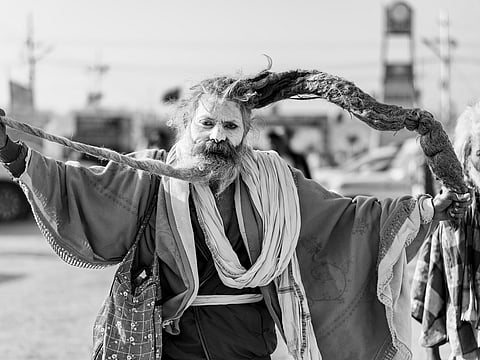
The Naga Sadhus are among the most striking and mysterious figures in India’s spiritual landscape. Their history is said to stretch back thousands of years, rooted in the worship of Lord Shiva and carrying echoes from the Indus Valley Civilization. Over time, they emerged as ascetic warriors, formed to defend Sanatan Dharma and to safeguard temples and sacred spaces during times of invasion and turmoil.

One of the Naga Sadhus at Mahakumbh |Source: Mahatta & Co.
Spiritual Discipline
At the core of the Naga Sadhu tradition lies intense renunciation. They embrace celibacy, simplicity, and detachment, dedicating their lives to meditation, rituals, and worship of Shiva. The ash smeared over their bodies is both a symbol of purity and a reminder of life’s impermanence. By living with almost no possessions, they embody complete freedom from material ties.
Advertisement

Naga Sadhus |Source: Mahatta & Co.
Warrior Heritage
Uniquely, the Naga Sadhus combined spiritual pursuit with martial discipline. Trained in the use of swords, tridents, and maces, they once stood as protectors of pilgrims and temples. Though they no longer fight wars, their martial traditions survive through ceremonial displays, reminding devotees of their heritage as guardians of the faith.
Role In Kumbh Mela
Their most visible presence is at the Maha Kumbh Mela. The sight of thousands of ash-covered ascetics rushing into the river during the Shahi Snan—the royal bath—is one of the most powerful images of the festival. It is believed that their plunge purifies not only themselves but also brings spiritual merit to all who witness it.

Platoon Bridge | Source: Mahatta & Co.
Way Of Life
The lifestyle of a Naga Sadhu is austere and symbolic. Many live unclothed, covered in sacred ash, with long, matted hair, echoing the image of Lord Shiva himself. They reside in monasteries known as akhadas or wander freely,depending on alms, practicing yoga, meditation, and sacred rituals. Their life is a constant reminder of renunciation and surrender to the divine.
Advertisement
The Kinnar Akhara
The Kinnar Akhara, a community of transgender devotees, has become one of the most prominent and meaningful groups at the Kumbh Mela, representing not just a religious tradition but also the values of inclusivity and acceptance. By participating in the festival alongside millions of pilgrims, its members challenge social norms and highlight the importance of embracing diversity within spiritual spaces. Representing the transgender community within a centuries old spiritual tradition, the Akhara affirms that devotion and spirituality transcend all boundaries of gender and identity.

Kinnar Akhada at Mahakumbh | Source: Mahatta & Co.

Kinnar Akhada at Mahakumbh | Source: Mahatta & Co
Inception And Growth
Founded in 2016, the Kinnar Akhara first made its appearance at the Ujjain Kumbh, marking a historic moment in the acknowledgment of transgender spirituality in mainstream Hindu practice. Its prominence grew further during the 2019 Prayagraj Kumbh, where it drew national and international attention, establishing itself as an integral part of the Maha Kumbh.
Pavan Mehta, Pankaj Mehta, and Arjun Mehta represent three generations of the Mahatta & Co. legacy, bringing together decades of expertise in photography, visual storytelling, and archival preservation. Spanning early adoption of digital imaging to contemporary practices across corporate, cultural, wedding, stock, and film photography, their work bridges India’s historic visual record with modern narratives.
Advertisement
The book is published by Mahatta & Co., a photography institution founded in 1915, committed to preserving and advancing India’s visual heritage across generations.
Published At: