The Ram Movement Revisited
Arrow Head
Ram is back in action. The ups and downs of dragging the icon for political gain.<a > Updates</a>

How the iconic hero of Ramayana came to occupy centrestage of Indian politics:
- December 1949: Babri mosque/Ramjanmabhoomi site declared a disputed area and sealed after Hindus and Muslims file suits in court.
- October 1984: VHP marches into Ayodhya to ’liberate’ Ramjanmabhoomi. Ram temple movement launched with L.K. Advani as its leader.
- February 1986: A Faizabad judge orders the site be opened to Hindus. Muslims challenge the decision.
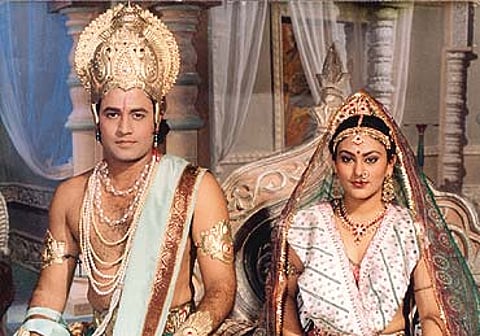
- January 1987: Ramayan, the TV serial, goes on air. It becomes hugely popular and adds an unforeseen, man-level steam to the Ram movement.
- September 1989: VHP begins Ram shila puja across the country for building a new temple in Ayodhya.
- November 1989: Then prime minister, Rajiv Gandhi, allows the shilanyas ceremony of a Ram temple at the site before the Lok Sabha polls.
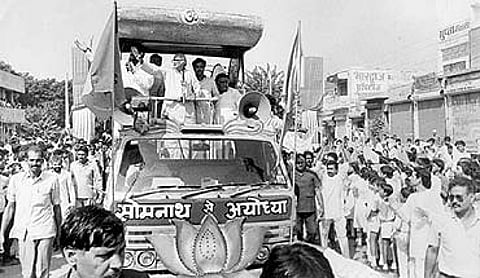
- September 1990: Advani begins the rath yatra from Somnath to Ayodhya. He is arrested in October at Samastipur, Bihar, before he can enter UP and proceed to Ayodhya. The same month, thousands of kar sevaks storm the Babri masjid and damage itpartially. Thirty persons killed as security forces foil an attempt to capture the mosque.
- November 1990: The V.P. Singh government falls as BJP withdraws support.
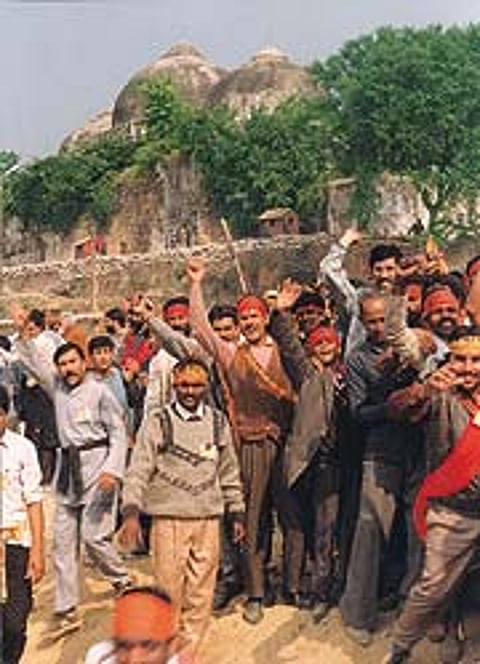
- December 6, 1992: Babri Masjid is demolished by kar sevaks, sparking countrywide riots. Several saffron leaders arrested.
- December 16, 1992: The Liberhan Commission is set up by the P.V. Narasimha Rao government to inquire into the Babri demolition.
- 1998-2004: Despite being in power at the Centre, the BJP fails to resolve the Ayodhya dispute. Many in the party feel it is no longer an issue that can yield political dividends.
- September 2007: The Sangh parivar sees the Ram Setu controversy as an opportunity to attack the UPA government and in the process unite Hindutva forces all over again.
***
"The chariot that leads to victory is of another kind.... Valour and fortitude are the wheels...strength, discretion, self-restraint and benevolence are its four horses, harnessed with the cords of forgiveness, compassion andequanimity—whoever has this righteous chariot has no enemy to conquer anywhere."(Ram's reply to Vibhishan, when the latter asks him how "chariotless andbarefooted" he hoped to vanquish "a brave and powerful adversary" likeRavan.)
— Tulsidas, Ramcharitmanas
Advertisement
O
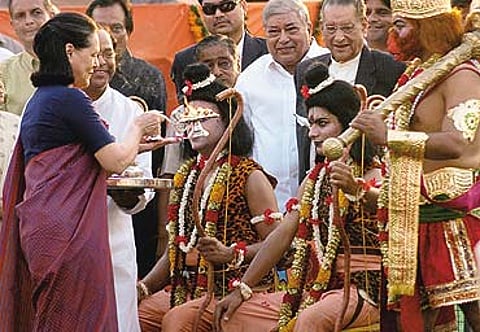
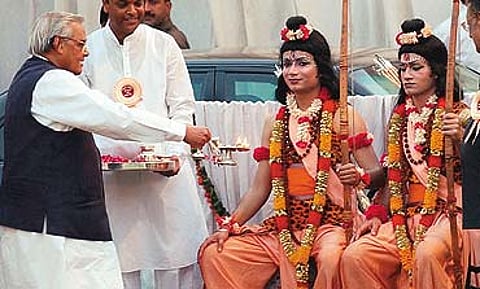
Sonia Gandhi with actors dressed as Ram and Lakshman during Dussehra in Delhi
So, what is it about Ram that evokes such strong emotions? Kunal Chakrabarti, professor of ancient Indian history at Delhi's Jawaharlal Nehru University, says, "Ram is an epic hero, the central figure in the Ramayana. His only competitor in terms of popular familiarity as a political mobiliser could be another epic hero, Krishna. But Ram has a wider appeal, he is more accessible, because his story is less complicated, and his character less complex than that of Krishna. Ram's is a linear story. He is seldom affected by ethical doubts; he is a decision-maker. Ram upholds and symbolises dharma in an unproblematic way. For instance, he doesn't think twice about beheading Shambuka. He is both king and divine being."
Krishna, on the other hand, is neither as idealised a figure as Ram—there is a playfulness associated with his childhood and adolescence—nor is his life as easily understood. The Bhagwad Gita, his sermon to Arjuna on the battlefield, is a great philosophical tract but it appeals more to the intellect than to the emotions. And Chakrabarti says it isn't just Ram: "There's a constellation who together uphold traditional values. Ram symbolises righteousness, Sita virtue, Lakshman, Hanuman loyalty. " In most traditional iconography, at least three of the four figures are pictured together.
Ram also has an edge over virtually any other god because of the vernacularisation of Valmiki's Ramayana, the oldest extant text on him, accessible only to those who understood Sanskrit. The many Ramayanas, over the years, in different languages, each one recreating the story, has automatically widened the appeal. There is a Buddhist version, a Jain version, there are tribal Ramayanas and there are women's Ramayanas.
Advertisement
But Tulsidas's Ramcharitmanas is the text that has ensured the pan-north Indian appeal of the epic hero. In villages across the Hindi belt, there is perhaps nobody who cannot recite a few verses from it, points out Rashtriya Janata Dal leader Raghuvansh Prasad Singh. "Ram, Ram" is a common greeting; at funerals, Ram naam satya hai is intoned. The Congress's Devendra Dwivedi says, "Ram is very important in the collective consciousness and mythological memory of Indians, particularly Hindus."
The Ramlilas, too, have helped to popularise Ram in the north: if Varanasi's famed Ramlila lasts a month, with one episode every day, and Delhi's rival Ramlilas are controlled by political parties, across the Hindi-speaking region, there are smaller versions, often with a local flavour—for instance, it is not unknown for Ravana being made to resemble an unpopular politician! Congress MP J.P. Aggarwal, chairman of Delhi's oldest Ramlila, says, "The Ramlila has both a religious and entertainment component. It ensures people's faith in the epics doesn't diminish and it is done in a way that makes it enjoyable for everyone." In more recent times, Ramanand Sagar's Ramayana on Doordarshan—launched on January 25, 1987—attracted over 100 million viewers at one time, making it the most widely viewed TV serial in the world. In fact, it directly preceded the politicisation of Ram at a mass level.
Outside the Hindi belt, the picture is different: though Ram is venerated across India, he has competitors elsewhere. In Bengal, there is Durga; in Maharashtra, Ganesh; in Orissa, Jagannath. And then there's the south: here, social reformer, E.V. Ramaswami used "morally ambiguous'' episodes such as the killing of Vali, Rama's harsh treatment of Sita, and the mutilation of Surpanakha to attack Hinduism—especially the worship of Rama—as a north Indian way of subjugating the south.
Advertisement
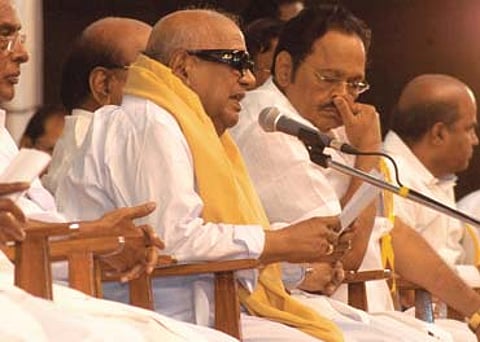
M. Karunanidhi at a rally in Erode where he took potshots at Ram
Says Vijaya Ramaswamy, professor of ancient Indian history at JNU: "The main ideological plank of the Dravidian movement was the rejection of epics like the Ramayana. But that's the political/ideological angle. At the popular level, the Ramayana, Ram and Hanuman are very important in the south. Folk renderings of their stories are popular. From the Indo-Gangetic belt to Kanyakumari, Ram has a pervasive influence but he can't work as a (universal) rallying figure."
Given his hold over the popular imagination, it was astute of the BJP to use Ram for political mobilisation. But before the BJP, Gandhi, Nehru and Rammanohar Lohia, too, had invoked Ram. How did their approach differ from the BJP's? In his autobiography, Gandhi writes movingly of the "foundation of his deep devotion to the Ramayana" and he regarded Ramayana as the "greatest book in all devotional literature". Nehru in The Discovery of India acknowledged the importance of the epics: "Ramayana and the Mahabharata...were known widely among the masses, and every incident and story and moral in them was engraved on the popular mind and gave a richness and content to it."
Advertisement
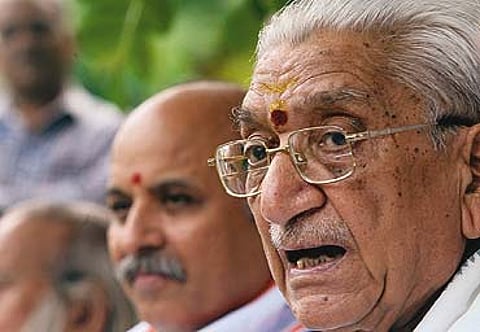
VHP’s Singhal, Togadia protest against Sethusamudram
In his preface to his own rendering of Valmiki's Ramayana, Rajagopalachari writes, "The attitude towards things spiritual which belongs to a particular people cannot be grasped or preserved or conveyed unless we have all three ( mythology, philosophy and rituals). " And in Ram and Krishna and Siva, Lohia held that whether the heroes of great Indian myths "ever lived or not is a comparatively irrelevant detail to the cultural history of the country, to the history of the Indian spirit definitely, and... to the spirit of Indian history."
On Gandhi, historian Ramachandra Guha says, "His devotion to Ram was a deeply personal, private matter—he never sought to make political capital of it. It did not require validation though an external structure like a temple or a coral reef. He occasionally spoke of Ram rajya—it was a metaphor for a wise and just society." Of Lohia, Raghuvansh says, "He saw Ram as a cultural unifier of north and south—from Ayodhya to Rameswaram—just as Krishna could unite east and west. But it was not political."
The BJP's use of Ram, by contrast, has been essentially political. The Ramjanmabhoomi campaign was initially described as purely religious, but after Advani's arrest in Bihar during his rath yatra, he described himself as a "humble" political worker who left religion to the religious leaders. By this token, the campaign was not religious, but a national movement. Ram was not just a Hindu god, but a national hero. Unfortunately, the BJP's vision was exclusive, not inclusive, pitting Hindus against Muslims. "As a result," says Dwivedi, "culture was politicised; the distinction between religion and culture was obliterated, and the universality of culture actually started shrinking and religious communities began to distance themselves from essentially cultural events." So, ironically, Muslim attendance at Ramlilas began to fall since the '90s.
Similarly, politicising the Sethusamudram project, many feel, is unfortunate. Says Ramaswamy: "There is politics on both sides. By raising Ram to dizzy heights to use him for political ends is unfortunate. Demonising Ram as a symbol of Sanskritic dominance is another kind of politics: both are undeserved. Those who should be consulted are not historians or archaeologists but environmentalists, ecologists and geologists. Tamil Nadu can't afford another tsunami."
Published At:
Tags