The agreement aims to leverage Dutch expertise in marine engineering and water management to accelerate Kalpasar’s implementation.
The Netherlands marked Prime Minister Modi’s first stop in the tour of European countries, including Sweden, Norway, and Italy.
The Netherlands, with cities such as Amsterdam and Rotterdam placed below the sea level, has evolved global benchmarks for urban water management systems.
Why PM Modi’s Visit To Afsluitdijk Dam Is Important For Gujarat’s Kalpasar project
A Letter of Intent was signed between the Ministry of Jal Shakti of India and Ministry of Infrastructure and Water Management of the Netherlands ‘for technical cooperation on the Kalpasar project.’

Summary
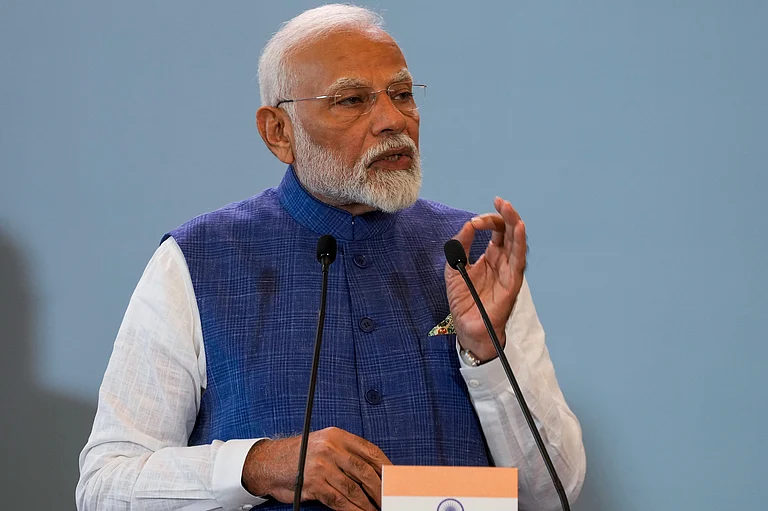
Underlining that India and Netherlands are "working to bring modern technology to India aimed at helping in irrigation, flood control and expanding the inland waterway network,” Prime Minister Narendra Modi thanked his Dutch counterpart Rob Jetten for the visit to the Afsluitdijk dam.
The Afsluitdijk, a 32-kilometer-long dam and causeway, is termed as the ‘global benchmark in flood control and land reclamation, protecting large parts of the Netherlands from the North Sea while enabling freshwater storage’ as per the official statement.
Netherlands marked Prime Minister Narendra Modi’s first stop in the tour of European countries, including Sweden, Norway, and Italy.
In a statement, the PMO pointed out the common linkages between the Afsluitdijk dam with the Kalpasar project in Gujarat. A Letter of Intent was signed between the Ministry of Jal Shakti of India and Ministry of Infrastructure and Water Management of the Netherlands ‘for technical cooperation on the Kalpasar project.’
This agreement aims to leverage Dutch expertise in marine engineering and water management to accelerate Kalpasar’s implementation.
Situated as a barrier between the North Sea from the IJsselmeer freshwater lake, the Afsluitdijk dam prevents parts of the Netherlands from flooding along with provisions for inland transport, tourism, and even freshwater security.
Constructed nearly a century ago, the project was conceived by Dutch engineer Cornelis Lely with the dual objective of protecting the coasts from flooding, and reclaiming land for agriculture.
Completed in 1932, the dam interrupted the connection between Wadden Sea and Zuiderzee or the South Seas. The resultant inland body of water, the Ijsselmeer, acted as a barrier against the storm surges from the North Sea thereby protecting provinces of Noord-Holland and Friesland from flooding.
Further, the associated ‘Zuiderzee Project’ led to the creation of vast areas of agricultural land thereby aiding land reclamation. Also Ijsselmeer, fed by rivers Rhine, Meuse and IJssel, is used for drinking water supply and irrigation of agricultural land and even regulating the water balance.
Advertisement
Netherlands, with cities such as Amsterdam and Rotterdam placed below the sea level, has evolved global benchmarks for urban water management systems with urban designs that are flood-proof and enable retention and usage of storm-water.
The Kalpasar project refers to a freshwater reservoir across the Gulf of Khambhat, with tidal power generation potential, irrigation, and transportation infrastructure.
Touting the letter of intent for technical cooperation on the Kalpasar as a significant outcome, Sibi George, Secretary (West) in the Ministry of External Affairs said “project is envisaged as a multi-purpose mega water project aimed at creating a fresh water subway contributing to water and food security in the Saurashtra region of India.”
As per the ‘Roadmap of India-Netherlands Strategic Partnership’ released during PM’s visit, ‘Water, Agriculture and Health’ emerged a key pillar with reference to the mutual Water Action Agenda joint commitment thereby supporting the ‘creation of Urban River Management Plans for the agreed cities’ along with calls to ‘renew the Strategic Partnership on Water signed in March 2022 and running until March 2027.’ The roadmap centred around ‘integrated water resources management, integrated coastal zone management, urban water management, flood resilience, river basin management and sustainable water quality & availability in the Ganga Basin.’
Advertisement
Published At: