DR Congo has recorded 4,945 confirmed cases and 2,325 deaths in the outbreak
A four-week detection gap, insecurity and contact-tracing challenges are hindering containment
There is no licensed vaccine or specific therapeutic for Bundibugyo virus disease
Why Is DR Congo’s Latest Ebola Outbreak So Deadly
The Democratic Republic of Congo’s Bundibugyo Ebola outbreak has killed 2,325 people among 4,945 confirmed cases. A four-week detection gap, insecurity, gaps in contact tracing, health-system constraints and the absence of a licensed vaccine or Bundibugyo-specific therapeutic are complicating containment.

Summary
The Democratic Republic of Congo’s latest Ebola outbreak is in a phase of intense transmission. By August 15, the country had recorded 4,945 confirmed cases and 2,325 deaths, giving the outbreak a 47% case-fatality ratio, according to the DRC’s National Institute of Public Health.
The latest situation report recorded 101 new confirmed cases in the previous 24 hours and 53 deaths — 33 in communities and 20 in Ebola treatment centres. Ituri remained the epicentre, accounting for 84.8% of cumulative confirmed cases and 88.1% of the latest cases.
The outbreak is being caused by Bundibugyo virus, one of the Orthoebolavirus species. Previous Bundibugyo outbreaks had case-fatality ratios of around 30% to 50%, while WHO says there is currently no licensed vaccine or specific therapeutic against the virus. Early supportive care can, however, be lifesaving.
But the mortality cannot be explained by the virus alone. Delayed detection, inadequate infection prevention and control, insecurity, population movement, unsafe burials and gaps in contact tracing are making it harder to interrupt transmission.
A Delayed Start
WHO identified a critical four-week detection gap between the onset of symptoms in the presumed index case on April 25 and laboratory confirmation of the outbreak on May 14. The DRC formally declared the outbreak on May 15.
People infected with Bundibugyo virus are generally not infectious until symptoms begin, meaning delays in recognising and isolating symptomatic patients can allow transmission to continue. Early symptoms such as fever, fatigue, muscle pain, headache and sore throat are non-specific and can resemble other illnesses, complicating diagnosis.
WHO said the detection gap suggested a low clinical suspicion of Ebola among healthcare providers. Co-circulating illnesses, including arboviruses and influenza-like illnesses, further complicated early recognition. The infection and deaths of four healthcare workers within four days at Mongbwalu General Referral Hospital also underscored serious gaps in infection prevention and control.
By August 15, the outbreak had expanded to 55 of the DRC’s 151 health zones across six provinces, according to the INSP. Ituri accounted for 28 of its 36 affected health zones.
Advertisement
WHO also cautions that part of the increase in reported cases reflects strengthened surveillance, laboratory testing and diagnostic capacity, although it says most of the rise reflects the actual expansion of the outbreak.

Why Bundibugyo Matters
Bundibugyo virus disease is a severe and often fatal form of Ebola disease caused by Bundibugyo virus, one of the Orthoebolavirus species. It is a zoonotic disease, with fruit bats suspected to be the natural reservoir.
Human infection is thought to occur through close contact with infected wildlife, while subsequent human-to-human transmission occurs through contact with the blood, secretions or other bodily fluids of infected people or contaminated surfaces. Transmission is particularly amplified when infection-prevention measures are inadequate in healthcare settings and during unsafe burials involving contact with the deceased.
The disease can be difficult to identify in its early stages. Diagnosis generally requires laboratory confirmation, while later illness can involve gastrointestinal symptoms, organ dysfunction and, in some cases, haemorrhagic manifestations.
Advertisement
The combination creates a difficult containment problem: transmission can continue through households and healthcare settings before a case is identified, isolated and linked to other infections.
WHO says previous Bundibugyo outbreaks in Uganda and the DRC had case-fatality ratios of approximately 30% to 50%.
No Specific Medical Countermeasure
The absence of a licensed Bundibugyo-specific vaccine makes the response heavily dependent on public-health measures.
WHO says there is currently no licensed vaccine or specific therapeutic against Bundibugyo virus. Control therefore relies on rapid case identification, isolation and care, contact tracing, safe burials, infection prevention and control, and community engagement.
That does not mean Ebola disease has no treatment. Patients can receive supportive care, including management of dehydration, organ dysfunction and other complications. WHO says early supportive care can be lifesaving.
Research and development efforts are under way to advance candidate vaccines and therapeutics for Bundibugyo virus disease.
Until specific medical countermeasures become available, however, the speed of the response remains critical.
Advertisement
The Health-System Strain
The DRC’s August 15 situation report shows how those measures are being tested on the ground.
There were 730 patients in isolation or Ebola treatment centres and 1,040 cumulative recoveries. Contact follow-up had reached 85.3%, but the report identified weak reporting and gaps in the listing and monitoring of contacts as continuing challenges.
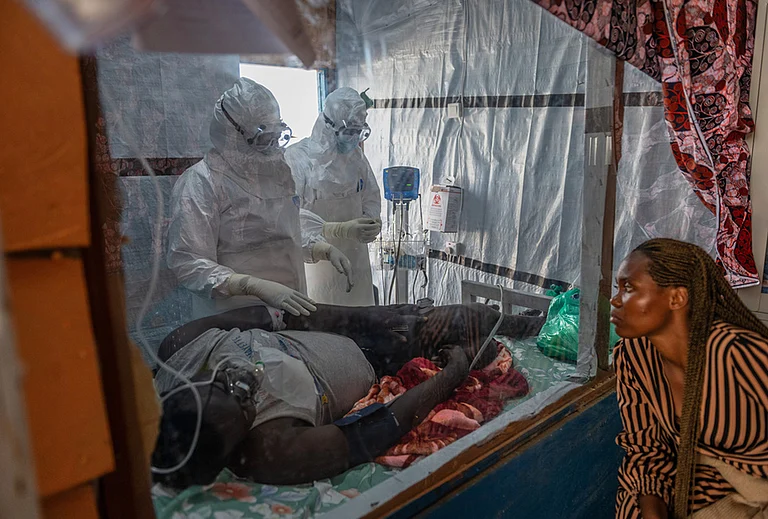
Treatment and isolation capacity is uneven across affected provinces. Several centres in Ituri were described as saturated, while suspected-patient beds in North Kivu were at 100% occupancy. The report also identified shortages of transport and other resources needed to sustain the response.
Logistical shortages are particularly acute in some areas. In Tshopo, for example, the report recorded zero stocks of some protective equipment and 349kg of chlorine against a stated requirement of 1,800kg. It also identified major gaps in motorcycles and vehicles needed for response operations.
These shortages matter because an Ebola response depends on moving people, samples, equipment and medical supplies quickly.
Advertisement
On August 15, 20,791 of the 24,383 contacts due for follow-up had been seen during the previous 24 hours, giving daily follow-up coverage of 85.3%. Coverage varied considerably between provinces, including 79% in North Kivu and 61.8% in Haut-Uélé.

Insecurity Makes It Harder
The outbreak is also unfolding in an area where insecurity can directly disrupt health operations.
WHO says ongoing conflict in Ituri restricts the movement of surveillance teams, limits rapid-response deployments and hinders the secure transport of laboratory samples. Contact tracing is also more difficult because of limited access and highly mobile populations.
The DRC’s latest report similarly records security problems affecting surveillance and safe burials. It cites insecurity in affected communities, resistance during response operations and several areas where health teams were unable to carry out activities safely.
Community resistance adds another obstacle. The report records refusals involving epidemiological investigations and burials, persistent rumours and incidents affecting response teams.
This is particularly significant for contact tracing. Finding an infected person is only the first step; health workers then need to identify everyone exposed, locate them and monitor them for the required period.
Why Ituri Is The Epicentre
Ituri has been at the centre of the outbreak from its earliest stages.
WHO believes the outbreak originated in Mongbwalu, a high-traffic mining area. Cases subsequently moved to Rwampara and Bunia to seek medical care. Ituri’s role as a commercial and migratory hub, combined with its proximity to Uganda and South Sudan, increases the risk of regional exportation and cross-border transmission.
The August 15 INSP figures show the extent of transmission in the province. Ituri had recorded 4,194 of the DRC’s 4,945 confirmed cases and 1,838 deaths. It also accounted for 89 of the 101 new cases reported during the latest 24-hour period.
The outbreak, however, is no longer confined to Ituri. Confirmed cases have been reported in North Kivu, Haut-Uélé, Tshopo, South Kivu and Bas Uélé.
As the geographical footprint grows, so does the logistical burden of surveillance, laboratory testing, treatment, contact tracing and infection control.
What Does It Mean For Neighbours?
The regional risk is already visible in Uganda.
Uganda reported imported Bundibugyo virus cases from the DRC in May. It subsequently contained its outbreak and declared itself Ebola-free on July 28 after recording 20 confirmed cases. Its Health Ministry said the outbreak was linked to imported infections and that contacts completed follow-up without evidence of continued community transmission.
WHO has nevertheless continued to classify Uganda as at risk of reintroduction because transmission remains active in neighbouring DRC and population movement continues across the border.
Rwanda has also maintained Ebola preparedness measures, including surveillance and preparedness activities for Ebola and other viral haemorrhagic diseases.
WHO’s assessment places countries with land borders adjoining areas with Bundibugyo transmission at heightened risk and recommends enhanced surveillance, laboratory capacity, trained response teams and cross-border coordination.
That makes the DRC outbreak more than a national health crisis. Movement across borders means a failure to contain transmission in eastern DRC can quickly become a regional public-health concern.
Why The Death Toll Is Rising
The high mortality of the current outbreak is therefore the product of several pressures operating at once.
Bundibugyo virus can cause severe disease, but the outbreak is also being shaped by delayed recognition, inadequate infection prevention, unsafe burials, insecurity, population movement and gaps in contact tracing.
The response itself is under strain. Treatment centres have reached capacity in some areas, protective and logistical supplies are limited, and community resistance can prevent teams from carrying out surveillance, disinfection and safe burials.
The result is a disease for which speed is critical being fought in an environment where speed is often hardest to achieve.
By August 15, the DRC had recorded 4,945 confirmed cases and 2,325 deaths, while transmission remained active across six provinces.
The challenge is therefore not simply finding a vaccine. It is recognising cases earlier, reaching communities faster and maintaining enough healthcare, surveillance and logistical capacity to interrupt transmission before another chain begins.
Published At: