Iran claimed its air defence systems struck a US F-16 over the Persian Gulf, but CENTCOM denied the attack.
CENTCOME denied the attack with a 'fact check'.
Tehran's military also threatened an immediate response to any fresh American aggression.
'All Fighter Jets Safe': US Central Command Denies Iran’s Claim That It Hit An F-16 Over Persian Gulf
According to Iranian media, the incident took place over the Persian Gulf, where Tehran's air defence systems allegedly detected and fired a missile at the US aircraft
Summary
The United States’ Central Command (CENTCOM) on Saturday rejected the Iranian Army's claim that its air defence systems had damaged a US F-16 fighter jet over the Persian Gulf.
Iran’s army claimed the attack forced the F-16 pilot to abort the mission and make an emergency landing at a nearby airport in the region, according to Iranian media.
CENTCOM rejected Iran’s claim, posting on X that it was false and that all American fighter jets operating in the Middle East were "safe" and accounted for. "Iran did not attack a U.S. F-16 fighter aircraft yesterday--at all," said CENTCOM, which oversees US military operations across the Middle East, Central Asia and parts of South Asia.
The alleged incident took place on Friday evening over the Persian Gulf, where Iran’s air defence systems detected and fired a missile at the US aircraft, Iran's Fars News Agency reported.
The claim comes amid heightened tensions between Washington and Tehran over the US economic blockade and negotiations on Iran’s nuclear programme. Iran has warned of retaliation against the blockade, while US President Donald Trump has reiterated his demand for a permanent agreement to prevent Tehran from acquiring nuclear weapons.
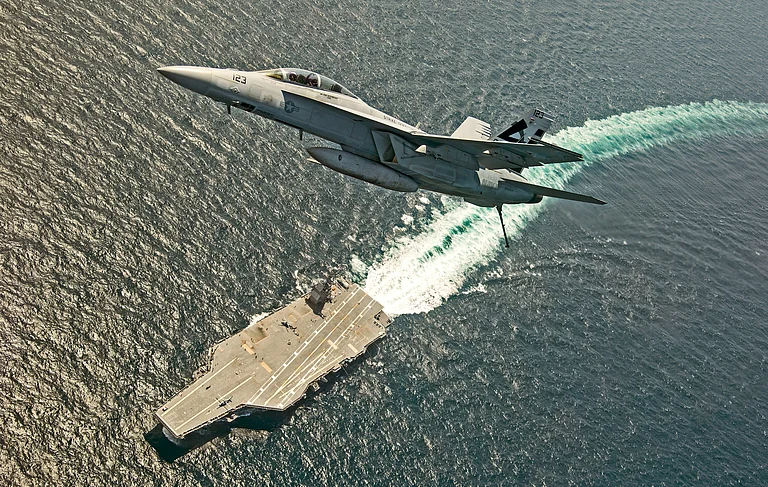
What Is Iran's Claim About The US F-16?
Iran's state broadcaster Press TV reported that the country's army air defence systems detected a US F-16 over the Persian Gulf on Friday evening and fired a missile towards it.
According to Press TV, the missile exploded close to the aircraft, causing damage and forcing the pilot to abandon the mission.
Iranian media outlets reported that the aircraft was diverted to the nearest available airfield in the region for an emergency landing. They cited flight-tracking data to claim that the F-16 transmitted the emergency code 7700 near the United Arab Emirates.
The reports further claimed that the aircraft landed at Al Dhafra Air Base in Abu Dhabi.
Iran's Previous Claims About US Fighter Jets
This is not the first time Iran has claimed to have targeted US military aircraft.
Advertisement
In late March, CENTCOM confirmed that a US F-16 had made an emergency landing at a regional base following a combat sortie in support of American military operations against Iran.
Around the same period, the Islamic Revolutionary Guard Corps (IRGC) claimed that an advanced Iranian air defence system had hit and severely damaged a US F-35 fighter jet flying over central Iran.
On April 3, the IRGC claimed that another F-35 had been targeted over the same region.
In a separate incident in June, the IRGC said its air defence systems had fired a missile at a US F-16 that allegedly violated Iranian airspace over the Persian Gulf.
Iran Threatens Immediate Military Response
Iran also warned Washington against launching fresh military attacks.
Iranian Army spokesperson Brigadier General Mohammad Akraminia said any renewed aggression would invite a "decisive and immediate" response from the country's armed forces.
Iran's state broadcaster IRIB reported that Akraminia made the remarks during a visit to troops in Bandar Abbas, Kohstak, Sirik and Jask.
Advertisement
He also said the US could not establish dominance over the Strait of Hormuz and would have to accept Iran's conditions to end the war.
"We are much stronger than in the past," Akraminia said.
"Any new aggression will be met with a decisive, immediate and effective response from the armed forces, and the defence of the country will not be limited to a specific geographical area," he added.
What Has Trump Said About A Nuclear Deal?
Trump, meanwhile, reiterated his intention to secure a permanent agreement with Tehran that would prevent Iran from obtaining nuclear weapons.
In an interview with Fox News on Saturday, the US president also said he had never been particularly interested in regime change in Iran.
"These people are probably more reasonable, but they are very, very difficult," Trump said, referring to Iran's leadership. "We reach an agreement, and then they violate it the next day."
Advertisement
"What I'm doing is making sure that even if, in four, 15, or 20 years, we have an incompetent president, the agreement I reach will be permanent. I won't let anyone allow them to obtain nuclear weapons," he said.
Published At: