Indian poetry in English that the author encountered beyond the textbooks in the 1980s seemed to be dominated by a small constellation of names.
Has elitism disappeared from poetry today?
Perhaps not entirely, but there have been changes over the years that resulted in the redistribution of cultural authority in Indian English poetry.
Outside The Centre: The Diverse Spectrum Of Indian Poetry In English
Indian poetry has more than one centre of experience


Gray Book's first volume was published in 1972
In the spring of 1972, the first volume of ‘gray book’ appeared, declaring, “gray book does not shun the world in which it lives. it only seeks to depict the contemporary mind’s response to the environment in terms of creative arts. as the journal grows it will keep on defining and re-defining itself for it will try to move with life.” The absence of capital letters at the beginning of sentences was deliberate.
Published from Orissa, it contained poems by Nissim Ezekiel, Saleem Peeradina and Pritish Nandy. It had a campus section which contained poems by Bibhu Prasad Padhi, who was also the associate editor. The back pages contained advertisements of Coca Cola and also a contact address in case you were desirous of buying “kenduleaves as bidi wrapper” and “durable quality of timbers round and sawn”. I am not sure whether further volumes of the ‘gray book’ priced at Rs 3 per issue appeared in print.
What I certainly know is that the Indian poetry in English that I encountered beyond the textbooks in the 1980s seemed to be dominated by a small constellation of names. Barely 14, and having received multiple rejection slips from Nissim Ezekiel’s PEN, I viewed him with awe and intimidation. I learned ‘Night of the Scorpion’ by heart. Dilip Chitre, in his poem ‘The View from Chinchpokli’ (from his collection Travelling in a Cage), wrote: “I will take a cab to the Manhattan-like/ Unreality of Nariman Point. There I will shape India’s destiny/ Using my immaculate gift. I will ride in a taxi/I zig-zag through. I shall smoothly go past/ The Institute of Art. Anjuman-e-Islam, The Times of India/ The Bombay Municipal Corporation, and Victoria Terminus.”
While these poets expanded the possibilities of Indian poetry by shifting the gaze to “create monuments out of the lifts, chowpatty, pavements, and the shrunken sky of Bombay”, they also shaped perceptions of what counted as poetry and who counted as a poet. This seemed to be evident in Arvind Krishna Mehrotra’s Oxford India Anthology of Twelve Modern Indian Poets, which interestingly did not include Kamala Das, whose oeuvre spoke to the female experience.
Advertisement
It took me many readings to internalise Jejuri, a fine work in its own right. I was the child of cloudy skies and swelling waters of the Nila. The Arabian Sea climbed the ladder of my DNA during the tides. Reading Jayanta Mahapatra and Kolatkar side by side, I wondered whether Indian poetry contained more than one centre of experience. Wasn’t it the same merciless tropical sun and weary dust that illuminated and blew through the poems of Kolatkar and Jayanta Mahapatra? I wondered whether the rest of India wrote poetry in English at that time. How was the history of their writing documented? In the absence of evidence by way of publications or photographs, who could prove they wrote poems and they too were legitimate poets? I have heard it said that my aunt, Sarojini Devi, fondly called Violet, an alumna of Fergusson College, Pune in the early 1940s, wrote poetry in her diary. There’s no proof but belief.
Advertisement
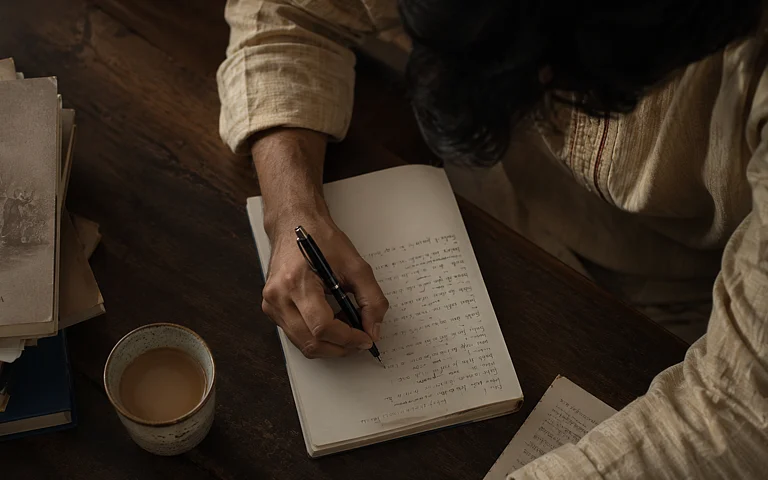
In the decades that followed, while little magazines such as Chandrabhaga and Quest and other movements were instrumental in archiving Indian poetry in English, the Poetry Society of India, based in Delhi, also acted as a catalyst in bringing together poetry from various cities of India. While rummaging through old papers, I chanced upon an envelope from the Poetry Society of India, containing a form for submission to their annual competition in response to my query. The year was 1997. Though I never submitted a poem, I had the opportunity to meet Dr. H.K. Kaul, the founder, in the 2000s when I moved to Delhi. Dr Kaul always had a place for anyone desirous of reading poetry in their gatherings held at Delnet, Jawaharlal Nehru University Campus, a tradition that continued till the time of the Covid pandemic when he passed away.

Advertisement
Indian poetry in English has drawn into its spectrum diverse voices that speak as much about trains pulling into the station at Madras Central as about Alli, a subaltern character from the Mahabharata who confesses that she has been tricked by Arjuna. Ghazal in English became a cult, inspired by Agha Shahid Ali and haiku as a form took wings to higher altitudes than what Basho or Issa may have ever imagined. Independent presses and online journals that emerged in the last decade also meant that, finally, a poet could have avenues beyond the big publishing houses. What changed was not merely the colour and texture of poetry, but also that no single literary group could any longer claim they had the last word on poetry.
While some continue to insist that to be a poet one must know one’s Shakespeare and Keats, and be able to speak fluently on literary criticism, in the loosening of its tongue, poetry becomes both journey and destination. While Anand Thakore’s ‘Mughal Sequence’ and Debasish Lahiri’s ‘A Certain Penance of Light’ respectively continue to exist as essential contributions to the reconstruction of the past, Robin Ngangom’s poems, grieving for the native land, flow from lived experiences.
Advertisement
Poetry has found its way to the footpath by the chai stall to literature festivals. Counter movements have come to establish a new order of the day. In this language which we have made our own, we perceive the world around us in all its glory and grief. Has elitism disappeared from poetry? Perhaps not entirely, but the change has also meant redistribution of cultural authority in Indian English poetry. After all, it might be worthwhile thinking–what are we living for, what truly matters to us when we write in our voices of resistance?
(Smitha Sehgal is a poet and legal professional)
Published At: