Kali Puja 2026 is scheduled for Sunday, November 8, coinciding with Kartik Amavasya, the new-moon night that aligns with Diwali. Particularly cherished in West Bengal, Odisha, Assam, and Tripura, the festival venerates Maa Kali as the formidable yet benevolent embodiment of Shakti that eradicates fear, ignorance, and internal obscurity.
Kali Puja 2026: Astrology, Tantra Traditions And The Power Of The Divine Feminine
Explore Kali Puja 2026 on November 8, including auspicious Nishita Kaal timings, astrological significance, Tantra traditions, puja rituals and the spiritual power of Goddess Kali, the Divine Feminine who symbolises courage, protection and transformation.

Date and Auspicious Timing:
In 2026, Kali Puja falls on the same night as Diwali and Lakshmi Puja. The Amavasya Tithi begins at about 11:27 AM on November 8 and ends around 12:31 PM on November 9, placing the principal night of worship squarely on November 8.
The most significant ritual window is Nishita Kaal, the midnight period. In Kolkata, the Nishita Puja Muhurat is approximately 10:55 PM to 11:46 PM on November 8; local panchang timings may vary slightly by city.
Unlike Lakshmi Puja, which is generally performed during the evening Pradosh period, Kali Puja is traditionally observed after dark and often continues until dawn. The darkness of Amavasya is not seen as inauspicious here; rather, it becomes the sacred setting for confronting fear and invoking transformative power.
Astrological Significance:
Kali Puja is observed during the Krishna Paksha, the waning lunar fortnight, culminating in Amavasya. In Jyotish and Shakta traditions, the new moon symbolises dissolution, introspection and the ending of a cycle—making it a fitting time to worship Kali, who governs time, change and liberation.
Goddess Kali is regarded as a supreme manifestation of Shakti, the dynamic energy of the Divine Mother. Her worship is associated with courage, protection from negativity, removal of obstacles and the wisdom to distinguish between what must be released and what must be nurtured.
The symbolism is psychological as well as cosmic. Just as the moon disappears before beginning a new cycle, devotees seek to dissolve ego, attachment and fear so that a renewed, more conscious life can emerge. Midnight worship intensifies this symbolism: the darkest hour becomes the moment of spiritual awakening.
Kali in the Shakta Tradition:
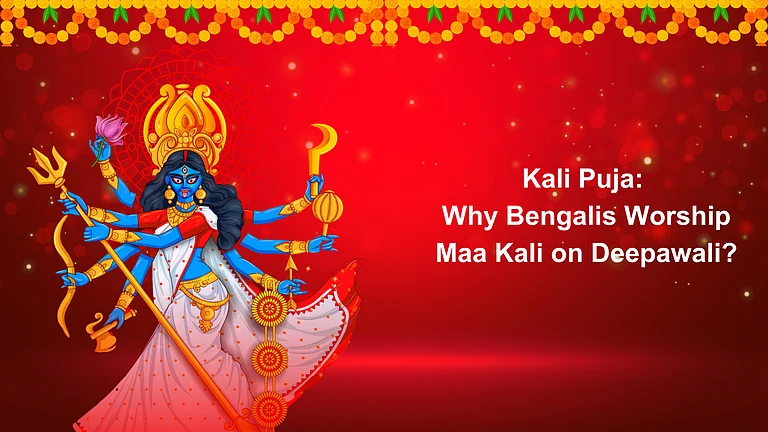
In the Shakta tradition, the Divine Feminine is not secondary to the divine; she is the primary creative and transformative force. Kali represents Shakti in its most uncompromising form—untamed, fearless and free from social convention
Her iconography communicates this philosophy. Her dark form suggests the vast, unknowable reality beyond ordinary perception. Her garland of heads and skirt of arms signify the dissolution of ego and attachment, while her raised sword represents the cutting away of ignorance. Yet devotees approach her as “Ma,” a protective mother who shelters those who surrender to her with sincerity
Advertisement
Kali’s fierce appearance therefore does not celebrate violence for its own sake. It represents the force required to confront injustice, inner demons and destructive habits. In the Devi Mahatmya narrative, she defeats the demon Raktabija, whose every drop of blood creates another demon—a powerful metaphor for overcoming problems that multiply when attacked carelessly.
Tantra and Kali Worship:
Kali holds a central place in Tantra, where spiritual practice often works directly with energy, mantra, visualisation and ritual discipline. Tantric worship of Kali may include japa or mantra repetition, nyasa or ritual placement of mantras on the body, meditation on the Goddess, and carefully prescribed offerings.
Traditional texts and lineages treat these practices as specialised sadhana, usually guided by an initiated teacher. They should not be confused with the simpler, devotional home puja performed by most families.
There are also two broad styles of Kali worship. In the tantric mode, some temples have historically included animal sacrifice, although this practice is increasingly restricted, contested and avoided by many communities. In the Brahmanical or devotional mode, Kali is worshipped as Adya Shakti with flowers, sweets, fruits, incense, lamps and prayers, without sacrifice.
Advertisement
For most devotees, the heart of the observance is bhakti: singing Shyama Sangeet, offering red hibiscus flowers, keeping a night vigil and experiencing Kali as the compassionate Divine Mother.
Rituals and Observances:
Preparations usually begin with cleaning the home and creating alpana, the decorative floor art common in Bengal. Homes, temples and community pandals are illuminated with earthen lamps, candles and lights, symbolising hope and the triumph of good over evil.
A distinctive Bengali custom is lighting choddoprodeep, or fourteen earthen lamps, on Bhoot Chaturdashi, the night before Kali Puja. These lamps are traditionally placed at doorways, windows, corners and near the tulsi plant; they are associated with remembering ancestors and warding off negative influences. Many families also prepare choddo shaak, a dish made from fourteen kinds of leafy greens.
On the night of Kali Puja, devotees install an image or idol of Maa Kali, light a diya and incense, and offer red hibiscus flowers, fruits, sweets, rice and other bhog according to family custom. Prayers, Kali mantras and aarti form the core of home worship, while temples and pandals hold more elaborate rituals through the night.
Advertisement
Many devotees remain awake until dawn, visiting temples and pandals, singing devotional songs and meditating on the Goddess. This vigil reflects the belief that Kali’s grace is especially accessible to those who remain present through the darkness.

Kali Puja invites devotees to see power, darkness and transformation not as threats, but as necessary aspects of spiritual growth. Kali teaches that fear loses its grip when it is faced directly and that true strength includes compassion, protection and surrender.
In a world that often associates the feminine with gentleness alone, Kali expands the idea of the Divine Feminine. She is tender as a mother, fierce as a protector, and liberating as the force that ends illusion. Her worship affirms that women’s power, like divine power itself, cannot be reduced to a single form.
For devotees in Kolkata and across eastern India, Kali Puja 2026 will be more than a festival of lamps and pandals. It will be a night to seek courage, release fear, honour ancestors and reconnect with the eternal Shakti that sustains and transforms all life.
Advertisement
Published At: