Ram Charan commits fully, but the 170-minute narrative lacks focus.
Sports drama tackles caste and class themes without sufficient depth.
Janhvi Kapoor and Boman Irani remain underserved throughout the film.
Peddi Review: Ram Charan's Sports Drama Mistakes Noise For Depth
Buchi Babu Sana's ambitious sports drama aims to address poverty, caste, and injustice. Instead, it buries those ideas beneath tired hero worship, shallow politics and deeply questionable storytelling choices.

Summary
There is a compelling film buried somewhere inside Peddi. A story about poverty, social exclusion and the power of sport to offer a way forward. What reaches the screen, however, is a confused mix of social commentary and commercial filmmaking that constantly undermines its own ideas. Directed by Buchi Babu Sana and led by Ram Charan, Peddi wants to say something meaningful about inequality and injustice. Instead, it settles for broad strokes, hero worship and emotional manipulation.
On paper, that combination sounds promising. Indian cinema has produced some remarkable sports dramas by using the playing field as a reflection of society itself. Peddi clearly wants to stand in that tradition. The problem is that it never decides what kind of film it wants to be.
Is it a grounded story about a labourer's fight against systemic injustice? A mass entertainer built around a larger-than-life hero? A political drama? A romance? A social commentary? It spends nearly three hours trying to be all of them and succeeds at none.
The film follows Peddi, a daily wage labourer whose life is shaped by poverty, social discrimination and a desperate desire to rise above his circumstances. Cricket becomes both an escape and a pathway towards dignity. As he navigates local sporting rivalries, political manipulation, and personal setbacks, Peddi's journey becomes a battle against powerful forces determined to keep him in his place.
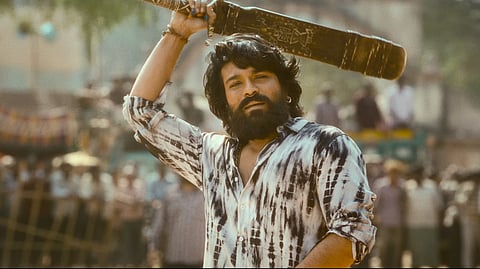
Ram Charan as Peddi YouTube
There are glimpses of an interesting story here. The film understands that sport often represents far more than competition in communities where opportunities are limited. The early portions effectively establish the importance of local cricket culture and the emotional investment it entails. The stakes feel real at first. Unfortunately, that foundation is gradually overwhelmed by a screenplay that mistakes excess for impact.
The biggest issue with Peddi is its confused relationship with the very themes it wants to explore. The film repeatedly gestures towards caste discrimination, economic inequality and political exploitation. Yet whenever these subjects demand genuine engagement, the narrative retreats into familiar commercial cinema shortcuts. Characters become symbols rather than people. Struggles become plot devices rather than lived realities.
Advertisement
There is a significant difference between representing oppression and using it as a decorative background for a hero's rise. Peddi often falls into the latter category. The film introduces social issues with considerable dramatic weight, but rarely explores their consequences with the same seriousness. Complex realities are reduced to simplistic confrontations designed primarily to elevate the protagonist.
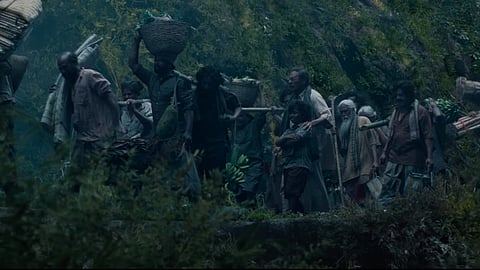
A Still From Peddi YouTube
This tension becomes particularly visible in the film's treatment of class. Peddi's poverty is constantly emphasised, while the wealth and privilege surrounding him are presented in broad strokes. Yet the storytelling never develops enough depth to examine what these disparities actually mean beyond creating obstacles for the hero to overcome.
The result feels less like social observation and more like social commentary forced into a conventional masala framework.
Ram Charan delivers a committed performance, and there is no question about the physical transformation or the effort behind the role. He fully embraces Peddi's intensity and carries much of the film's emotional burden. Several moments, particularly those linked to cricket and personal humiliation, benefit from his screen presence. But even a dedicated lead performance cannot rescue writing that repeatedly prioritises spectacle over coherence.
Advertisement
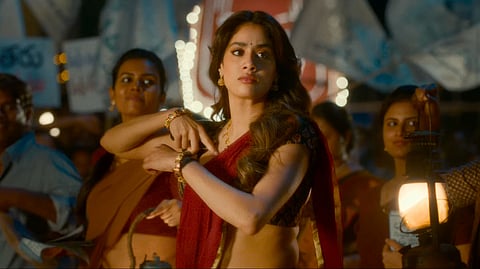
Janhvi Kapoor as Achiyamma YouTube
Janhvi Kapoor as Achiyamma fares considerably worse. Her character largely exists to serve the narrative needs of the hero rather than functioning as a fully realised individual. The role is poorly written and the performance struggles to transcend those limitations. Much of her screen time feels disconnected from the central story, reducing her presence to a distraction rather than a meaningful contribution.
More troubling is how the film frames its romantic interactions. Several scenes rely on behaviour that appears less romantic than intrusive. What is presented as flirtation often resembles harassment, yet the narrative treats these moments as entertaining and endearing. It is a dated approach that feels particularly uncomfortable in a contemporary film.
Veteran performers receive little better treatment. Boman Irani, an actor capable of bringing remarkable depth to even minor roles, is given almost nothing meaningful to do. His talent feels completely wasted. Jagapathi Babu operates in an exaggerated register that pushes the character towards caricature rather than menace. Shiva Rajkumar and Divyenndu leave stronger impressions despite limited material.
Advertisement
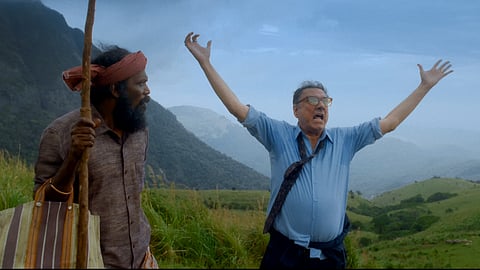
A Still of Boman Irani YouTube
Technically, the film is equally inconsistent. There are stretches where the visual texture works well, especially during the cricket sequences. The use of real locations lends authenticity and scale to certain scenes. A.R. Rahman's music occasionally injects energy when the narrative stalls. Yet the editing frequently undermines whatever momentum the film manages to build.
Abrupt jump cuts disrupt emotional continuity throughout the second half. Entire developments seem to occur off-screen. At one point, a major character trajectory becomes so poorly communicated that viewers are left wondering whether crucial scenes have been removed altogether. Instead of creating intrigue, these transitions create confusion.
The action suffers from a similar problem. The film repeatedly uses violence as spectacle without considering its emotional consequences. One sequence involving a dead body being treated as little more than an action prop feels particularly misguided, reducing tragedy to entertainment.
By the final act, Peddi has exhausted itself chasing too many ambitions at once. It wants to be inspirational, political, emotional and crowd-pleasing. Instead, it becomes a film trapped between competing identities.
Advertisement
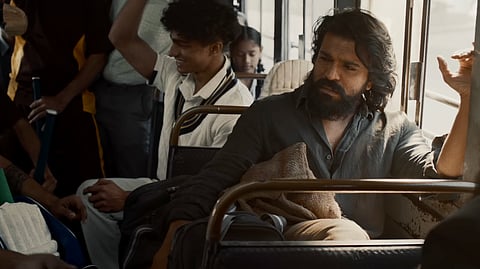
A Still From Peddi YouTube
There may be an audience willing to embrace its larger-than-life emotions and mass appeal. But for viewers seeking thoughtful engagement with the issues it raises, Peddi offers frustration more often than insight.
What ultimately lets Peddi down is not a lack of ambition but a lack of conviction. The film introduces themes of poverty, social discrimination and political injustice, yet rarely spends enough time with them to offer any meaningful insight. Every time the story appears ready to engage with these ideas, it retreats into familiar commercial cinema tropes. As a result, the film feels pulled in multiple directions, never fully committing to either its social concerns or its masala ambitions. Ram Charan delivers a sincere performance and there are occasional moments that hint at a stronger film underneath, but they are overshadowed by uneven writing, muddled storytelling and a narrative that struggles to understand what it wants to say.
Published At: