The restored version of John Abraham’s cult classic Malayalam film Amma Ariyan was screened under the Cannes Classics section at the 79th edition of the Cannes Film Festival recently. The film that released in 1986, a year before Abraham’s passing away at 49, was made through funding received from people as part of the Odessa Collective—an initiative of Abraham, the avant-garde filmmaker, who graduated from the Film and Television Institute of India (FTII), Pune. The film has been restored by the Film Heritage Foundation (FHF). Actor Joy Mathew and editor Bina Paul were present at the screening, along with FHF director Shivendra Singh Dungarpur. In this interview, Paul discusses Abraham’s vision, legacy and the film’s journey with Arvind Das, Director of School of Media and Communication Studies at DY Patil International University, Pune.
Amma Ariyan at Cannes Classics: Restored Malayalam Cult Film, John Abraham’s Vision and Legacy Revisited
Discover the journey of Amma Ariyan from a crowd-funded Odessa Collective experiment to a Cannes Classics showcase, as editor Bina Paul reflects on John Abraham’s avant-garde language, the film’s mix of documentary and fiction, its Naxalite and humanist themes, and its legacy in Malayalam parallel cinema.

You were present during the screening of Amma Ariyan (Report to Mother) at Cannes. How was the experience?
It was a very good experience and a proud moment for all of us. John died soon after the film was made. Though it was sent to one or two festivals, there is not much push for external exposure after the director’s death.
Why was it not released?
The idea was not to release the film in the traditional way. The idea of the Odessa initiative was not to get into the whole distribution circuit. But the film was shown widely in Kerala.
I remember seeing it at the FTII 15 years ago.
The film didn’t receive the kind of critical appreciation it should have. Besides, there was only one print left, so we were nervous to show that print. Though the NFAI [National Film Archive of India] had done some digitisation, it was necessary that it be restored. The sound had to come out properly, and only then could we show it. The restoration was a very important moment of rediscovering the film.
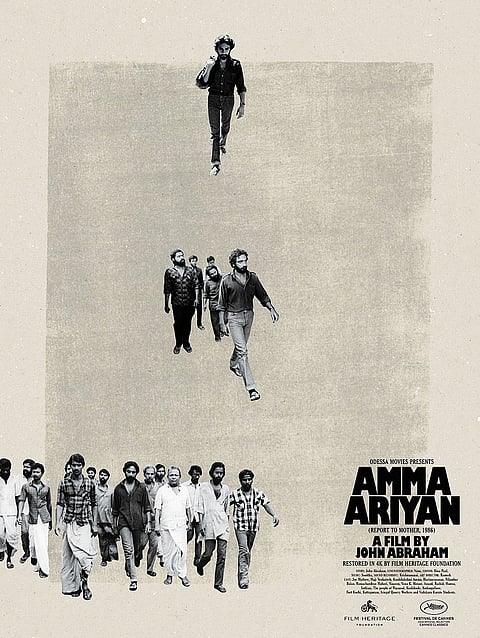
The film has long been considered a cult classic among cinephiles and film students. Why do you think it continues to resonate across generations?
The form of the film is very interesting—it’s a travelogue and has documentary and fictional elements. The idea of the film is about this sense of unrest that people feel when there is great inequality. After Independence, there was so much hope in this country, but with globalisation, a lot of people lost their bearings. And again, in the global situation today, people are feeling quite lost. So, I think that humanism and the need to address the essential human question appeals to people.
How do you reflect, four decades later, on Abraham’s cinematic language and vision?
For me, it was a great learning experience. When I saw the film this time, after 40 years, I was watching it on a big screen. Of course, there were moments when I thought I could have done things differently, but I felt there was a good flow to the film. John’s guidance made it possible. Because there wasn’t a tightly written script, I understood a lot about editing through this film.
The narrative was quite unconventional…
It was difficult that there wasn’t a script, but the travel bit—that we were moving from Calicut to Cochin—worked as the backbone of the story. We had to work on weaving different stories, giving them prominence and also highlighting the central idea of the mother being the person who is the observer.
I noticed that the mother figure is not just the mother of Hari, but she is present throughout the film…
Yes, that was part of the design we made. Though he was very close to his own mother, who passed away, his elder sister was his mother figure as well. He came from a close-knit family. Though he was a completely crazy person in that family set-up, he was still loved by his sisters, and he believed that his mother was the grounding force. So, when the mother and the girlfriend are together, a sort of amalgamation takes place. We had a lot of discussions. He [Abraham] kept saying that the film is not just about Hari’s mother, but is the story of how a mother needs to know what is happening in her son’s life. In the end, when she says she could not prevent it, that brings forth the tragedy that mothers are unable to control the destinies of their children, though they love them very much.
While it was a personal movie for John, it was also political. What would have been his reaction if he were at the Cannes?
The world is a worse place than it was. We hoped that there would be a change, but there isn’t. John would have reacted the same way. He was a great humanist. He did not align himself with any one political party. His politics was much deeper.
While watching the movie, I felt that there was some element of Ritwik Ghatak in it.
John was Ghatak’s student at the FTII, so it’s natural. I think, for John, Ghatak was a kind of life figure. He internalised Ghatak a lot. There is that sense of political pain that I think he inherited from Ghatak. And his lifestyle.
How long was the duration of the shooting?
They shot for about 30 days or so. I only went for a few days. They decided to be very fluid with the camera and chose to do it in black and white.
The movie starts with the suicide of a young Naxalite. What was John’s take on the Naxalite movement?
While he was talking about Naxalism in the movie, he was also talking about small protests everywhere. There were many unsuccessful movements. I think he was talking about the disappointments of all that.
Odessa Collective crowd-funded the movie. Was there another movie made?
No other movie could be made. But this was not really crowdfunding; it was much more organic. Everybody was giving one rupee, two rupees, but they were actually participating because they were present during the shooting and distribution.
What was the reaction of the audience in Kerala?
The audience really liked it. But I think there was some disappointment about whether the film had achieved its objective. The political class didn’t like it.
During the parallel cinema movement, filmmakers often engaged deeply with socio-political issues through their work. In recent years, however, many films appear to be leaning more toward propaganda. How do you view this shift?
There are different viewpoints that they’re trying to propagate. So, it’s a completely different time. I don’t know if the same kind of films are being made now. They are ideologically different.
With the rise of OTT platforms, Malayalam cinema has become more accessible to audiences. How do you see the legacy of the parallel cinema movement of the 1970s and 1980s influencing the new generation of filmmakers?
I think the legacy of experimentation is there. People are willing to try out new things.
Are you satisfied with the restoration of the film?
The archive has kept the only print that was available in good shape. But since there was only one print, it was important to revise that, to make it possible to see a proper version on digital. So, they worked on the subtitles and the sound. It was a painstaking process, even though that one source material was quite good.
Did John talk about any other films he wanted to make while you were working on this project?
He would have liked to make many movies. He could talk much more with Venu [the cinematographer]. He did want to make movies on some of Paul Zacharia’s stories.
Tags