About 60% of the electorate voted, higher than the voter turnout rate of Jan 2024's 40%.
The BNP fielded the highest number of candidates—291, while JeI fielded 229.
Bangladesh has not seen any free, fair and competitive election since 2008.
Bangladesh Explainer: Liberal BNP Dwarfs Jamaat-e-Islami In Post-Uprising Polls
BNP, which launched a high-pitched campaign against religious conservatism and intolerance, has won in over two-third parliamentary seats.

Summary
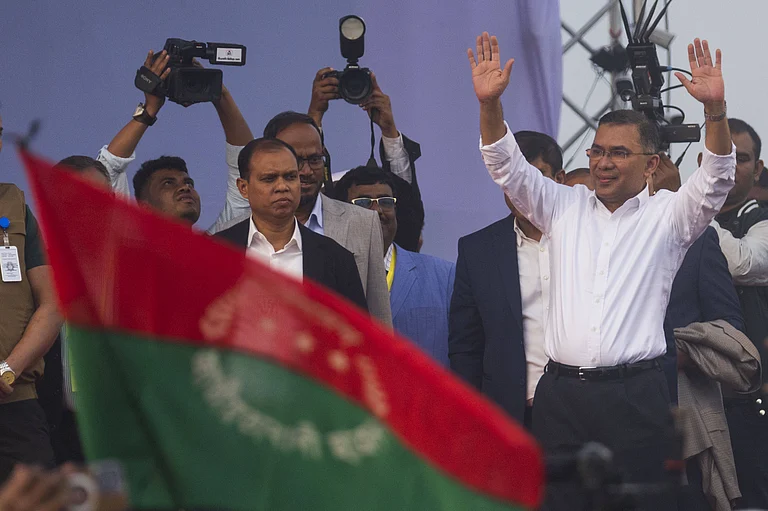
Three days after giving the slogan Dharmo Jar-Jar, Rashtro Sobar (religion is personal, State belongs to everyone), Bangladesh Nationalist Party (BNP) chief Tarique Rahman has led his party to a massive victory in the February 12 parliamentary election.
As of 3pm on February 13, the election commission had not officially announced the results. However, unofficial results published by leading Bangladeshi media outlets put the tally of the BNP-led alliance at 212 and that of the Jamaat-e-Islami (JeI)-led alliance at 77 seats.
In the simultaneous referendum for constitutional and democratic reforms, most voted in favour of it.
Elections were conducted in 299 of the 300 parliamentary seats. Tarique Rahman, the BNP chief and its prime ministerial candidates, won from both constituencies he contested–by a margin of 1.19 lakh from the rural constituency of Bogura 6 and by a narrow margin of 4,399 votes from Dhaka 17, an urban centre.
The National Citizens Party (NCP), launched last year by a section of youths who led the anti-Hasina uprising in 2024, contested in 32 seats as part of the JeI-led alliance. It won six.
Almost all BNP bigwigs have won, while several controversial and right-wing candidates have suffered defeats.
Bangladesh has not seen any free, fair and competitive election since 2008, when Hasina came to power for a second term. The BNP, JeI and their allies had boycotted the 2013 and 2024 elections. The 2018 election got discredited due to widespread allegations of rigging. The 2026 elections remained mostly peaceful.
According to the election commission’s data shared on Friday, about 60% of the electorate voted—a rate significantly higher than the voter turnout rate of the January 2024 election, in which only about 40% had voted. Prime Minister Sheikh Hasina’s government fell within seven months of that election.
Hasina’s Awami League (AL) party and its allies were not allowed to participate in the 2026 election. Their political activities remain prohibited, pending trial in cases related to state-sponsored violence during the July-August 2024 youth upsurge. Most of the party’s top leaders are outside the country, many of them in India.
Advertisement
Hasina, who has been living in India since flying out of the country on August 5, 2024, called for the cancellation of the “voterless, illegal and unconstitutional” February 2026 election. However, India Prime Minister Narendra Modi conveyed his “warm congratulations” to the BNP chief for leading the party to “a decisive victory.”
Noting that this victory reflects people’s trust in Rahman's leadership, Modi said India will “continue to stand in support of a democratic, progressive and inclusive” Bangladesh.
The BNP’s victory comes as a major relief to a large population of Bangladesh, as Islamic conservative and right wing forces had kept the country tense since Hasina’s fall.
“The people of Bangladesh have given religious extremism a tight slap,” said A-Al Mamun, a professor of journalism at Rajshahi University, hoping that the results should bring these forces to their senses.

Advertisement
The interim government helmed by Peace Nobel Laureate Muhammad Yunus largely failed to maintain law and order situation, especially handling mob violence targeting political opposition, minority faiths and practices.
After the trends became clear, the BNP asked its supporters not to take out any victory rallies. “Our priority is to restore law and order, initiate economic growth and tackle corruption,” BNP standing committee member Salahuddin Ahmed, who won from Cox’s Bazar 1 by a big margin of 92,000 votes.
Ahmed, who had served in the last BNP government (2001-06) helmed by Tarique Rahman’s recently-deceased mother, Khaleda Zia, argued that there was nothing to celebrate since their victory was expected. “It’s time to focus on the responsibilities,” he said.
The BNP fielded the highest number of candidates—291, while JeI fielded 229. Islami Andolan Bangladesh fielded 258 candidates and Jatiya Party nominated 198. While the election remained bipolar between the BNP alliance and the JeI alliance, there were rebel BNP candidates in almost 80 seats and, in several of them, these rebels split BNP’s votes to allow JeI’s win.
Advertisement

While the JeI’s performance is their best in electoral history, it is partly being attributed to the vacuum created by the absence of AL and its allies, and partly to growing right-wing support, anti-India sentiments and anti-corruption anger. In fact, JeI and its allies have fared well mostly in India-bordering districts.
The BNP ruled Bangladesh from 1991 to 1996 and then again from 2001-06. In the last term, the JeI was the BNP’s junior partner. Since then, till 2022, the two parties remained allies. However, after Hasina’s fall and exit from the country, the BNP and the JeI emerged as bitter rivals.
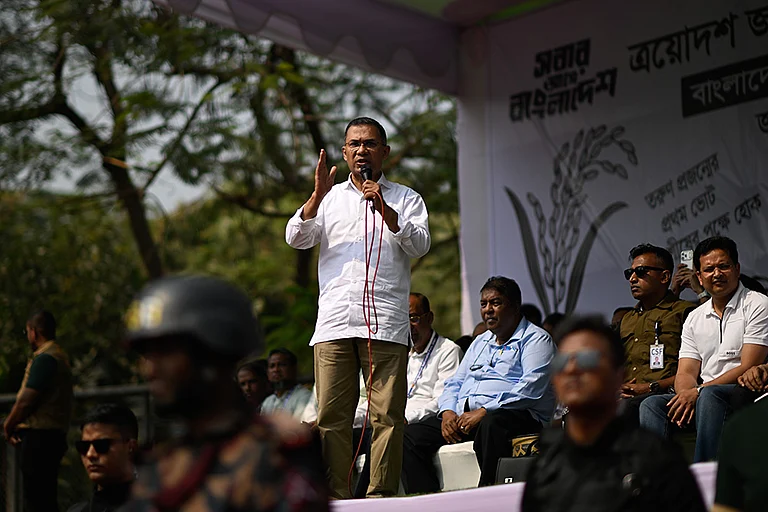
In his election speech to the nation on February 9, BNP chief Tarique Rahman warned devout Muslims against getting misled. “BNP wants to build a safe Bangladesh where every citizen, Muslim, Hindu, Buddhist, Christian, believer, non-believer or skeptic, living in the hills or plains, will be safe,” Rahman said, adding, “People of each religion will practice their religion according to their own religious beliefs and customs. This is the custom of a modern civilized society.”
Advertisement
His pledge of safety and security to ‘non-believers’ and ‘skeptic/agnostics’ in a country where 90% of the population are Muslim and where atheists have often faced violent attacks, resulting in several killings, was politically sensitive, if not bold. He gave the fight the shape of one between liberal democracy and conservative intolerance.
Notably, some far-right candidates like Mamunul Haque have lost, while staunch anti-right campaigners like Fazlur Rahman and Rumina Farhana have secured big victories, the last as an independent candidate.
According to Dhaka-based researcher and political commentator Altaf Parvez, the elections show that the majority of Bangladesh’s people favour a middle path instead of extremism. “Of course, the right wing is fast expanding. Their vote share and seat share both quadrupled. Nevertheless, the elections reaffirm that the majority prefers centrist policies,” he tells Outlook. He thinks the BNP lost about a dozen of seats due to splitting of votes by rebels who contested as independents.
Parvez points out that the JeI-led alliance fared better in urban centres, contrary to previous estimates that they would do better in the rural belt. Parvez explains this phenomenon as urban voters’ protest against local-level extortion and corruption perpetrated by BNP leaders since Hasina’s fall.
Published At: