Nearly a week after Manipur’s popular government took office, fresh violence in Ukhrul and political unrest in Kuki-Zo areas highlights persistent instability in the hill districts.
Houses were torched and internet services suspended in Ukhrul amid rising tensions between Kuki-Zo and Tangkhul Naga communities, even as security forces remained deployed.
Protests against Kuki-Zo BJP MLAs and conflicting responses from tribal bodies reveal deep divisions over the new government’s legitimacy and leadership choices.
A Week Into Manipur’s New Dispensation, Hill Districts Remain On Edge
At least nine houses were torched in Manipur's Ukhrul district on Tuesday, escalating tensions between Kuki-Zo and Tangkhul Naga communities, even as prohibitory orders remained in force and central armed forces were deployed.

Summary
Nearly a week after the return of Manipur’s popular government, tensions continue to simmer across the state’s tribal districts, with fresh violence reported from Ukhrul and lingering political unrest in Kuki-Zo-dominated areas reflecting unease over the new dispensation.
At least nine to ten houses were torched in Ukhrul district’s Litan Sareikhong area early Tuesday, escalating tensions between Kuki-Zo and Tangkhul Naga communities, even as prohibitory orders remained in force and central armed forces were deployed.
Police said the violence followed an alleged assault on a Tangkhul Naga man on the night of February 7. Abandoned houses were set on fire and shots were fired, allegedly to drive residents away.
“Armed men set ablaze abandoned houses and fired several rounds at Litan Sareikhong. The situation remains tense and security forces are trying to bring it under control,” a police officer said.
The unrest continued despite prohibitory orders under Section 163 of the Bharatiya Nagarik Suraksha Sanhita. Officials said several villagers have fled the conflict zone over the past two days, with women, children and elderly residents moving to safer areas in Ukhrul and Kangpokpi districts.
In response to the violence, the state government suspended internet services in Ukhrul district for five days from Tuesday morning. Home Commissioner-cum-Secretary N. Ashok Kumar ordered the suspension of “internet and data services, including broadband, VPN and VSAT,” citing the prevailing law-and-order situation.
Two Tangkhul Naga organisations, Katho Long and Katho Katamnao Long, have also restricted the movement of Kukis in Ukhrul and the adjoining Kamjong district, further heightening tensions in the region

Protests before the violence in hill districts
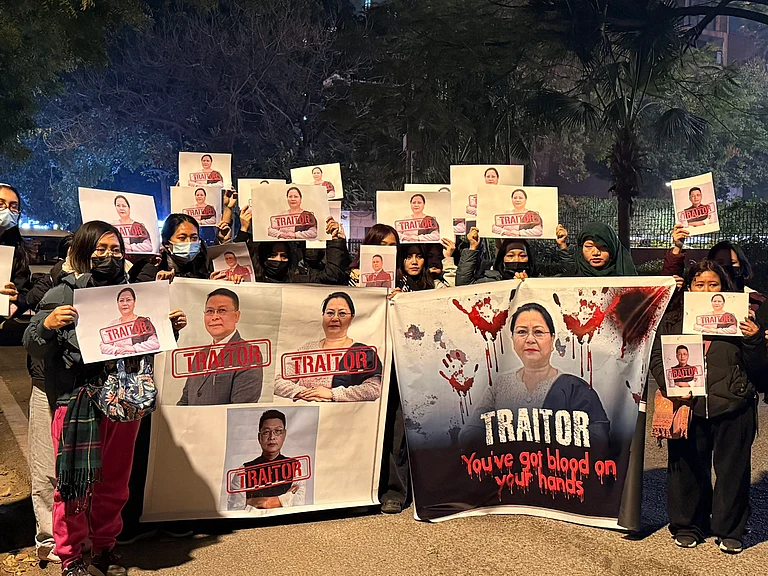
The latest violence in Ukhrul comes days after protests erupted on February 5 and 6 in Churachandpur, a Kuki-Zo-dominated district, against three BJP MLAs from the community who joined the newly formed popular government.
The protests were directed at Nemcha Kipgen, L.M. Khaute and Ngursanglur Sanate, three of the ten Kuki-Zo legislators in the Manipur Assembly. Kipgen was sworn in as Deputy Chief Minister, a move that deepened resentment among sections of the community.
Advertisement
According to ITLF spokesperson Ginza Vualzong, the protests reflected anger and a sense of betrayal among people who felt their leaders had ignored the community’s suffering. He said many viewed the MLAs’ decision as prioritising individual political interests over collective sentiment.
Referring to the violence in Ukhrul, Vualzong described it as “deeply unfortunate” and said the situation had escalated despite attempts to resolve the matter at multiple levels. “What began as an isolated incident ultimately resulted in the burning of houses belonging to both Kuki and Tangkhul Naga communities,” he said.
More than 20 houses have been torched so far.

'Not All Tribal Bodies'
A senior police official said the protests in Churachandpur were limited in scope and directed specifically at the three MLAs.
“People were uncertain about what to do next. They knew the government formation would happen, but felt betrayed by their own leaders. The main demand was that the three MLAs should resign,” the official said, adding that the situation in Churachandpur was now under control.
Advertisement
However, the other tribal bodies, who had otherwise stood strongly with the kuki community urged restraint at the time and issued statements warning against targeting elected representatives.
The Indigenous Tribes Advocacy Committee (ITAC) of Pherzawl and Jiribam districts said MLA Sanate was the legitimate and constitutional representative of the area, cautioning that any attempt to intimidate or harm him or his property would be viewed as an attack on the collective will of the tribal populace. It also appealed for restraint, urging that political developments should not fuel inter-community animosity.
The Zomi Council rejected allegations branding tribal MLAs as traitors, stating that all ten tribal MLAs were collectively responsible for the formation of the popular government. It warned against interference in the personal lives or properties of Zomi MLAs and urged the Centre to expedite political talks for an immediate solution.
Meanwhile, the Thadou Students’ Association (TSA) condemned the actions of Lamminlun Singsit, accusing him of intimidation, coercion, and invoking the name of the United Kuki National Army (UKNA) to spread fear and disrupt peace in Kangpokpi district. The TSA said such actions undermined democratic processes and communal harmony, reiterating the Thadou community’s commitment to peace, constitutional governance, and lawful authority.
Advertisement
However, Vualzong said it would be incorrect to suggest that entire tribes supported the MLAs’ decision, arguing that any approval came only from limited sections aligned with individual leaders, rather than reflecting the collective will of the people.
Government outreach amid fragile calm
Chief Minister Yumnam Khemchand Singh appealed to all communities to maintain peace and harmony, while a team of legislators led by Deputy Chief Minister Losii Dikho visited the Litan area to assess the situation and hold meetings with community leaders.
The Chief Minister also visited RIMS Hospital to meet those injured in the Ukhrul violence and met BJP MLA Vungzagin Valte, who continues to recover from injuries sustained during earlier unrest.
As the Chief Minister hosted BJP Manipur state president Sharda Devi and party office bearers at the Secretariat for an informal interaction over tea, an engagement he later shared on X, one absence stood out. Deputy Chief Minister Nemcha Kipgen was missing from the gathering.
Advertisement
She has reportedly been unable to return to Imphal due to the prevailing security situation. Outlook reached out to Kipgen for comment but did not receive a response at the time of publication.
As the popular government completes nearly a week in office, continued unrest in Manipur’s hill districts underscores the fragile political and social terrain confronting the new administration.
Published At: