Hindi cinema once treated a lip-lock as a moral emergency.
Pre-Independence cinema, influenced by theatre traditions and European filmmaking styles, did not tremble at the sight of intimacy.
Censorship forced cinema to create a language of longing that defined generations.
Retro Express | From Locking Flowers To Locking Lips
This Valentine’s Day, we explore how Bollywood’s longest romance has been with the kiss itself.

Summary
For an industry that runs on love, Bollywood has always been strangely suspicious of the kiss.
This Valentine’s Day, when streaming platforms serve us intimacy without coy cutaways and actors kiss with abandon, it’s easy to forget that Hindi cinema once treated a lip-lock as a moral emergency.
But here’s the twist: Indian cinema did not begin prudish.
The first kiss in an Indian movie was in 1929, in the silent film A Throw of Dice, in which Seeta Devi locked lips with Charu Roy on screen. Devika Rani and Himanshu Rai's lip-lock in Karma (1933) still remains one of the longest on-screen kisses in Indian film history. Pre-Independence cinema, influenced by theatre traditions and European filmmaking styles, did not tremble at the sight of intimacy.
So what changed?
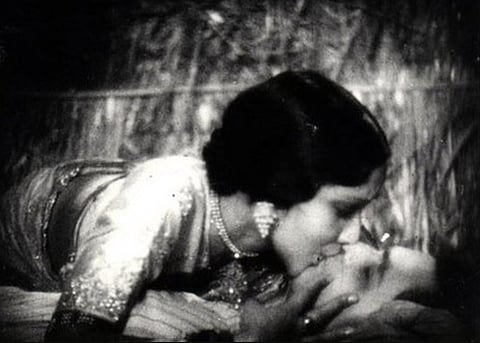
Karma Still Wikimedia Commons
The British left. Nation-building happened. And with it, came nervousness.
After Independence, the newly formed republic became cautious about cinema’s influence. The Cinematograph Act of 1952 formalised censorship in ways that reflected a moral anxiety about what films could do to “impressionable” minds. The Supreme Court articulated this fear with startling absolutism: “Film censorship becomes necessary because a film motivates thought and action and assures a high degree of attention and retention as compared to the printed word. The combination of act and speech, sight and sound in semi-darkness of the theatre with elimination of all distracting ideas will have a strong impact on the minds of the viewers and can affect emotions. Therefore, it has as much potential for evil as it has for good and has an equal potential to instil or cultivate violent or bad behaviour. It cannot be equated with other modes of communication.”
In 1954, 13,000 women in Delhi signed a petition urging Prime Minister Jawaharlal Nehru to curb cinema’s potential to encourage “precocious sex habits.” One might ask—where were the men of Delhi at this point? Did they not have a counter to the petition?
But the subtext was clear: cinema was tainting the nation’s youth. The least we could do was protect the morality of a newly free country—surely moral laxity was not on the menu. The simple kiss became suspect, symbolising the root of all evil. There was no explicit legal ban on kissing. But culturally, the message was received.
And so began Bollywood’s most inventive phase. Censorship forced cinema to become lyrical. The absence of the kiss created a language of longing that defined generations. If lips could not meet, flowers would, birds would. Because how could Bollywood stop being romantic? If anything, it became operatic. Rain became foreplay. A brushing of hands carried voltage. A forehead touch felt seismic. Neck romance was a thing. Desire was contained in lyrics and a love song could accomplish what lips couldn’t, even if they quivered. Billowing saris could stand in for skin-to-skin contact, while the union unfolded in choreography. Anything could be a metaphor—even clothes flying away randomly from a clothesline.
Advertisement
The camera would pan discreetly to two blossoms brushing against each other. Two birds would peck. Butterflies hovered. Waves crashed. A waterfall roared at precisely the right moment. The lovers would move closer, almost leaning in to kiss—and the frame would obligingly move away.
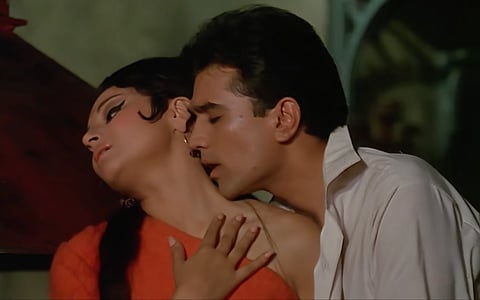
Roop Tera Mastana Rajesh Khanna Sharmila Tagore Still Youtube
Even marriage did not guarantee cinematic intimacy. In Kohra (1964), Waheeda Rehman attempts to wake her husband in a scene that feels almost apologetic in its flirtation. The presence of twin beds in the marital bedroom ensured that no one misunderstood the moral geography.
Yet repression did not extinguish sensuality. It refined it.
The 1960s mastered the art of suggestion. “Roop Tera Mastana” in Aradhana (1969) remains one of Hindi cinema’s most charged and steamy sequences—torrential rain, a fireplace, Sharmila Tagore in an orange bed sheet coyly not kissing bare-chested Rajesh Khanna—all of it provided a single-shot swirl of proximity, breath, shadow and longing. The choreography famously settled for nose-to-nose instead of lip-to-lip. The effect was electric nonetheless (of course a child had to be born out of wedlock).
Advertisement
Raj Kapoor, ever the provocateur, occasionally tested the waters. Mera Naam Joker (1970), Bobby (1973) pushed at boundaries and Satyam Shivam Sundaram (1978) teased it again. RK Films flirted with boldness more often than most. But even Kapoor wrapped eroticism in metaphor—wet saris, transparent rain, vulnerable heroines caught between innocence and desire.

Raja Hindustani Still youtube
In the 1970s and 80s, although violence grew more explicit, romance often remained coded. The angry young man could smash skulls, but he could not kiss freely.
The turning point arrived tentatively. The kiss between Vinod Khanna and Madhuri Dixit in Dayavan (1988) was marketed as audacious, almost scandalous. That it caused such ripples revealed how far the industry had travelled from Devika Rani’s four-minute embrace.
With satellite television, MTV aesthetics, global exposure of the 90s, the frame was loosened further. The almost-kiss became a kiss. And soon, the bar was raised. Lovers in films like Raja Hindustani (1996) kissed in the rain for real, not metaphorically. The audience gasped—and then bought tickets.
Advertisement
By the 2000s, the kiss had become a publicity device, a marketable commodity. Emraan Hashmi built an entire career persona around it. Mallika Sherawat and Bipasha Basu were labelled “bold” for doing what global cinema considered ordinary.
Today, intimacy coordinators stand where once the censor loomed. Streaming platforms bypass some theatrical squeamishness. Couples kiss without a cutaway to a startled parrot. The nation survives.
And yet, something about the era of evasion lingers in collective memory.
The evolution of the Bollywood kiss, then, is not merely about morality loosening. It is about how a young nation negotiated modernity, sexuality and control—often on the bodies of its heroines. It is about how desire survived surveillance and eventually, stopped apologising.
So whenever we watch on-screen lovers lock lips without metaphor, it’s worth remembering that for decades, two flowers touching were doing the work of two mouths.
And perhaps that is Bollywood’s real genius—not that it learned to kiss again, but that even when it couldn’t, it made the whole country feel it.
Advertisement

Published At: