Oliver Laxe's Sirat won the Jury Prize at Cannes 2025.
The film interposes a rave with mourning and mortality.
Sirat notched up the FIPRESCI award at the Palm Springs Film Festival 2026.
Sirāt Review | Oliver Laxe’s Desert Rave Thriller Shocks To The Bone
The 'Fire Will Come’ director’s breakthrough road odyssey heads in soul-shaking directions

Summary
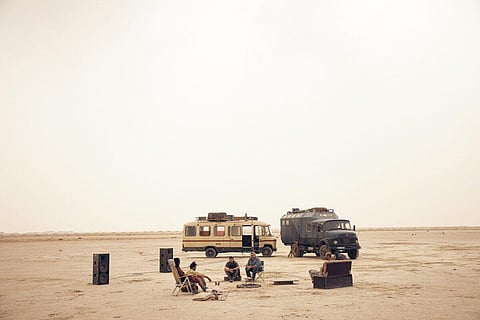
In Oliver Laxe’s jaw-dropping new film Sirāt, we’re hemmed to a cliff of anticipation and apprehension. In the deserts of Southern Morocco, Luis (Sergi López, the only professional actor in the cast) and his young son Esteban (Bruno Núñez Arjona) stumble into a rave gathering. There’s a dog too, Pipa, which stays constant even as most wither away. Luis’ daughter vanished months ago and he believes these vagrant parties could be a roadmap for where she went. Luis and Esteban trail vans of ravers—Jade, Tonin, Stef, Bigui and Josh. Laxe reconfigures this missing-person tale into something pounding with mythic magnitude. Screened at the Palm Springs International Film Festival, Sirāt summons geographical force, rewiring characters through an odyssey of grief and numbed acceptance. Laser light cuts rectangular shapes into stone and sand. Laxe takes symmetries and casts them in a fugue of existential sunder.
Luis hopes the nomads can guide him. He doesn’t warm up to them as readily as his son does, who’s intrigued, amused and drawn. Luis is still reserved, flinching, whereas Esteban is delighted and enthused with the ravers. His son’s quick affiliation with them alarms Luis. Inadvertently, Luis is only veered towards more tragedy, widening loss. There’s so much that seems unfathomable, yet alluring. It’s the dangling on this precipice which lends Sirāt its outrageous, lurching energy. There’s a spiritual rassling, zigzagging from disembodied reality to acutely sensed limitations. Even the caravan of non-conformists isn’t as outside the grid as it fancies. The social ropes are still binding, even if briefly invisible. Luis’ journey entwines with the ravers. But their banding together is headed for disaster. Death looms beyond all reckoning. Tension mounts through the question: would anyone make it out alive, unscathed?

Still Neon
This isn’t a film that goes on an overdrive explaining and pronouncing character dynamics or well-hewn backstories. The bodies bear the mark and stand testament to all that the people have endured and absolved. Sirāt is one of those rare wonders that are intensely plugged into the natural elements. The Sahara becomes a soundstage for characters to transmogrify, be intimately challenged and lose everything. Amidst the rippling bareness of the Moroccan dust, a plea for answers and healing is put out. The breadth of Laxe’s career has seen him gravitate to landscapes—the endless mysteries, cycles of violence and catharsis embodied within. This film embraces those with full-bodied confidence and brio. The act of setting a narrative in a place subsumes the environment itself. You watch the land rage at, consume and exhume the characters. They live in polarities of co-habiting the desert and being churned out by it. Laxe’s regular DP Mauro Herce mines tranquility and unease in the remote reaches. The camera soaks in blankets of unnerved stillness hovering over characters, knocked out by loss. The vastness is as terrifying and inaccessible as a reminder of all that the horizon cannot contain.
Advertisement

Laxe whips out transfigurations that move Sirāt across several existential registers. Epic leaps morph into wrenchingly tender moments—a bereaved father submitting to the sandy expanse. Mourning and melancholy gain humbling dimensions. It’s so visceral you want to look away, but the score wraps you in. A strange alchemy is in effect, where these landscapes haunted by migration veil, obscure and are untenable, by turns.
Still Neon
Laxe is unafraid of metamorphosis and darkness, ruthlessly keeping us on knife’s edge. He’s as comfortable with fomenting spells of agonized silence, the aftermath of unspeakable shock. It’s dignifying how the father is allowed his space as tragedy multiplies abruptly. Introspection on the sudden accelerating loss assumes transcending proportions. He gets a lease of strength to charge on while explosions swirl around. Redemption is in the air which he clutches at. Both excavation and exorcism are summoned. The group that totters around is as composite as fragile, courting their own destruction. What once seemed irreducible meets its tether. There’s the glimpse of absolute doom, a point of no return. The group stares at it, teetering on whether to go forth or retreat. But the drama already builds to a place where stakes are immediate and inevitable. Walking further is the only road, be it towards self-negation or unsure escape. Kangding Ray’s score and Laia Casanova’s sound design shift, displace and constantly fracture something within. It’s a simulacrum of sensations spurred by the most disorienting emotional uncertainty, facing the chance of collapse. “Is this what the end of the world looks like?” a character remarks midway. Sirāt glares with undomesticated power at the edge of moods and situations. The voice echoing back is indelible.
Advertisement
Published At: